An Introduction to Researching Canadian Federal Documents: transcript
- Help! I’m an Accidental Government Information Librarian Webinars
- Added
- 40:11
- English
- auto-generated captions
AI summary
AI-generated from the transcript below. Check anything that matters against the video.
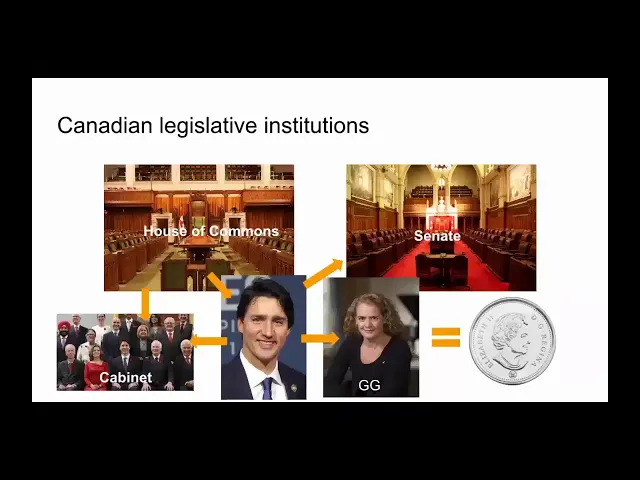
This webinar, presented by Nicholas Worby of the University of Toronto for the Help! I'm an Accidental Government Information Librarian series, introduces American librarians to researching Canadian federal documents. Worby outlines Canada's constitutional monarchy, the roles of the Governor General and Prime Minister, and the appointed Senate versus the elected House of Commons, noting the division of powers between federal and provincial governments. He explains where to find statutes, regulations, the Canada Gazette, orders-in-council, bills, Hansard debates, committee materials, royal commissions, sessional papers and Library of Parliament reports, demonstrating tools such as LEGISinfo, the Department of Justice site, Early Canadiana Online and Canadian Parliamentary Historical Resources. He also covers the executive branch, access-to-information requests, cabinet confidences, crown copyright and the depository system, which ended print distribution in 2014 and now relies on Treasury Board guidelines without strong enforcement. Fugitive documents, inconsistent coverage across House and Senate sites, and the fragility of the depository program are highlighted as key challenges.
Key points
- Canada is a constitutional monarchy; the Governor General gives Royal Assent and performs largely ceremonial duties.
- The Senate is appointed with regional representation, while the elected House of Commons is based on population.
- LEGISinfo links bills to debates, votes and committee material from roughly 2001 onward.
- Canadian Parliamentary Historical Resources covers debates, journals and committee material from Confederation to modern online coverage.
- Sessional papers (Confederation to 1925) are a key source for historical Canadian statistics.
- Royal commissions and commissions of inquiry produce rich reports, indexed through Library and Archives Canada's Aurora tool.
- The print depository program ended in 2014; the electronic program relies on non-legislated Treasury Board guidelines.
- Crown copyright means Canadian government documents are not public domain, unlike US federal materials.
Chat with AI
Ask about this video. Answers come from its transcript, with links to the moments they use.
Free with a Google, Telegram or email account.
Sign in to chatTranscript
- 0:03
hi this is Linda welcome to the NCL a government resources section help on an accidental government information librarian webinar series or help for short thank you for coming so today's webinar is an introduction to researching Canadian federal documents and it is our presenter today is Nicholas worthy who is the government information and statistics librarian at the University of Toronto he provides reference and instruction for domestic and international government documents and he oversees the collection development for government information and quran' coordinates the university's web archiving program thank you very much Nicholas thanks for having me um I'm happy to talk to what I am still mostly an American audience about Canadian federal material first off I wanted to give an overview of some of our institutions for those of you who aren't familiar with Canadian politics and for those of you who are apologies if it seems a bit like a high school
- 1:00
civics class I'm going to cover finding current and historical material from our houses Commons and Senate and other parliamentary material like royal commissions and sessional papers I'd like to talk a bit about our library of Parliament which is somewhat analogous to the US Congressional Research Service and finally I'll touch briefly on executive and departmental material as well as our depository system and some of the distinct challenges government information faces in Canada at the moment I'll try my best to answer your questions in the chat as they come up and apologies if there's a little bit of a delay with that I've also linked my slides they'll be linked in another slide at the end so let's start with looking at the Canadian federal government from the top down so at the top is our Constitution our last Constitution was passed in 1982 when it was repatriated from the UK it enacted the Canadian Charter of Rights
- 2:00
and Freedoms and sets out the rules of our executive judicial legislative branches of government and most importantly from a research perspective it describes the division of powers between our federal and provincial governments so if a researcher comes to you with a question about Canadian policy you may need to look at material from the provinces depending on the topic some topics like indigenous natural and natural resource rights may span a number of different jurisdictions and there's going to be overlapping overlapping provincial and federal jurisdiction different departments that you'll need to look at for this area I'm just going to circumscribe myself to looking at federal stuff for the next 30 or so minutes but our provincial governments for the most part are structured in a similar fashion with the same sort of documentary outputs and institutions okay so this is probably the most recognizable face in Canadian politics right now it's our prime minister Justin
- 2:59
Trudeau you may see him representing Canada at meetings of the heads of state point the g7 but is a your head of state the issue is a little bit more complex than a simple yes or no and that comes out of our history so Canada is a constitutional monarchy with elizabeth ii as a head of state if you've ever come here and had some canadian money her face is on the front that's why her representative in canada is julie payette our current Governor General and the governor-general is it's mostly a ceremonial role which involves giving the throne speech which is like our State of the Union address signing bills into law which we call Royal Assent and summoning Parliament after an election swearing in the PM and cabinet dissolving Parliament on the advice of a prime minister before an election or after a failed confidence
- 3:57
about a vote of no-confidence is triggered if government can't pass a budget or if a motion is brought forward in the house that the government has lost the confidence of the House to lead so the Prime Minister loses a confidence boat they have to resign and the governor-general can call an election or invite another contingent within Parliament to form government that's very rare and the governor-general is selected based on the advice of the ruling preeminent prime minister but they're supposed to be impartial in all this like the US Congress Canada has an upper house the Senate and a lower house the House of Commons also like the u.s.
- 4:40
bills need to pass through both chambers however there's a few distinctions both of the Senate and House can introduce bills however the Senate can't introduce bills that call for new taxes or appropriations and the House of Commons is an elected body it's representation is by the number of seats that's determined by more or less the size of population and different writings the Senate on the other hand is appointed by prime ministers with no fixed term limits beyond mandatory retirement age is 75 about 47 percent of the current Senate is made up of Trudeau appointees and 35 of the previous Prime Minister Harper's appointees there's also a big contingent of Senators without party affiliation at the moment the Senate tries to achieve balanced regional representation by the provinces and that's not necessarily tied to a representation of total population so to
- 5:39
give you an example Ontario has 22 percent of allocated Senate seats despite having about 40 percent of the Canadian population there's been a lot of calls for Senate reform I don't have time to get into it but the idea was for the Senate to be a check on the power of the population which is represented through the House of Commons it's also referred to as our legislative silver second thought most legislation in Canada is sponsored and introduced in the House of Commons and the majority of legislation is drafted by the Cabinet which comprises Canada's executive branch so cabinet ministers are appointed by the Prime Minister to head different portfolios or departments which are the ministries that execute Canadian government programs appointment doesn't require any sort of confirmation hearings and there are comparatively few explicit rules about its composition there's general
- 6:37
conventions so prime ministers will try to get some sort of regional / provincial balance as well as a gender balance and the composition of cabinets cabinet ministers are mostly members of parliament from the House of Commons although there's typically one senator in each cabinet the Prime Minister him or herself typically runs for a seat in the House of Commons we don't have quite the same separation between the executive and legislative branches of government like in the u.s. the PM is active in the House of Commons active and debates on the floor responding to questions which are a really great source of research material that all said some of our processes look pretty familiar or should look pretty familiar to an American we basically have the same stages for a bill to become a law the key difference is at the end instead of a presidential signature or a president vetoing a bill the Governor
- 7:37
General signs a bill to give it a royal assent the Governor General can veto or choose not to sign a bill or leave that decision up to the British monarch but neither of those things that really happened since the 19th century I just want to quickly talk about some terminology before discussing where to actually find some of this stuff our legislative terminology is fairly consistent with the u.s. a law is a bill until it's passed and then it becomes an accurate statute we have public laws that originate with cabinet which are the majority of all the bills in all houses we also have private member bills which are introduced by other members of the Senate and house outside a cabinet we use acts pretty interchangeably with statutes from what I understand our definition of regulations are pretty consistent with the u.s. since we have
- 8:35
no president we don't have executive orders instead we have orders and council which are made by the Governor General on the advice of cabinet so where do you find these things that really depends on what you're looking for and when you're looking serious there isn't a consistent tool that gives you access to everything and that's that's public or commercial for max the practice has been for Parliament to publish all of the acts that have received Royal Assent in a year in the annual acts of the Parliament of Canada each act is published in order that it was passed and given a chronological chapter number so when you're looking at citations of Canadian acts you see a little lowercase C and a number at the end of the title of the act you can access the Acts of Parliament of Canada publications freely through a tool called early Canadian online which also
- 9:34
includes the pre Confederation acts and also the Internet Archive going forward for stuff post 2000 for Acts you can use the annual statutes tool on the Department of Justice website the Department of Justice website also has a number of other handy tools so for looking at things that are currently enforced you could use the consolidated acts and you could also use the same tool to view previous versions of the same Act going back to the early 2000s you can do the same thing with regulations looking at the consolidated regulations tool but viewing previous versions of acts and regulations earlier than 2000 is kind of a nightmare for Acts it requires the use of the table of public statutes and the annual acts of the Parliament of Canada and then checking for amendments going backwards or forwards each year this guy's from
- 10:33
Simon Fraser University which is linked at the bottom of the page goes into more depth in doing this type of work if you're interested the Canada Canada gives that is another critical tool it's kind of similar to the US Federal Register so it contains new EX new regulations proposed regulations and orders and council you should be able to find it freely online before Confederation to present through both the Gazette website and library librarian archives canada tobacco orders and council there again like the canadian equivalents of us executive orders they're not debated in Parliament before they're enacted and they can cover a lot of things really important to Canadian history for example it was through an order-in-council that Canada declared war on Germany and later another ordering council that was used to strip many people of
- 11:32
Japanese descent of citizenship orders and council were also used to dispossessed some indigenous indigenous peoples of their land the ordering Council on the screen here which you probably can't read very well was the order and council that barred immigration from Canada from Canada's sorry immigration to Canada from Canada's World War one enemies following the war you can find contemporary orders and council online through the Privy Council office database some historical orders and council are also available through Library and Archives Canada and you can check for all of them going backwards and forwards through part 2 of the Canada Gazette for bills you can find contemporary legislation from about 2000 2001 to present through legend in foe and I'll just run through a quick
- 12:31
little demo with it it's a pretty straightforward tool that enables you to it links together the text of the bills throughout all stages of the House and the Senate as well as the transcripts of the debates where it was discussed the boats and committee material and more so by default it's set to look at the most recent Parliament and session so if you want to search for something you'd have to use the search on the left so I'm just going to pop open the advanced search so let's say we're interested in finding all bills past and present that have passed through both houses that mention climate change to do that search you'd make sure that you have title and content selected underneath the search field Canadian Bills have short titles and long titles that may not always be descriptive of their content very often things can get
- 13:29
buried in very large budget bills so I always select title and content so that I so search the title of the bill in addition to any of any of the clauses and to limit bills that have passed through both houses you can use the status facet here you could either select awaiting Royal Assent so things that haven't been signed or royal assent received just for our purposes I'm going to select Royal Assent received there's other facets in here to limit to political party sponsors time frames individual sponsors just can I do a quick search so when you look through the results here you'll notice that there's a bunch of entries with creme C's and numerical characters these refer to the fact that they were introduced in the House of Commons so you see a see if
- 14:29
it was introduced in the Senate it would have an S and the number is the order in which it was introduced in the session in that particular chamber so if you see a Canadian news article talking about Bill cat6 that just happens to be the 86th bill introduced in the House of Commons in that session so if you follow up on a reference from two years ago it's really important to make sure you're searching for the right Parliament accession these numbers get reused every session so if an election gets called while a bill being discussed the process stops if a bill gets reintroduced in a new session after the election it's going to get a new month new number that's why it's really important to at least get a short title and a date from a citation so I'm just going to select c57 here the entries for these bills are fairly easy to use in the top right hyperlink there you can
- 15:27
get a copy of all versions of the bill as it moves through the various stages if you expand the sittings underneath each chamber you should get some hyperlink date these will take you to the transcripts of the debates where the bill was discussed and there's also detailed voting information linked there the committee material works pretty much the same pretty easy to access the committee hearings where they heard testimony and debated amendments of a bill clause by Clause you just need to click on the hyperlink date so I'm gonna click on meeting 82 and the meeting there just to give you a sense of what these look like so included in the entries they're not just the transcripts of the meeting but the the hearings and the briefs
- 16:24
submitted but stakeholder groups who may not necessarily have gone to Ottawa and discuss this bill in person testimony you just have to expand witnesses and to get to their individual transcripts you just hover your cursor here you click on the microphone icon to get to the full text transcription and as you can see there's a pretty broad range of people that came to discuss this bill both from government and NGOs and other organizations I'm just going to hop back to the bill profile so if you want to do the full span of the bill you could do the exact same thing with the Senate there's additional information on the right here you can you can get information from the department so press releases reading lists that were put together as well as
- 17:22
legislative summaries which are put together by the Library of Parliament which again it's sort of akin to CRS reports on the bill so just hopping back to my slide deck so going deeper into our House and Senate the document types we use are pretty similar to US counterparts our debates are sometimes referred to as Hansard like in the UK we have journals which are somewhat like the minutes and lists of decisions and actions that took place in a chamber they can be used as a really effective index for older publications our committee material is pretty similar to the u.s. stakeholders and interested parties can submit written briefs to committees considering a piece of legislation or show up in person these are generally hosted on committee sites along with the Proceedings of the hearings one general trend you'll notice very quickly is that there isn't a
- 18:21
single portal that provides an entry point for all the parliamentary material the House and Senate produce really similar outputs like bills debates and committee material etc but you have to access them through separate sites and even coverage there isn't consistent the Senate site starts coverage in 1996 and the house in 1994 Canadian parliamentary historical resources addresses this gap by providing free access to the debates journals and committee material from Confederation until contemporary online coverage starts the Internet Archive - is also a really great resource for digitized Canadian gaut Docs that can address and plug some of these gaps left by other tools so legit info is great but it only gets you into material if it's related to a specific bill to find any other House or Senate material you have to use their
- 19:19
individual sites for contemporary stuff I'm just going to use a few basic tasks to show you how the inconsistencies between the house and the Senate sites can impact your search if you're looking for debates or committee material the path to the publication tool on the House of Commons site is not where you would logically think it would be like maybe the magnifying glass on the top right-hand side of the page it's kind of buried your and if you use it your search results they're a bit of a mess you won't get the facets that you find in the publication search that let you limit to different document types if you need the publication search tool the way to get there is through the top navigation menu you click on parliamentary business then search debates or Hansard even if you want to search committee material you need to click on search debates or Hansard to get to the publication search you also
- 20:18
need to be mindful of the parliament in fashion in the search refinements by default it's set to the current current Parliament in session thing over to the Senate side on the Senate site the path to the publication search is simply just the the magnifying glass in the top right of the page if you're looking to search the debates of the Senate you'd need to click on the chamber tab so it's a little different from the House of Commons again you need to be mindful of the Parliament in session as it defaults to the most current session another critical task where the House and Senate site can be a bit frustrating for users is searching for witness transcripts and the committee materials if you're searching for committee meeting these briefs and hearings to do with a bill that's something you could easily do with ledges in fo we saw before it's all linked in there however like in the US Congress
- 21:16
committees do more than just studies of individual bills moreover if you wanted to look at the participation of an individual or an organization in parliamentary committees you need to look across a wider spectrum of bills and committees so let's say we wanted to look at the activity of the Canadian Association of Petroleum Producers which is an oil interest group we want to see how active they've been in parliamentary committees the House and Senate sites both have witnessed search tools that can help facilitate this kind of search but they work differently and they can't be found inconsistent places so for the House of Commons it can be found by going to the house site selecting parliamentary business from the top navigation menu like before but you click on the list of committees and overview from the menu that pops out and the witness search is at the very bottom of the committee's page and that'll help you search across the House of Commons
- 22:15
committees from roughly 1994 onward for the Senate you'd click on the committee's link from the top navigation menu and you select an individual committee the witness button is at the bottom of the individual committees page and that will open up the witness search frustratingly you can only search for witnesses one committee at a time you may not always know which committees where your witness or your organization has been active earlier than 1994 and 1996 for the Senate historical debates journals and committee material can be find through the librarian carve up library carlomon Library of Parliament and K&E Ana's canady Canadian parliamentary historical research at sari resources tool it's great but the primary entry point is a full-text search which can be a bit overwhelming if you're looking for a broad topic like oil or climate change
- 23:14
it also lacks the ability to facet by things like witnesses so a better strategy might be to first search in something like the journals within this tool which will give you some contextual information like dates names of committees names of bills etc there's more in a parliamentary material than just the debates bills and committee staff in Canada and other countries with Westminster style governments we have these things called royal commissions as well as Commission's of inquiry which are independent inquiry is appointed by cabinet they're somewhat similar to u.s.
- 23:59
presidential committees oh sorry commissions in Canada the official inquiries their official inquiries into something of national concern and the point is to usually obtain advice about a problem or inform policy making or to investigate a specific event the Commission's of inquiry and the Royal Commission have basically the same powers but the Royal Commission's are higher profile and cover broader subjects they usually involve cross country hearings and reports with formal recommendations some key royal commissions include the Royal Commission on Aboriginal peoples in the 90s the Royal Commission on the status of women and the Royal Commission on bilingualism and biculturalism in the 60s they're led by experts and that experts name is uses like an informal shorthand for the Commission so for example the Royal Commission on the future of health care in Canada is sometimes referred to as the Romanow Commission
- 24:58
after the lead investigator Roy Romanow both the royal commissions and Commission's of inquiry have the power to subpoena witnesses and to get people to testify under oath interested parties can also submit written briefs and testify at the hearings these are really really rich sources of research material you can find final reports through the Privy Council office Library and Archives Canada hosts and index to all the material related to each Commission through its new Aurora search tool you just have to use a collection code when searching it and also early Canadiana online host material from the pre 1901 Commission's sessional papers are also pretty key especially for historical research in Canada they're similar to the u.s.
- 25:53
congressional serial set they were documents formally tabled in Parliament for review they contain things like annual reports reports royal commissions and Commission's of inquiry as well as government responses to committee reports they predate the founding of our Dominion Bureau of Statistics so what became Statistics Canada so the sessional papers contained census and election returns trade transport agriculture immigration and other statistical sources that make it really like your go-to starting point for historical Canadian statistics the sessional papers were published as a discrete multi-volume set from confederation and until 1925 and afterwards the papers were published separately of serials in most cases as well as a collection of annual departmental reports the common kind of tricky to use you can find the early
- 26:51
ones through early Canadian online until 1900s and afterwards the University of Toronto and the Internet Archive partnered to digitize and provide access to the remaining papers until 1925 it was a unique feature of item-level so a sessional table at paper level description Parliament also produces some really valuable publications it performs the function similar to congressional the Congressional Research Service so it gives you those legislative summaries that you find in legit info but background errs and reports for parliamentarians on a wide range of issues thankfully they're available to the public on their website hey I often use Library of Parliament reports for the starting-point with students they're short they have great references and chronologies of policy and legislative activity they're awesome for building up context on an issue really quickly
- 27:50
before I finish I just wanted to cover a bit of the information available from our executive branch publish documents from federal departments are generally available on departmental websites and the current iteration of our federal depository program unpublished documents are typically held by Library and Archives Canada in Ottawa if they've been kept and transferred according to retention schedules Library and Archives Canada does a great job of digitizing and making contents available but not everything has been digitized material that hasn't made its way to the archives may be available through an access to information and Privacy Act request or we call them a tips this is our Freedom of Information requests mechanism one quirk of the Canadian system that may be shocking to an American is existing sorry the existence of cabinet confidences so the principle behind this is that cabinet needs to be able to have
- 28:49
frank closed door discussions and the policy formation phase and eventually come to a consensus and presents a united front to the country access to information and privacy acts so these two acts exempt cabinet meetings cabinet papers communication among cabinet ministers reports draft legislation and other material for 20 years under cabinet confidences clauses afterwards cabinet material may be available at Library and Archives Canada online we only have limited access to cabinet conclusions which are just a minute and decisions we do have a depository program but it has drastically changed in the last five years our depository program which centrally distributed print government publications to libraries for public access only began in 1927 after some pretty persistent lobbying on the bat
- 29:47
beretta on behalf of librarians instead of a piece of legislation like title 44 in the US the program was started by an order-in-council which again is kind of like an executive order right now it's governed by a policy created by the Treasury Board Secretariat and it's it's not legislatively protected in the same way that it is in the u.s. under title 44 our print depository program ended in 2014 currently the depository services program collects digitizes catalogs provides mark records and host PDF documents from the Canadian government our current depository system and the management of federal government information leaves a lot to be desired the Treasury Board Secretariat publishing guidelines don't really have a strong set of enforcement measures for example it's the heads of government
- 30:45
communication of sorry the heads of communication of government departments that are responsible for keeping track of publications and ensuring that they successfully submit everything the publication's Canada so our electronic depository there's no real and independent oversight or any explicit punishment for non-compliance it's really easy for departments to just publish documents to the web and not tell their head of communications that's why it's hard to track fugitives are a significant issue the scope is a current mandate of our electronic depository service is mostly PDF and epub formats that excludes vast swaths of information like HTML pages news releases databases and other ephemeral ephemeral material so that that's a necessitates web archiving and other initiatives but I'm happy to talk about in the question and
- 31:43
answer period the depository services program and they also doesn't cover some organizations like Crown corporations which are like politically independent state-owned enterprises here so some examples are the Canadian Broadcasting Corporation our train our passenger rail service via rail unlike in the US where government materials are in the public domain copyright to Canadian government material is owned by the crown crown copyright is something that really hasn't been updated in like a century prior to 2014 the depository services program that managed copyright Clearance for government documents now that's done by individual departments often inconsistently this adds an extra layer of frustration for institutions wanting to engage in digitization programs but maybe are concerned about solely relying on the fair dealing guidelines of our Copyright Act to do so
- 32:43
there's currently a bill in the House of Commons aimed at addressing crown copyright that's bill C 440 which I'll have linked in the yeah I have a link to here if you want to check it out these are some additional resources that can help you understand the current state of government information in Canada including a link to bill C 44 be interesting to see where it goes I've talked for a long time I'm happy to take your questions at this point and I do have my slides linked there if you want to follow up on anything I said thank you very much mrs. I have a question wait for people to chat in do you want to chat any questions so I'm not the institutional expert on that here my colleague Sam Shanley oversees a project that reports fugitive documents
- 33:41
to publications Canada or a depository program so the I'm stumbling over my words so the Treasury Board Secretariat guidelines for publishing outlines what should be in scope of our electronic depository but it's it's up to communication managers to provide them an index of everything that was published in the year those are often incomplete so there might be items missing metadata that hasn't been added to the repository it's often librarians that are reporting this to publications Canada who will then and thankfully catalog stuff and add it to the repository I don't have any statistics on the on the extensive non-compliance I'm not sure if it actually exists but fugitives are a really big issue and yeah if I can remember I might follow up
- 34:45
with an article or two to share with you that can explain the situation much better than I can no that's great is there a big movement yeah absolutely and I think that's spearheaded by the Canadian government information digital preservation network which is a confederation of mostly academic government information librarians in the country that back up everything from the publication's Canada repository and locks boxes and are engaged in fugitive reporting okay okay thank you we have actually a few questions yeah change it to the depository program on their horizon I'm not part of the library Advisory Committee for for the depository services program so I'm not privy to all of that information I will say something it's pretty scary about that program is
- 35:43
that it can change with with any new administration it doesn't have to be passed through the House of Commons or Senate these are Treasury Board Secretariat guidelines which are just executive department changes that can happen at any time so it's pretty fragile we have an election coming up in the fall which if our current prime minister is unseated there might be a new information management regime everything on the horizon depending on the priorities of the person in power and that will impact metadata district distribution but currently we get Marc records through a weekly checklist and there's also knowledge bases that people can subscribe to to download to your own OPAC crown copyright sorry did I answer your question regarding the depository program I feel like I'm just talking into the ether cool crown copyright so
- 36:43
our government documents aren't in the public domain the the crown so it is the definition basically the Canadian government so not necessarily between owns copyright technically we should ask for permission if we want to reproduce something and they've changed it if we wanted to republish a bill or something it should be covered under our fair dealing guidelines but if we're pretty risk adverse and don't want to rely on fair dealing typically you would go to the depository services program to get copyright clearance following the changes to the depository services program in 2014 that responsibility was evolved to individual departments so they're responsible for giving copyright
- 37:42
clearance to their own stuff that's not been handled consistently from what I understand so it's an additional pain the bill that's in the House of Commons is only passed the first reading it was a private member's bill so it's not something that cabinet is put forward so I'm not sure what's going to happen there or if it'll even get any further than the first reading I would check out the ledges info profile of the bill and check back with that in the next few months as things roll through the current parliamentary session you can only go as far back as 2001 using ledge ascend so so anything earlier than 2001 you could use Canadian parliamentary historical resources to get the debates committee material etc there's also an
- 38:42
annual publication for both the Senate and the house that would contain the bills yeah the Senate website and the house websites were updated fairly recently hey that's a good question I I don't know if they're exempt from the common look and feel but yeah you're right most Canadian web pages have a very distinct template they're not templated websites I don't have an answer to that but it's incredibly frustrating because it does happen every few years and we have to relearn pathways to all the documents that we need I definitely want to follow up on that though great questions everybody there
- 39:37
any more questions thank you so much yeah happy to do it and if you have any further questions feel free to email me and I can follow up I'm definitely not being a spirit on crowd and copyright and fugitives but I'd be happy to connect you with some of my colleagues who are very active in that space well join me in thanking Nikolas and we will have have the recording up as soon as possible thousand babies
Questions
AI-generated, and answered only from the transcript.
Who is Canada's head of state?
Canada is a constitutional monarchy with Elizabeth II as head of state, represented in Canada by the Governor General, currently Julie Payette.
What is the difference between the Senate and the House of Commons?
The House of Commons is elected with seats based on population, while the Senate is appointed by prime ministers with mandatory retirement at 75 and provides regional representation.
Where can I find Canadian bills and their related debates?
LEGISinfo provides contemporary bills from about 2001 onward, linking bill text, debates, votes and committee material; earlier material is available through Canadian Parliamentary Historical Resources.
What are orders-in-council?
They are decisions made by the Governor General on the advice of cabinet, similar to US executive orders, and are published in the Canada Gazette.
Why are Canadian government documents not in the public domain?
Crown copyright applies, so permission is generally needed to reproduce material; since 2014 copyright clearance has been handled inconsistently by individual departments.
What are fugitive documents?
They are government publications that departments publish online without reporting them to Publications Canada, so they are missing from the electronic depository.
Related transcripts
Inside the “Play Labs” Helping Refugee Kids Heal | Erum Mariam | TED
In this TED talk, educational leader Erum Mariam describes how her team at BRAC created "Humanitarian Play Labs" for Rohingya refugee…
Résume de la 1ere phase PIE خلاصة أربع حصص لأولى لبرنامج ريادة لأعمال
يسجل هذا الفيديو خلاصة أربع حصص من المرحلة الأولى لبرنامج «PIE» (برنامج ريادة الأعمال)، وهو مشروع تعليمي يهدف إلى تكوين الشباب في مجال ريادة…
[BIO] Endogamia e Deriva Genética
A aula 6 da disciplina de Evolução, com a professora Luciana Machado, trata de dois fatores evolutivos que desviam as populações do…
1 ноября 2026 г.
This is session 15 of a university course called Disruptive Technologies for Innovation and Change, taught by Sofia Tokareva, and it focuses…
Is the Electoral College Broken?: Crash Course US Government #5
This Crash Course episode examines the Electoral College, the group of people who actually cast votes for president. It traces the system to…
The Joy of Foraging Your Own Food | Alexis Nikole Nelson | TED
This TED Membership conversation features curator Whitney Pennington Rodgers interviewing Alexis Nikole Nelson, a forager, cook, outdoor…


Latest transcripts
+ Agua + Carbono Una mirada a través del CIHH
El video del canal UTPPanama presenta el trabajo del Centro de Investigación Hidráulica e Hidrotécnica (CIHH) de la Universidad Tecnológica…
The Work of the Co Creator: Visualization II - Hugh McCague
In this RosicrucianTV presentation, Hugh McCague continues a series on mental creation or visualization as a central Rosicrucian exercise…
The Work of the Co-Creator - Visualization - Hugh McCague
This RosicrucianTV presentation by Hugh McCague explores visualization, or mental creation, as one of the central Rosicrucian exercises for…
Rosicrucian Exercises: A Foundation for Daily Living VI - Hugh McCague
In this sixth installment of the Rosicrucian Exercises series, Hugh McCague of the Rosicrucian Order, AMORC, guides viewers through an…
Rosicrucian Exercises: A Foundation for Daily Living V - Hugh McCague
This video is the fifth installment in a Rosicrucian Order AMORC series on Rosicrucian exercises as a foundation for daily living, presented…
Rosicrucian Exercises: A Foundation for Daily Living IV - Hugh McCague
In this RosicrucianTV session, Hugh McCague guides viewers through a series of Rosicrucian exercises as a foundation for daily living. He…