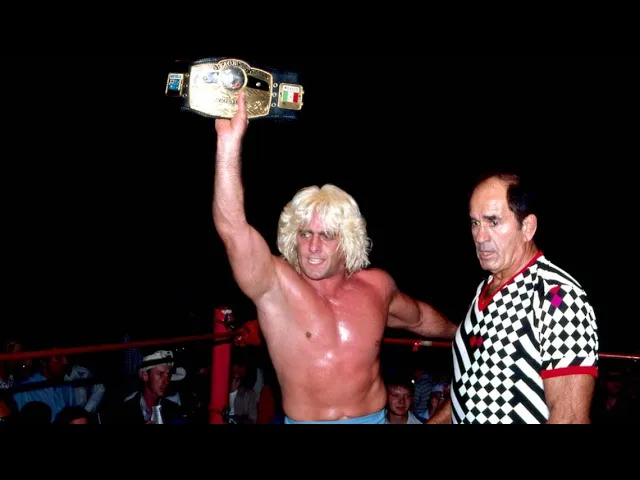
NWA Wrestling History & Tradition The Definitive Documentary: transcript
- Edtrader Music & Entertainment
- Added
- 2:07:52
- English
- auto-generated captions
AI summary
AI-generated from the transcript below. Check anything that matters against the video.
This documentary traces the history of the National Wrestling Alliance and its World Heavyweight Championship, beginning with the July 18, 1948 meeting of Midwestern promoters in Waterloo, Iowa, called by Paul L. "Pinky" George. The NWA was formed to trade talent, recognize a single world champion and define territories, and it grew to roughly 40 members by 1952. Orville Brown was the first champion, but a car accident ended his career and the title was awarded to Lou Thesz, who is presented as the standard-setting champion. The film covers later champions including Dick Hutton, Pat O'Connor, Buddy Rogers, Dusty Rhodes, Harley Race, Ric Flair, Kerry Von Erich, Giant Baba and Adam Pierce, plus the role of television, the 1983 Starrcade, the title being stripped from Shane Douglas, and the NWA's decline and ongoing survival. Interviews with wrestlers and historians discuss what the title meant to promoters, wrestlers and fans, and debate whether the NWA remains relevant today.
Key points
- The NWA was founded on July 18, 1948, at a hotel in Waterloo, Iowa, by Midwestern promoters led by Paul L. "Pinky" George.
- The alliance aimed to trade talent, recognize one world champion and define territories; by 1952 it had almost 40 members and worldwide presence.
- Orville Brown was the first NWA World Heavyweight Champion; a car accident ended his career and the title was awarded to Lou Thesz.
- Lou Thesz is described as the greatest champion of all time, bringing credibility and mainstream recognition to the title.
- Buddy Rogers is called the first heel champion and a premier box office attraction with strong television appeal.
- Dusty Rhodes is portrayed as a charismatic transitional champion who did not need the belt to be a superstar.
- Ric Flair won the title from Harley Race at Starrcade 83, described as a forerunner of the modern super show.
- Adam Pierce is presented as the complete package and a classy modern NWA World Heavyweight Champion.
Chat with AI
Ask about this video. Answers come from its transcript, with links to the moments they use.
Free with a Google, Telegram or email account.
Sign in to chatTranscript
- 0:02
[music] are presented by the National Wrestling Alliance. >> National Wrestling Alliance World Heavyweight Champion. >> The NWA >> National Wrestling Alliance. >> National Wrestling Alliance [music] um was formed in 1948 in Waterl, Iowa. >> July 18th, 1948, a group of Midwestern Wrestling promoters met at a hotel in Wateroo and founded the National Wrestling Alliance. Little did they know at the time these individuals were changing the future course of professional wrestling forever. At this meeting were Sam Mutchnook of St. Louis, Over Brown, an active wrestler from Kansas City, Max [music] Clayton of Omaha, Wally Carbo representing Tony Stker of Minneapolis, and the man who called them to this initial meeting, Paul L. Pinky George.
- 0:49
Paul L. Pinky George represented De Moine. By the 1940s, he had well established himself as one of the top promoters in the Midwest. By 1948, however, he was finding it hard to to obtain wrestling talent from promoters in uh St. Louis and Chicago and felt that by establishing a national wrestling alliance, he would better receive talent and trade talent with his neighboring states. He was the founder of the National Wrestling Alliance and called these individuals to this meeting and uh was the initial president. Uh Pinky George was a distinguished individual. He had a lot of credibility, but the NWA soon grew well out of his grasp and became an international conglomerate. The And boy initially was going to be just a small Midwestern union, but by 1952 it had grown to more than uh almost 40 members and had a worldwide presence.
- 1:46
>> Well, the National Rifle Alliance was a it was an alliance between promoters. It was pretty much big-time business. If you were a member, if you were an end promoter in NWA, you had a choosing of all the top talent in the world. All you had to do was call around to want them [music] on this date, you could book them, you know, and if if people went [music] against you or people did whatever or ran a town that you didn't want them running, all you had to do is pick up the phone, call all the other NWA promoters, and they were black ballalled. It was control. NWA controlled the wrestling profession for decades.
- 2:20
>> It was the hotbed of professional wrestling. Whatever organization you want to talk about [music] in professional wrestling today, um, trace it back. It came from the National Wrestling Alliance. National Wrestling Alliance is is is the wellspring um, for professional wrestling, whether it be the WWE, whether it be TNA, whoever, even foreign promotions. NWA's wrestling is professional wrestling. There were many reasons for these individuals to meet at this hotel on this particular evening. among them were to uh better trade talent to recognize a single champion and to acknowledge their specific outlined territories. It was important to have one world champion uh in the late 30s early 40s. I know there was one particular night in the United States [music] that there was 12 matches for the heavyweight championship of the world in one night.
- 3:13
>> It's like it is now. Anybody can buy a belt and become a world champion. They say I'm a world champion. They advertise their world champion. Well, who is disputed? But now, if you've got 30 to 40 promotions, promoters in big cities across the world saying this is the world champion, then that just kind of outweighs everybody else that claimed to be the world champion. The National Wrestling Alliance felt that it was important to have a single world heavyweight champion because for far too long, the business had been plagued by innumerable world champions in almost every major territory. This had contributed to a major downside in attendance. So with every promoter promoting pretty much their own world champion, uh they thought it'd certainly diminish [music] the title.
- 3:54
>> The NW wanted to bring credibility to the business by having an undisputed [music] world champion. >> It was the most prestigious belt. You take a look, you take a look at just across the country, Portland, Oregon, Seattle, Washington, uh, Dallas, Texas, Fort Worth, Houston, San Antonio, Amarillo, Birmingham, Knoxville, Memphis, Louisville, Nashville, Charleston, Charlotte, Greensboro. Other than in Atlanta, Georgia, other than a few of those, those were major cities that did it did not have NBA, NFL, or Major League Baseball. So the biggest sports stars they saw was the NWA wrestling on TV every week and the grand prize was the NWA world champion.
- 4:36
>> The world title belt meant many different things to many [music] different people to promoters and meant money at the box office because when the wrestling champion was coming to their territory and meant a spike in attendance from their usual attendance figures to to the wrestlers and meant an issue of pride. And so they they got together, they agreed, you know, that they would indeed um get together and have one world champion. And they picked Orville Brown to be the [music] first world champion. He was very popular in in the Midwest in that area certainly and and at that time Orville Brown was a Kansas City uh blacksmith turned professional wrestler in the 1930s. He tooured extensively throughout his [music] early part of his career, but by 1940 he had settled into his home territory of the Central States. And by 1948, he was the most logical choice to be the National Wrestling Alliance World Heavyweight Champion. Uh Orval Brown tooured uh many places, many new locations for the NWA that first year.
- 5:34
He was scheduled to wrestle LZ in a unification match in November 1949. >> Before all that could happen, he was in a automobile accident, which ended his career. And uh the NWA had no other choice but to award the NWA world title to Luthz. And so Luz was probably the greatest champion of all time, you know, got the title and [music] um not only became champion but I think defined what the what the National Wrest Alliance and what the world championship [music] should be and was from then on.
- 6:10
Lou took the title um and uh became the really the first uh undisputed [music] hewway champion since you know the early 1900s with Hacken Schmidt and Gotch and Ster and you [music] know so so that was a great milestone for the sport. Ludz was able to achieve recognition in many places that the NWA had previous not previously not been recognized and uh strengthened the world champion to [music] immense proportions where it was recognized as the sole undisputed world heavyweight title. He you know he he went around the world and really established the NWA as a world championship.
- 6:50
But Lou was the one who established this not only as a regional world title, but actually the world heavyweight championship. >> You know, back in those days, they wanted a guy who um could really handle himself in the ring. You know, who who was a um shooter hooker kind of guy. So, you know, the champion traveled from territory to territory defending the title. And they didn't want, you know, some promoter pulling a fast one on on them and putting their local champion over whoever the NWA champ was. They wanted to make sure they always had a guy who could beat everybody. And [music] you know, Luz fit that category perfectly.
- 7:27
>> Luz was tried and true. You know, that's why he was the world champion cuz he could beat anybody that wanted to at any given time and there was nothing they could do about it. And you had to have a champion like that in case you went into your local area and you had some local Yahoo was going to try the guy, maybe try to knock him out or take him down, hold him or whatever. They couldn't do it to this. Luz was the epitome of what they wanted a world champion to look like. He dressed the part. He wrestled the part in the ring. He could speak the [music] part and he had a credibility with sports writers and newspapers that no other wrestler had. Slack, sport coat, suit, tie. Um, you know, always looked like a champion in in and out of the ring. Always acted acted like a champion. I think a big part of that is because one, that's who he was. I mean, it wasn't a gimmick. It wasn't an act with him. It's who he was. But he brought that to the championship early on.
- 8:15
>> [music] >> Wrestling and TV have always went together. >> The dawn of TV was great. >> They're cheap to produce. They draw ratings. People watch them. People [music] like it. >> Desperate for programming, desperate for cheap programming. And wrestling was tailor made because, you know, you had those huge cameras. you know, they were pretty much stationary. You had a ring.
- 8:45
You had two contestants [music] and a referee. It didn't cost much to produce. You know, it was it was action. [music] Uh and and that's that's what I think made wrestling grow so much too is because again people are watching especially in the early days of Americaz [music] at [music] one time he was the most watched man on television even more than Milton Burl back in the 50s >> add a TV they could really you know promote you know there's a world champion [music] traveling around and and that helped >> when TV first hit and there's Lou the with that belt and they're saying this is the man this is the best in the world. Well, the whole world had the right to believe that. You know, the president hadn't went on TV and lied to us yet. You know, they hadn't exposed the game shows yet and everything else.
- 9:32
So, when they said something, you believed it. And in this case, they couldn't expose it because Lou [music] The was the world champion and he was as true as anything on television. um one year, you know, uh seven years I think a little bit more just at one stretch, which was pretty much unheard of. But again, he was he was what everybody saw as a champion and he he you know defended the title. He drew a great crowd and uh you could couldn't have found anybody better.
- 10:05
>> He made a very good touring world champion, made a lot of money for the promotion [music] and and for the NWA. He brought a lot of prestige and honor uh you know to the world championship and and which which still is today. you you can't hardly talk to anyone I think or you'd be hardressed to find someone that actually knew Lou worked with him that didn't really appreciate now you know looking back and just saying um you know thank you to him probably not only the the great probably the greatest NWA champion of all time the greatest wrestling champion of all time but you know he set the standard you know he he not only sets I think he helped set the standard for the business in a lot of ways but certainly uh brought wrestling you know in the 30s and the 40s you know, into into a real mainstream.
- 10:47
[music] Lou also had a great respect for the business and if it was good for the business for him not to be champion for a while, then he was he was more than happy with that. You know, there's always this question about what happened in Chicago, you know, with Edward Karpartier, you know, cuz Kapartier had beaten Lou and they were claiming him as world champion. So, Karpardier then, you know, didn't want to face Lou again [music] and Carpio was it was a good draw. you know, he he was more of a yeah, acrobat uh actually from from Poland, but uh but but I think a great athlete and a and a good draw, but so there was a little controversy there, but but Lou did still have the title. Um was ready to retire.
- 11:29
He'd been in a long time, had a lot of business interests and all. So when he was ready to drop the belt, uh he wanted to drop it to um Dick Hutton. Dick out of Oklahoma, three-time NCAA champ. So, uh, you know, Dick, uh, becomes the, uh, world champion and didn't draw real well. It was a great athlete. In 59, um, before the match with Pat O' Conor, uh, Mudnake and a couple guys came in, Pat came in and says, you know, Dick, we want you to to drop the belt tonight or the title tonight. And he said, you know, no, you know, I didn't want to, you know, no.
- 12:06
And so they explained to him, you know, it's time for a change and you know, we'll be a Pat will be champion and and also he just looked over at Pat and this is all according to Dick and he says, Pat, if you want it, come and get it. And he said Pat [music] said no. So he he agreed to drop the title and kind of like Lou, I think he was counted out one fall and maybe um maybe in both falls, I can't remember, but he said, "I lost I lost the title without losing a fall." the NWA heavyweight champion of the world, Pat O' Conor.
- 12:36
Pat was a great champion again, a great amateur champion from New Zealand, British Empire champion, New Zealand national champion. I mean I mean a great resume and and a a great [music] wrestler, not just a worker, but just like by like Dick um you know a great wrestler. He had it for for uh almost four years and and and drew well. >> From Camden, New Jersey, the NWA, United States title holder, Buddy Rogers.
- 13:13
Buddy Rogers was coming on strong and he just drew so well across the board that uh he took the title for and at at that time the largest wrestling crowd ever in Kamisky Park winning two out of three falls from Pat and [clears throat] and did a great job as as a as a traveling champion. Nature Boy Buddy Rogers was a premier box office attraction. He made big money at uh any wrestling arena across North America and across the world. >> They never really had a heel champion. But there's one thing I want everybody to know, and that is to a nicer guy, it couldn't happen.
- 13:47
>> Buddy was certainly kind of the first heel champion. >> Buddy Rogers was a performer, and he [music] knew how to perform. He knew enough wrestling to make you believe that he was as good as he said he was >> and was more of a showman than in the vein of LZ. He was a top champion and brought a lot of attention to the NWA. He said, you know, Buddy wasn't wasn't a great wrestler, you know, on on the level of like the cutting and all of that cuz he didn't have that amateur background, but he was a great worker. He was good. He was a good wrestler. He was a great worker, but he said as far as showmanship, so there was nobody that could beat Buddy Rogers.
- 14:19
>> He also had that gift of Gab because when television came along, they [music] realized people were watching wrestling, but also they realized something was missing. >> Buddy Rogers [music] is much better TV. >> TV was big. But he was flamboyant, you know, a lot like like gorgeous [music] George, blonde hair, you know, um would say, you know, stuff like um you when the going gets too tough for everyone else, it's [music] just right for the Nature Boy. Or if you want a champion on your card, you need Rogers to fill your fill the bill. And Buddy Rogers and guys like him and Gorgeous George. Those was what was missing. The bleach blonde, the tan, the bodies, and guys that could get on TV and talk and not just they didn't have to wrestle to make you want to buy a ticket. Buddy Rogers could just start talking and you wanted to buy a ticket to see him get his tail beat that week somewhere.
- 15:04
>> There were some questions about his dedication to the Alliance. Uh, however, these were vetoed in 1961 when he beat Pat O'Connor and won the championship in Chicago. However, it wasn't too long after that that uh a lot of fears about Rogers being the [music] champion came true. Um, but he kept the title. um got got promoted mostly by Vince's dad, you know, uh [music] uh Tootszmont and kind of the the group uh in New York and they wanted to pretty much control the championship and and they did for for quite a while. he started to uh spend more time in the northeastern [music] territory uh wrestling in bigger cities like Chicago and would go to some of the NWA member territories [music] but did not spend a lot of time uh like his predecessors had. This angered a lot of NWA members. He didn't venture out of New York very much or Ohio or Washington DC, Baltimore where they they were
- 16:02
stronger. They were members of the NWA, but they were pretty much controlling the belt and Muchnik and the rest of the country, you know, wanted wanted the world champion, too. They paid their dues to [music] get the world champion to come. And of course, Buddy had to go where he was booked. So, the NWA decided it was going to be time to um take it, >> go shopping for a new champion. And when they did, they knocked on the door of Luke. In 1963, Sam Munchnick convinced Louzz to return to the helm of the National Wrest [music] Alliance, >> who was retired, and you might even say semi-retired, but they wanted Lou to take the belt. And I don't think Lou was really even convinced because Lou was, you know, almost 50. And, you [music] know, was was very comfortable with his other business ventures, but he said he he would. And so, they met with with Buddy. Everybody I know didn't want to drop the title, but I think they held the money in [music] escrow. When a when a champion back in those days, he became world champion, you had to put up a
- 17:00
$10,000 cash bond for the belt. So you wouldn't drop the title to [music] somebody you weren't supposed to. And they said, "Buddy, you know, we're going to take the title and we got your $10,000. We're going to give it to charity and if you want your money back, you know, it's time to change." And so he met Lou in in Ontario one fall Montreal one fall match and uh Lou took the title. Buddy Rogers uh continue to be recognized as the world title holder uh by the Worldwide Wrestling Federation and this was actually the precursor to today's WWE.
- 17:33
>> So we had another three-year run and and again established really that traveling champion. You know Lou is Lou is everywhere. I mean, Lou is still the champ and been very tough to beat. Uh, really decided that, okay, now, you know, I've been in it for 30 years. Uh, it's time for me to get out, at least from the the competition part. So, he picked Jean Kanniski. He he liked Jean, had some great matches, respected Jean. Jean Kanniski was, you know, again, another fit that bill. He he was he was one badass. he could go in an hour with anybody.
- 18:11
>> So we dropped the title to to Jean and I think he was very happy to do it. Jean was really steel as you know Buddy was a heel champion. Jean was really a heel champion unlike you know Fez. He he was a little more colorful. He was big and mean and he was a heel more or less you know um he he didn't follow the rules. [music] >> [music] >> He, you know, he he could brawl and punch and kick with the best of them, but you know, he could also handle himself in the ring. Great world champion.
- 18:50
>> Jean Kiski just loudmouth, braggadoc braggadocious, brought size to the world heavyweight champion and a slam bam, always moving style. A lot of the wrestlers of that era, um, guys that saw him and worked with him really praised his style. He got an exciting [music] match every time with him and and a guy that people wanted to see get his knock his block knockoff. >> Kinesiski was a different kind of worker, but he was a machine. >> He was a wrestler's wrestler. He wasn't flashy. He was like Dory Jr. But he to me, he didn't have that gift of gab either. But, you know, he held up all these matches held true. There was 40ome wrestling promoters that voted to make him the world champion. So, he he had to have something. He was a very versatile performer and was good behind the microphone, good in the ring, and had a reign lasting from 1966 to 1969. One thing about the title, especially back then, you know, it's just the the rigors of having the belt and traveling that 2
- 19:49
3 4 5 years, you know, into it like Dory had it four and a half years. It's just that mental and physical exhaustion of wrestling night after night after night. >> [music] >> Jean Jean was great and again just when I talked to him about when when he dropped the title which is unusual with with Dory because it surprised everybody. I mean it came out of nowhere you know on a Tuesday night in Fort Hester Auto Armory in Tampa, Florida in February. As I talked to Jack, he said you know we all thought Dory was going to get the title sooner or later. Uh but we thought it'd be St. Louis. We thought it would be a big venue, but it ended up being on a Tuesday night and and Jean said, you know, I was just so tired, you know, I was ready. I was ready to to drop the title. And >> it can always happen. Um, and it was a great match. From what I can say, from my position, it was a great match with Jean Kiski. And uh, I feel very close to Jean Keski. He was
- 20:49
responsible for me being able to continue in the wrestling business. He helped me through a knee injury and uh uh the match was great and I did walk out of the ring on that day. NWA World Heavyweight Champion. Tonight I won the NWA World Heavyweight Championship against Jean Keski. It's a night that uh will never leave me. And even though it took place what 35 years ago [music] and uh uh the match was about 15 minutes, my father was in my corner.
- 21:23
>> He needed a change. It was it was it was 1969. You know, the the old champion look and all that the kind of the uh the flat top burr haircut kind of thing had had gone gone out of the way. It was a new generation coming up and they and they picked Dory, you know, they they picked Junior to take take the belt and and to bring it to another to another level, a new generation. >> Dory [music] from Junior, you look at him, you didn't think he was all that all that. But I want to tell you something in the [music] ring, the guy knew how to move. He knew the moves. He knew [music] how to use the moves.
- 21:55
>> I found Dory boring as hell. Again, a great wrestler. [music] Um, he could handle himself in the ring, tie anyone in knots. People say he's bland and he's this and that. He did his talking in the ring. His brother [music] could talk and yell and scream and make you buy tickets that way. Dory made you buy a ticket because he knew how to take his time and [music] make every movement mean something. And he could take anybody and get in the ring now and and make them look [music] like a million dollars. >> My brother had more ability than what I ever had. He was he was wonderful in the ring. reporters get together and that was did in Las Vegas every year and they would vote you know who's going to be champion and so I mean it's a great honor you know I mean you got to be able to you got to be able to wrestle you got to be able to hold the title [music] and be able to draw money and just have all these pieces together you know and there and there's few very few folks who actually you know could put those pieces together but Dory again a new look young man you know very well spoken again [music] the the same as as Lou you know sport
- 22:54
coat tie you know he have his cowboy hat he'd carry the belt high. It meant credibility. It meant that when people went to to the arena to [music] see a world heavyweight championship match, they thought this time was [music] going to be for real. They really thought they were seeing real wrestling. And I could give that [music] credibility to the NWA World Enter Championship. >> You can't not talk about uh Dory Font Jr. without talking about his number one opponent, his number one um you [music] know partner in the ring and that would be Jack Brisco.
- 23:27
>> Him and Jack Brisco had great matches. [music] >> [music] >> I think having a good guy challenger, having a babyface challenger, hero challenger going after a hero champion was was a was great cuz, you know, Dory would always be wrestling, you know, some a lot of times it would be, you know, baby faces, sometimes it would be heels, but to have two great competitors.
- 24:00
>> They had some of the best wrestling matches anybody ever saw. >> You put him against a Jack Brisco or somebody like that who was one of the greatest in the world. You got two guys that know how to wrestle, how to tell that story, and there's nothing bland or boring about it. It's as exciting now as it was 40 years ago. [music] >> [music] >> Don't do this.
- 24:41
[music] [music] >> [music] [music] >> Okay. Good.
- 25:20
>> [music] [music] [music] >> I think I was like Frasier and Ali, but I think funk and Brisco matches were like the gold platinum standard. You know, you hear guys for years saying, "That was a good match, but it was no Brisco Funk or it was no funk Brisco match."
- 25:48
>> Jack had everything that I needed as his opponent to give those people a very credible wrestling match every time out. >> They were one of the first acts that could really take their feud because of the way television evolved and the Florida Championship Wrestling Show began to get shown in different markets. Um, and just reputations began to come around, too. they were able to take that feud and headline shows all over the country um with not even being in the promotion. It was it was one of the first national feuds.
- 26:19
>> So they they pick Jack and before he gets to be champion, you know, again, now you got to put up the the bond and now it's up to 25,000. So Jack had to put up $25,000 in cash to the NWA to secure the title. And another thing he had to do was he just like any other champion. Uh but I think more so now with Jack, he had to travel around the country and lose to every major star in every territory. But he said back then, you know, losing really meant something. And now there's films at me all over the country, losing to everybody. So my credibility is getting kind of bashed around the country. [music] I was on my father's ranch. He said, "Let's move some cattle." Called Terry out. got him on the phone.
- 27:06
And you have to understand what my father's ranch was like. He had an upper plateau and also there was a lower part where a creek ran through the bottom country and we were going [music] to bring the cattle up from the bottom to the top and we had a pickup truck and I was driving the pickup truck. My father and my brother were on foot and we were chasing cattle and we took [music] off after a calf and watching a calf. Our pickup truck ran over a six sixt embankment. That's not far. But when you run a pickup truck off an embankment like that and you hit the water and the ice, it it messed me up pretty good. And uh I really know it was a winter time for sure. I don't know what the day was. Maybe you guys will know because you know when the match was
- 28:02
scheduled for Jack in uh Houston, but uh there was about an inch of ice on top of the water and it all came in front of the car. Uh in that pickup truck accident, I received a separated shoulder among other things including facial and head lacerations. So he was he was scheduled in May to take the title from Dory. Depends on who you believe uh about uh the truck accident.
- 28:32
Now Jack uh was under was of the opinion a lot of folks are too was they call it kind of the phantom truck accident. You know Dory did say it happened and again I'm not the one to to say what what did and what didn't happen. >> He was supposed to have the match on a Friday night in Houston. I was in uh Miami Beach on Wednesday night. [music] Eddie Graham called me and he said it uh we went back in the shower. He says, "I just got a phone call from uh Dory Funk Senior." He said, "Junior supposedly uh has rolled his pickup on the ranch and has separated his shoulder and won't be able to make use on a Friday night."
- 29:12
I knew right then anytime the old man with behind something, something was wrong. He was playing games with somebody. So, Junior didn't show up. >> That's the only match I missed in my career. And I could not make it to Houston for the match with Jack Brisco. >> I think he didn't want to lose the belt to Brisco. >> I've heard Harley Race's take on it. I've heard an interview with Brisco where he talked about [music] it and I've heard Dory's take on it. And it's business. Business is business and that's that. and and it don't matter.
- 29:41
It's all it's it's all dollars and cents at the end of the day. >> They called and they begged my father. They said, "Can't you just [music] get him to come down to Houston and walk in the rain?" And I had one shoulder that wouldn't uh that I couldn't raise. And uh there was no way I sp I was in the hospital for 3 days. So they were very very upset that I didn't make the m that I didn't make Houston and I had never missed a match in my life and haven't missed the match since.
- 30:17
Lori comes back uh the Funks had a great relationship with Harley. Uh you know they looked at Harley initially kind of as a transitional champion but he certainly proved that to be wrong. I did uh come back and I I came back wrestling maybe a little bit soon uh at the request and the pressure of Fritzvon Eric, Sam Mushnik, Eddie Bram for that matter wanted me back in the ring wrestling for the world title and I did and I came out uh probably came back too early and went in the ring against Harley Race in uh Kansas City and uh in a disputed decision, Race walked away with the World Heavyweight championship.
- 30:58
>> The match itself probably wasn't one of our better ones in the overall scheme of things. I think he personifies the traveling champion. He just did, you know, out just an outstanding four and a half years, you know, as world champion. >> I don't know dated cuz he, you know, [music] he held for four and a half years. So, I I don't think they um um if they would have thought he was that underrated, they would [music] have let him hold the belt that long.
- 31:30
>> My brother, I think, was probably, and I'm not just saying it's cuz he's my brother, but I've analyzed it through the years. I think he is probably the greatest NWA champion ever. >> Really? >> Oh, absolutely. because he would go into these different areas and wrestle guys in Tennessee and wrestle him for an hour and and everywhere that he went as a the guy that he got into the ring with was much better than whenever he stepped into the ring at the [music] first time, you know, his opponent.
- 32:01
>> Yeah. >> You know, uh he always [music] did wonderful things for his opponents. >> Dory Funk Jr. for four years [music] probably was the most successful uh world heavyweight champion of his era. But I do want to say that at the time [music] that I was uh predominant in wrestling business, the biggest thrill was [music] winning the NWA World Heavyweight Championship. And just uh have to say that all the other titles kind of pale [music] in comparison to having the honor of being the NWA World Heavyweight Champion for 4 and 1/2 years. But the NWA World Heavyweight [music] Championship, held so much prestige and was so big and was so important in those days that that is the one that really sticks [music] with me.
- 32:54
July 20th, 1973, uh they were going to retire the belt. That was one thing they're really promoting. Bosch was promoting there and and was that there's going to be a new new title belt. There was a new $10,000 [music] belt made uh in in Mexico. They retire the old belt, the one that Dory had, the one that uh Pat, Buddy, and Lou and and Jean all had. Uh Sam Mushley came into the old Sam Houston Arena that night with the brand new belt and I was the last champion to hold the belt that had been around since early 30s [music] and handing him that belt [music] and taking that Mickey Mouse thing that they come up with and especially then was had a velvet backing.
- 33:42
>> Jack wrestles two out of three falls. Jack loses the first fall. The Harley had that suplex. [music] Jack took the second fall with the figure 4 and then the third fall he did with Luz Press and he said he had that plan because uh he wanted to do it, you know, in tribute to Lou. So he wanted the world championship with with the Luz press was awarded the new belt and um became came champion. Well, it was after all that that happened and the games [music] being played by everybody, it was uh you know, it wasn't what I thought it [music] was going to be. You know, if it had come off as as what it was supposed to be and I would have been sure [music] I've been a very u uh proud moment for me and something [music] I'd worked for for years, something I had counted on doing all my life. But when the way it happened, it you know, it took a lot of thrill away from it [music] for me. Now, Brisco was champion, had never beat me for the World Heavyweight Championship, and made an [music] ideal rematch, at
- 34:41
least for Florida and for Texas than any other place. So, [music] it worked out much better for Jack anyhow. So, I really don't understand why he would complain. Jack, I mean, Jack was tremendous champion again along the lines certainly along the lines of of Lou and and Dory, you know, traveled uh, [music] you know, worldwide, you know, with the bells. >> Jack Brisco, um, smooth, um, good-looking, babyface, world heavyweight champion that people respect. And of course, he had the amateur credential. He was uh technically a phenomenal wrestler.
- 35:23
He had the credibility that it takes to draw money being the amateur, the great amateur champion he was. >> He had the credentials, NCAA [music] champion, but but Jack also was a good-looking guy, good body, Indian blood, you know, he was part Indian. He had, you know, that dark skin, dark hair, [music] girls liked him. So he he was not on before. Most of the time the world champion when he went into a town had to be the villain because people want to see the local [music] hero beat him. Brisco was kind of different. He could go into the local area and be the hero. [music] You know, they could they could put some steam on a villain and here comes Jack Brisco and this good-looking Indian [music] from Oklahoma, the world champion that we're all behind. He's going to take care of this guy. So he was kind of a little bit different from the rest of the the world champions in that mold, [music] but his wrestling ability was second to none. Nobody could touch him.
- 36:11
>> But then Jack, you know, you got a popular champion, you got a [music] guy, a former collegiate champion, now is the world heavyweight champion, good-looking guy, you know, early '7s, you know, had long hair. And again, just where Dory took it into a new generation, Jack was was kind of continuing that. You know, Jack had two runs as champion. Yeah. the first run and then in um was it 74 uh Baba wanted the title and you know the story that Jack told me was Terry Funk was the one who kind of helped coordinate that cuz they the funks were doing a lot of work with Baba in Japan >> at the time Funks they were booking Japan I said so uh uh of course BMWA was uh Sam Mnik booked the world's champion So, Japan always uh uh brought the world's champion over there, but this time they wanted to uh
- 37:10
they wanted to do a belt switch and able to do a belt switch. You had to get all the NWA members to agree to it. [music] And so, uh Junior and Terry was booking the other American Bors over there, but you know, like I said, Sam booked the champion over there. So, uh, they wanted to switch the belt [music] to bobin. Boba wanted this. And [music] the funks wanted it. So, Terry approached me that, uh, when you go over there, why don't we, [music] he says, we you can work out a deal. He says, Bob said he'd pay you $10,000 if you dropped your [music] belt.
- 37:51
>> I think he said he'd offer him u it was $5,000, maybe 10,000. And [music] to me, it was 10. And he says, "You know, I had to put up $25,000 for the belt just like Dory did. You know, I'm not going to lose 25 to gain 10." [music] >> I said, "Terry had offered me 10 grand." I told Terry, tell Bob if he wants the belt bad enough, said, "I'll have to have at least 25 grand for it." No, no, no. I didn't want to do that. He said, "Well," she said, "Let me talk to Baba." So Terry called back and said, "Well, Baba agreed to to your figure." Giant Baba, you know, was promoter and and you know, that's part of being, you know, um having the pool of of um running, you know, >> [music] >> um all Japan like he did. He could he could buy the belt. Um he was more over in Japan than you know anyone like Dory Funk or um Jack Brisco ever could imagine be here in the United States.
- 38:46
and probably like on on the level of like Ric Flair was at his heyday or you know um Hulk Hogan was was Baba in Japan. >> Baba wanted to build up his territory. >> You know he and Anokei had split uh you know there two wrestling territories there and you know all Japan and pro Japan and Baba needed the title. You added that was instant instant credibility. You know if you had a world if you're the world champion that that's instant credibility.
- 39:13
>> Giant Baba stood 6'9. I mean he was a real giant in the ring. He was a legend in Japan. He won the NWA world title on three occasions and his uh winning the title brought a lot of repute to professional wrestling in Japan and to himself that put him above Noki and and the other promotions is you know not only do they have their champion but this is the NWA world heavyweight champion. This is the title Luz held. This is the title Dory Funk Jr. held.
- 39:40
Now Baba has him. Baba was probably the nicest of all the big guys. >> He had a heart every bit as wide and as big as him. [music] And for some reason other bub and I clicked. I could do a lot of things with him that other people couldn't do with him. And [music] he really liked that. >> Three times. Three times. DJ >> [cheering] [music] >> only twice again for only a week at a time.
- 40:23
>> I made him world champion two different times around. Bubba was just a a great great human being. >> [cheering] >> There were short runs. He he bought it. Um, a lot of people in the United States didn't even acknowledge it ever happened.
- 40:50
>> Jack did make a deal with Baba. Uh, dropped the title there, won it back a couple nights later, you know, before he came back, you know, to take the title a second [music] time. >> First, um, couple of years was great. I loved it. just going around traveling. I lived on an airplane and in airports and for 3 years that's my whole life was was either in an airplane or a hotel or or in a coliseum somewhere. It was tremendous. I loved it. It was a great life. Great way to make a living.
- 41:23
>> [music] >> It didn't uh it took about uh about 2 and 1/2 years and uh uh I was just very tired, very worn out. The uh the deal with the NWA and the champion was supposedly 3 weeks on, a week off, 3 weeks on, a week off. [music] Well, uh that's the way it started out. And then pretty soon everybody said, "I want the champion. [music] I want the champions." that week off that I was supposed to get every 3 weeks just evaporated and I was just working all the time and just uh like doing hour Broadways almost every night and it would just get to the point where I was just uh [music] just exhausted.
- 42:05
I'd have to wake up and uh wake up in the mornings and get my airplane ticket to look see where I was and where I was supposed to go. It just everything just [music] started running together confusing. I stayed in the holiday ends and I didn't all one room left like the rest of them. I didn't know where I was at half the time [music] where I was supposed to go. I checking the airplane ticket and uh [music] was just I was very mentally exhausted and physically exhausted and I needed a rest. >> He talked to the NBA he said I I want to drop the title by the end of the year and they didn't want Jack to lose the bell, you know, just because he was drawing well. is very popular and he said, "No, you know, it's time."
- 42:45
Of course, Terry was picked. You know, in 75, Jack uh [music] dropped the title. He was supposed to wrestle Dory, as the story goes. >> Gosh, I remember one of the one of the not so fond memories of [laughter] >> uh really I I went down to Miami as a substitution for my brother that night, which uh worked out wonderfully. you know, you have kind of a substitution which gets everybody kind of, oh, you know, maybe maybe he's not ready for this guy. So, so [music] Jack, as he said, you know, when I went for the figure four and, you know, Terry cradled me and counted three [music] and said, you know, Terry had the title and I got my life back.
- 43:22
>> Terry was a great [music] worker. a great success and I I went against uh Brisco that night and defeated Brisco and uh it was you know I was very very [music] you know elated at that time. I really was cuz it means that I was on top of my business at that particular time. >> Yeah. The only bad part about it is if you'll see the three count in there, you know, whenever Brisco went for the cradle, you know, he went for the figure four and I cradling him. Uh, as you see me go to get up, you'll see my hand come back like this. Sunny Myers was the referee and I just came right across his nose like that. Broke it like in four or five places, you know, and he just, you don't see the referee after that point, you know. I mean, his nose was like this, you know.
- 44:15
But uh it was it was really something to be you know to follow in my brother's footsteps. First two brothers to have the NWA championship for two brothers never [music] to hold the championship was was great cuz when Dory was champion they always would say you know Terry will never have a chance because as long as as long as Dory is has the title. >> For my money one of the best performers [music] I've ever seen in wrestling. >> Terry thought he was going to be the first uh buffoon champion. and he was, you know, he did a lot of goofy crap.
- 44:46
>> Sometimes Terry Funk could be over the top and act like a clown. And they were very ser, you know, it was beginning to degenerate a little bit after Sam Rustik lost some control over the world title of the credibility of the world champ of the NWA world [music] champion, but they wanted the NWA world champion to be um somebody who was um you know, who was credible. Terry Funk sometimes didn't do that, but I mean, um, he [music] he was an exciting performer that could go in and and do the job of bumping [music] us, you know, just bumping around the ring and making that local hero look great.
- 45:20
>> Terry Funk is known as a hard hardcore icon today, but back when he was the And world champion between uh 1975 and 1977, he uh was known as a very versatile performer. He could brawl. He could wrestle technically. >> A lot of people don't know this about Carrie Funk because he's got such a hardcore reputation right now, but in his early career, he was a a very good Matt wrestling style professional wrestler. [music] [music] >> [music] [music] [music]
- 46:20
>> Terry Punk reinvented himself, you know, in the [music] middle and crazy after he had had to run as a world champion and he had to run the WWF. But if you go back and watch Funk, they're a wrestling family. The dad, both brothers, everybody come out of Amarillo could wrestle. [music] They were wrestlers. That was a wrestling area. And Terry got that belt because he was a wrestler. He got that [music] belt because people had enough confidence to know that he could go out there and have [clears throat] legitimate wrestling in the ring, but he could still wild and crazy and brawl.
- 46:51
And he was he was the perfect mixture. [music] He could fight, he could wrestle, and he could talk. He can make people love him or make people hate him. >> Terry had a had a good run as champion uh you know for a year. I thought he he was a good champion. I would like to have seen him hold the title you know longer. I think [music] fans today if they don't know at least that part of Terry's career they really missed a lot. >> I think you know Terry Funk was to me who went on history one of the great workers of all time. >> [music] >> Harley made history again up in up in Canada meeting uh Terry on a Sunday after. And Harley took the belt and had a great run. He was [music] wrestler, fighter, talker. He can make people love him, make people hate him, [music] but you believed in him. When he pointed that finger at the camera and he looked and you saw them big rings and that big fist, you knew this man is no joke.
- 47:48
Harley commanded a lot of respect and got it. >> Harley Race is is one one badass guy. AND WHEN I GET BACK, I'M GOING TO HURT YOU. I'M GOING TO HURT YOU SOMEHOW if I GOT TO DO IT THAT WAY. HEY, you have [screaming] the world heavyweight champion. Anybody who stepped in the ring with Harley Race didn't say he was one of the toughest men alive would be lying. Harley was just was amazing. I mean just methodical and he wasn't colorful but again for you know the late 70s and early 80s when he had the title he was the champion he was the face of the title and I think he was he fit the time very well but also you know wrestled tremendously.
- 48:32
>> Paulie Rice had a real style. [music] He was um when you watch when you watch him in his prime in the ring when his weight was down and um he he was very graceful in his way, but he you know um was a tough guy wrestling. [music] I mean just was came across taught that way and was serious about his profession. Bill, I devote a lot of my life to what I do. And I say a lot, I'm saying darn near 95%.
- 49:00
I stay in condition above and beyond anything else. >> Harley Race was tough as nails. You knew when you saw a match with Harley Race [music] in it, you knew you were getting a great professional wrestling uh bout. He held the title on eight different occasions. And that in alone signifies what the NWA felt about him, especially when it came to defending the title, meeting all comers, and being a reputable champion. eight title runs. Uh the competition that he went up against, uh you know, he he was he was a great champion.
- 49:32
>> Ari Race is the greatest wrestler on God's green earth. He said it every week on television. [screaming] >> Let me tell you something. It's going to come down TO YOU, ME. >> He was the greatest that I ever saw, you know, in person as a kid. [music] There was something to him just that when he walked to the ring and he take the robe and pushes back and there was that 10 lbs of gold. [music] Harley Race was a man. He's like like your perfect kind of NWA champion where you know he's got those multiple styles that he can work.
- 50:03
He he can go that 60 minutes with Brisco or Dory Funk and and trade arm bars and [music] and and um headlocks with them or you know he go out there and brawl with anybody. He was an effective world champ. But Harley was kind of the end of that era and that certainly brought a lot of prestige to the belt when [music] he had it certainly. >> And this right here is symbolic of being in the greatest shape of any human being [music] on the face of the earth. It says right on top world's heavyweight champion [music] and which means that I can beat any man in the world. And Harley descent [music] much integrity you would never do anything hurt.
- 50:43
I mean, Hari will pride himself the rest of his life on being in the champion. You know, every >> If the only thing you've ever done is wrestle and you finally hit that epitome of what what you set out to do, there is no better feeling. It was, you know, the greatest [music] feelings you could ever have being, you know, doing what you're doing. >> Harley had it almost for a full decade other than losing it for short periods of time there. He was [music] the man and he grew everywhere. He grew in Tokyo, Japan. He grew in Memphis, Tennessee. He grew in Kansas City. He grew in Charlotte. He drew everywhere he went. Atlanta, Georgia. Wherever Harley Race was at, it was a sold it was a sold out house. And Harley [music] Race is kind of the beginning of turning the title over a few times.
- 51:27
>> Lost it for just a couple days down in Georgia to Tommy Rich. [music] >> And I know people looking back who are fans look back at, okay, Tommy Rich in Georgia. What's the big deal about him? >> Tommy was the first true national superstar that WTBS out of Atlanta when that channel 17 went on cable and satellite around the world. Tom I I don't think to this day Tommy ever realizes how over he was in the late 70s and early 80s on WTBS.
- 51:57
>> There probably wasn't a bigger star when Georgia Championship wrestling was at its heyday on on TBS there than Tommy Rich. >> He wasn't the greatest wrestler in the world. He could he could show some fire in the ring. Wildfire was his was his nickname and he could talk in a way that um particularly rural people, country people could really get behind and he [music] became a big star. >> You know, talk about an anomaly. I you know there there's all kinds of stories of how that happened and all. >> It was a short run. Um I I don't know the circumstances why they gave him the belt. He was extremely over in Georgia.
- 52:27
Jim Barnett um who who was booking the world champion at that time got Harley Race to go along with losing the title [music] and losing the title to Tommy Rich and then and then getting it and then getting it back to give Tommy Rich [music] that boost and he was a big star at that time. Everybody knew he was all over the magazines at a time when the magazines wrestling magazines meant something. >> Barnett was booking the champion at the time. Uh he was fighting the fight there between uh and Gungl and himself. Uh Oie was not into Atlanta then.
- 53:07
Fred Ward and a couple other people were in were in Atlanta with him and he wanted to assure himself that he'd win the fight. So they asked me if I would put uh [music] Rich over and I said, "Well, if you think I'm going to do this for any period of time, you got another thing coming." >> All right.
- 53:35
>> And I dropped it to him in in uh Augusta, Georgia. Want back in Gainesville. Dropped it on Monday. Want it back on Friday. So I guess we're in six days. >> I will I have to rest defend it for the seven days and then we come back to uh Gainesville, Georgia. I've been on the road. We come back to Gainesville. Harley beat me back in Gainesville for the title. >> Rich is winning the title was very uh important to the business and showing fans that a title could happen any a title change could happen anywhere. And again, it was a big boost to the promotion in uh Georgia.
- 54:09
>> That was a lot of pressure there. that yeah that was you know I mean cuz it's a lot of responsibility and uh I might not [music] have been ready for it but like I said I've been there and I've done it and uh you know Harley race that was another one of the great ones you know he was I [music] mean one of the top in the wrestling business and and I had the opportunity to wrestle him all and it's been one of the greatest greatest educations I mean that you could ever have. >> Yeah had a lot of fun doing it today. >> Yeah, [laughter] >> you know Tyler Reigns is a title reign. >> He couldn't have [music] um handled being a longtime champion. Tommy Rich, he's um um he didn't have the um grappling [music] shooter, hooker skills that the other guys who held the belt had. As a in ring performer, Tommy Rich was as good as anybody. Um he just wasn't a real wrestler.
- 54:55
>> I I don't believe Tommy wouldn't be because Tommy, he was a good-looking guy. People loved him. Country boy. Thank you, Mr. Soulie. You know, he he was he was that old down home white meat country baby face that everybody loved. And how you going to take that kind of guy and take him [music] to Charlotte and he's going to have to be the the you know the guy that everybody wants to see get beat? Well, it ain't going to happen. You're going to bring him home to Tennessee and people boo him. It ain't going to happen. >> He carried the belt so he should be recognized. But he's not going to go toward the top of the list [music] of great champions in my opinion.
- 55:26
>> I think Tommy was a guy with incredible popularity, good fire. He was a good performer, you know. I think he worked real hard in the ring. I I wrestle Tommy many Broadways. I can't say anything but good [music] things about Tommy Rich, you know. Um I think he had some personal stuff going on, but God who am I to talk about personal issues. So I mean I think he held himself back a little bit, but he clearly was a [music] big star and he was over and the crowd loved him. The girls loved him. He was easy to work with. [music] Very very good worker.
- 55:56
>> He's he's on the list, you know, he's he's in the record books as as that. But hard hard to um measure a champion with such a short reign as as that. But again, can't take it away from him. He was he was heavyweight champion. >> A lot of people say, you know, I mean, common 7day wonder, but uh the thing about it is 1981, I was 19. Uh and had the opportunity, I mean, there's not many people that can say that they wore the NWA heavyweight title. Whether it's one day or, you know, a year, it don't matter. It was one of the biggest accomplishments in my life that I'd ever done, you know, and I I love to held the belt longer, but like I said, I was there. I did it. And uh you know, people say what they want, but they ain't never been there. [music] >> Lost it to Dusty Roads. Dusty Roads was a phenomenon out of Florida where that talking [music] and then just kind of the stylized, the elbow, the um the the
- 56:55
the trash talking, the the the prancing in in the ring. Um he could entertain fans in a way that um and he had he had promised so often to win the world title and they they booked it so much and um there were there were people that didn't want him to win the world championship because he didn't have that. It was important to those particularly those oldtime promoters, the older promoters that there was some wrestling credibility there and that was the Dusty Roads act and so but he was a big draw and he was he was money and so it was decided to give him a brief time as the world champion so he could say I won the title and then you could rip it off from him.
- 57:31
>> Dusty was a transitional champion. He was never I don't think meant to hold the title long. Dusty didn't need the title to be [music] the superstar that he was simply because he was the most charismatic individual of that era. Um [music] he was a common man. He had connections to the common people. That's what those people related to. Um he was the one that you rooted [music] for and that was the draw. >> They put it on Dusty because the charisma part. >> Dusty [music] was a people's champion.
- 58:00
Dusty had it three different times, but he never needed to keep it long because it kind of it kind of tarnished. His whole thing was chasing that belt, but once he got it, okay, yay, he's got it. Now what? So he had to lose it so he could chase it again. You know, he didn't need a belt. Dusty was so so charismatic, so over such a star. And you and it didn't matter if if it was professional wrestling or whatever Dusty Rose was going to be in, he was going to be famous. He was going to be the star. >> [music] >> But wrestling was his chosen profession and and he made it to the fullest. He didn't have to have a a belt to say there's [music] the American dream. He was the people's champion.
- 58:40
>> He was good to be champion, but he was even better trying to be champion. >> Doesn't even all of his reigns were very short and, you know, more of a transitional kind of champion. Would have been interesting to see if he would have kept it for a longer period of time, you know, how the run would have been because he he certainly was popular. Dusty's colorful. He He's I find Dusty very entertaining. A lot of people don't like Dusty. His um stick gets old a little bit, but you know, um he wasn't someone the NWA probably wanted to hold the the belt on for a long time.
- 59:11
>> Dusty certainly wasn't uh on that same wrestling level, you know, as Jack or or Dory. Great a great showman. >> You know, could draw a crowd. Fans loved him. And you know, that's that's the nature of the business. >> He was that far ahead of his time. And he was over that way. Dusty Roads when he was on [music] which was 99% of the time who could nobody could follow his interview nobody could follow him in the ring for charisma and he could work Dusty could work his ass off and what I as I said before people thought you know the perception of Dusty [music] might not be in shape and that nobody ever thought about that then he sold himself for what he was a son of a plumber you know the working [music] man trying to make it to the big time dusty for a big guy and and really not an in shape guy, just a big guy.
- 1:00:03
Had probably as big a heart as far as being able to do what he loved to do as well as about [music] anybody around back at that time. I've had several hour Broadways with Dusty Rose and nobody looking at would think he could ever go an hour. As far as ability in the ring, Dusty could work with anybody. >> The thing that [music] made Dusty unique is if people really believe he was the modern day Steve Austin, [music] >> but I don't think Dusty necessarily wanted to uh drop the title to Rick, but again, it was it was time for a change and but to do it in Kansas City, Kansas just kind of came out of nowhere, too.
- 1:00:48
Why? [music] Nobody knows. It's the best kept secret. Even I don't know that answer. The worst place, [music] worst atmosphere. Why Lou is a referee? I don't know why. [music] >> They wanted to do it for for Geel and let him have the world title change, but he said, you know, I wasn't known in that area really. Dusty wasn't, you know, so we had really wasn't um the big bang that that [music] title match or chain should have. Ric Flair had been kind of been groomed ever since he they started [music] George Scott the Booker in the Mid-Atlantic area started seeing something in him very early on with with the in ring talent with the the ability to talk the ability to to to [music] draw people in the charisma that he had and the ability to get people to hate him and to love him at the same time.
- 1:01:34
There's a [music] big difference in Ric Flair in 81 82 83 and even into 84 then Ric Flair after that. Ric Flair was great. [music] He was the nature boy. >> Rick uh first title reign was wasn't great, but they pretty much took the title from him after his first title [music] reign because he wasn't drawing well in Florida. Of course, I don't think they were putting him with with great great opponents, but he wasn't drawing as well as they thought he would. uh Vince was making his move and they thought Harley would be a stronger champion to kind of try to fend off what um you know the WWF at the time WWE now was starting to do.
- 1:02:16
So they didn't think Rick really could carry the company on his shoulders at the time. >> Was Harley saying they're going to have [music] to beat me really beat me to come into my territory Harley. It was all about that. I had no problem losing the title Harley at all. We had a great match. We had a better match St. Louis than we have when I won him back. No, I love them. [music] I had no problem losing it either. I I you know, in looking back on it, I've said this a hund times, I was a much [music] better performer and much more skilled the second time I got it. But Harley wanted to be the the [music] world champion when those guys came knocking and he was and he told him and nobody said boo. Just so you know, whatever you've heard about anybody smarting off Harley raced, it didn't happen.
- 1:02:59
>> And part of that too is to build up a starcade. So they they built up to Stara Starcade, the big show, because they'd had they had been able they had had a show at the Greensboro Coliseum a few months before with Ricky Steamboat and Jay Young Bloodood challenging [music] um Sergeant Slaughter and Don Kernodal and Steel Cage and Drew drew a sellout with several thousand people outside the building. And so it was beginning to be the era of the big shows and naming the big shows. So Starcade came in and they they really just built up Flare. Um they did an injury angle with Flair that [music] Harley Racer put $25,000 on on a bounty on the television.
- 1:03:34
>> The forerunner of the super show right there. I mean there have been other super shows prior to that but u one [music] that would be a reoccurring one that was that was the first one >> that was the first closed circuit broadcast >> that that was that was certainly the forerunner but then of course you know again [music] Vince I think the uh the PT barum of our time you know took it into into a whole another level. I really believe that it was bigger than Wrestlemania [music] because Wrestlemania followed it. Crockett was the first one to have the guts to [music] put it on closed circuit satellite TV and everywhere else out there. And you look at the long how long they built just that one match of Flare and Race to get to that, [music] you know, but even before that there was the final conflict with Steamboat Young Bloodood, which gave gave them the idea uh Steamboat Young Bloodood against Slaughter and Cornoodle. They said, "If we can do this with one match and sell the building out, imagine what we can do with a whole card of matches [music] like this and put it out there for people all over the country to see."
- 1:04:33
>> It was basically it was basically Wrestlemania. >> So they also, you know, gave Harley another run at the title to see what they could do, you know, with the competition, but also set up, you know, that the, you know, Wrestlemania in in Greensboro, you know, the cage [music] match where Jean Kannisky was was referee. The issue became him being in New York and then that huge we know that uh Crockett head [music] um not uh played closed circuit down to all these venues. We had the worst snowstorm I [music] ever remember down here. Remember even went all all the way from Savannah to Richmond. It's terrible, you know. And [music] now Harley couldn't get out of New York and Harley got to the show about 8 or 8:30 or 9:00. Crockett [music] was a wreck. I was a wreck >> that night. I mean it was like unreal.
- 1:05:18
That was my very first ever really big show [music] to go to. >> When Ric Flair came out and got in that cage with Harley race and you knew it was going to be a fight. >> Flair [music] and and race. I knew I was going to be a good one because the two of them were basically equal. >> They um did big big business that night even though it was a huge [music] winter storm. And Flair won the world title and then went to be the touring world champion after that. When Flair captured the belt at Starcade [music] 83 off Harley Race, that made him the man. That was basically the springboard that made him the champion that he would later become. [music] Um, getting the bell is one thing, but seeing what he could do with it over the next couple of [music] decades was tremendous.
- 1:06:05
[music] >> [music] >> David did die unexpectedly and really tragically. The rumor was that that he was going to be picked to be the next champion. And whether or not that was true, again, depends on on who you talk to. But how it all came about, I think it was as much a tribute to to David and and to Fritz. [music] Uh when when Carrie taken the title, >> we all knew that Curry couldn't succeed in a national level, you know. So that didn't bother me at all. And I think that [music] uh the U finer meant that much at NWA and I think Fritz had been NWA guy, you know, loud and clear his whole life. I think it was a very rewarding moment.
- 1:06:59
>> It was a magical moment. Carrie went to the aisle, won the match for his dead brother, and 43,000 people loved it, and went home happy. He couldn't have lost it like Tommy Rich the next day. >> It was as much a tribute uh to to David and his passing away as it was to to Carrie. And Carrie certainly had the look, you know. I mean, he was looked like he was chiseled out of stone. >> I don't think there was any way in the world that anybody thought Carrie was going to wrestle 7-hour Broadways the next week in Florida, you know, 7-hour draws. and he got a plane to come to Carolina and do seven more. I mean, that's what we did back then. You know, we wrestled an hour every night.
- 1:07:35
And uh but he was such a likable guy. I mean, I couldn't get mad at Carrie. He could just say, "Hey, what are you doing, man?" >> It's always good kind of mix things up for a while. You know, again, Carrie only had it for like 3 weeks and and Rick, you know, took it back in Japan. [music] What do you want? [music] [music] >> [music]
- 1:08:36
>> And that may have been in in the plan all along, too. It's just the fact is, you know, it was just going to be a transitional champion. >> I just think that they knew going in it was going to be a short-term deal, and that was part of the agreement, but I can't tell you how or why it happened in uh Japan. not a horrible champion, but not a long-term solution. >> You know, physically and working-wise, I think he probably could have held the title for a while. Again, as far as him being champion, it's goes back to like Dusty's reigns, although you Dusty had two or three reigns, is a couple weeks. Uh Baba's reign, you know, is is a couple of weeks. You know, it kind of has to be categorized in that.
- 1:09:08
>> The NWA didn't have control of the NWA World title probably after after Carrie lost it back to Flair. The National Wrestling Alliance World Heavyweight Champion, the Nature Boy, Rick Flair. Flair. [music] >> Ric Flair is probably one of the greatest champions of all time. >> When you think of, you know, some of the top NWA world champions, of course, the the name Ric Flair always stands a cut above the rest. Champions, I think, help define their times, but I also think they're defined by their times. And I think Rick was the perfect guy, you know, to hold to hold the belt. you know, with the the limousine riding, jet flying, the three-piece suits, you know, you know, always carrying the belt, always, you know, having these these Brooks Brother suits. You look like the champion back in the day, you know, Rick did, you know, for the 80s, you know, and his interviews WERE GREAT.
- 1:10:01
>> LOS ANGELES, YOU SEE ME IN THE MAJOR MARK OF THE WORLD. YOU KNOW WHY? BECAUSE I'M THE WORLD HEAVYWEIGHT WRESTLING CHAMPION, THE GREATEST ATHLETE ALIVE TODAY. >> HE LOOKED like the champion. You know, again, these nice clothes, world belt, long hair, sunglasses. You know, he was he was a champion for the 80s for sure. >> He [music] very much believed in dressing the part and talking the part and and living the part of the world champion and he and he lived for that. >> Ric Flair kind of was like the first one [music] to really break that mold and um he was more of a sports entertainer as you would say today. The way wrestling was going at that particular time period, they had to go to somebody like Ric Flair or you know they would have lost interest. [music] And you have Ric Flair who's always going to be the man as far as champions goes.
- 1:10:46
>> Flair was the perfect champion for that time period for what what they needed. They were at that time when um wrestling has started to move away from the guys who were you know shooters and that into more >> [music] >> um colorful Hulk Hogan era you know rock and wrestling. Flare is what the NWA needed and Flare saved the NWA for X amount of years. [music] >> The whole thing was is putting asses in seats. That was the whole niche behind [music] people that were world title holders.
- 1:11:21
It was putting butts in seats. [music] And that was the whole bottom line. And Flair could do it. >> He's box office. You know, our profession doesn't have a batting average or or really a win loss [music] record cuz nobody keeps up with it. What we base everything on is dollar and cents and gate receipts. And Flair was gate receipts. Everywhere he went, he made money. >> Territories, you know, by this time in the 80s were starting to to fold. Jim became president of the NWA. And of course, the president of the NWA also controls the booking of the world champion. So, but and Rick was also a Mid-Atlantic guy. So he was appearing more and more, you know, just through here and not not wanting the champion to go too far out because of course you're going to draw more money with the champion.
- 1:12:04
>> He had athletic ability. He [music] had an ability like no other person I've ever seen that could draw a connection to that crowd. You went there to see somebody beat Ric Flair and it never happened. But it kept you coming back because you had that hope that one day [music] it would happen. >> Ric Flair could make anybody look good. Ric Flair was the last touring [music] NWA World Champion who played that role of going into a territory and getting the excitement [music] level up, defending against that local hero and making him look like a million bucks before he left.
- 1:12:37
>> Once you've been there and you've represented [music] this huge alliance with so much history, so much you know um depth [music] and you know to the to the thought process. I mean, I can do this all day long. LZ, Dory Funk Jr., Jean Kanniski, Jack Brisco, [music] Harley Race, Ric Flair, Dusty Rhodess, Terry Funk.
- 1:13:06
>> I think more people loved him than hated him. >> He was what to me what a world champion should have been. Even today, they need people need to watch him and how he acted and how he [music] carried himself. The Nature Boy, Ric Flair, was a legend by all accounts. I mean, he uh when most wrestling fans think about the National Wrestling Alliance, they if they have any memories of the Alliance itself from the 1980s, Ric Flair is the man they think about. Flair was cocky. He was arrogant. He brought a lot of different things to the ring. [music] And uh he will forever be looked at as one of the true great NWA world champions. When you're wearing that belt, you think of yourself as being it [music] cuz you're representing this huge monster that's got such a great legacy.
- 1:13:50
And you know, Sam, I mean, the whole [music] thing was just really when I got it, I got it at the tail end, but it was still the cat bird place to be. Every time I won the belt when it was NWA until Crockett switched those belts out, I put down 25 grand and it sat in Barnett who was a secretary of the NWA. It sat in the account. When I lost it, he sent me a check. When I won it back, sent me a check. When I lost it, bingo. So, the last time I lost it or last time I won it, I kept it until I traded Crockett traded out belts, which meant he was taking over the business. I understand things change for marketing reasons or whatever to make it more appealing and you know this being the belt that had been recognized for so long before that. Um big gold as I think they call it um nice belt but it lost something. I don't think you would see the letters NWA on there >> through the 1980s. It was Ric Flair and
- 1:14:49
and you know he he would you know lose it to Harley Race there and he'd lose it to um Ronnie Garve. >> You know the problem with Ronnie is I perceived Ronnie [music] as being bigger than a lot of the other guys did. You know, Ronnie was clearly over huge here. Hands don't know all that. But when we took Ronnie out to Detroit and Chicago [music] and different places, we're working we're working uphill cuz I was over and the [music] fans didn't want to see me lose. That's when that that started the eventual turn. You know, back here [music] was hardcore. You know, we were in the Southeast. Ronnie was over huge here, but he hadn't had enough national exposure.
- 1:15:27
>> That was the wrong person to drop it [music] to. You know, Ronnie Garvin had the title for a while and and so no, don't mean to say he was a weak engineer, but he didn't have it long, but but Ronnie was a great athlete. >> He didn't have that star [music] status label on him, which I thought I thought he had. But eventually, I mean, eventually [music] when I've had to figure out that he didn't have that, they didn't see him in that in that role because he'd been in [music] in between in mediocracy for so long. >> He'd lose it to Ricky Steamboat. I think the fans were were excited when finally Rick Steamboat got a chance, you know, at the belt.
- 1:15:59
>> Ricky Steamboat and [music] Ric Flair could do a 60-minute match nonstop. [music] There weren't the outside runaway, give me two or three minute break kind of thing. These guys went bell to bell for 60 minutes toe to toe and gave the crowd the best wrestling match [music] anybody could have ever asked for. Ricky did a great job as a big champion. you know, he he was a different style of champion, >> great athlete, great worker >> when Rick won the belt [music] in 83 and from that point forward, basically he carried [music] the the title. I mean, he was recognized as the UA champion. He had his matches where it it was good for business for the belt to come [music] off of him, but it always came home to Ric Flair because he could carry that belt and be the figure head of any company better than any wrestler out [music] there.
- 1:16:59
So, the NWA started um I wouldn't say started falling apart, but then you've got another another front. She had a fight with the WWF, you know, as they're, you know, now on cable and cable is coming in pretty strong and of course WrestleMania came in and they're getting Cindy Looper and they're getting, [music] you know, Madison Square Garden and they're really building this up. Uh, MTV joined them, you know, the Rock and Wrestling Connection, you know, and of course they switched their champion from from Bob Bland to Hogan and the merchandising. It just, you know, kind of all that just kind of kept chipping away at what the NWBA had done. they were still kind of the old school type and um till Turner bought it didn't really kind of didn't keep up [music] with the changing times.
- 1:17:42
>> Vince McMahon taking over in the early 80s and you know [music] his national expansion and and basically buying TV time and buying um the wrestlers [music] off of you the NWA territories didn't help either. >> Vincent Kennedy McMahon, the one we know today, was getting ready to make his move. Even in ' 83, he was taking over. he was getting ready to take over from his father and starting to cherrypick talent out of the [music] territory that said he was going to go against the NWA completely. >> So Crockett uh did sell, you know, ended up having to sell to [music] uh Ted Turner in Atlanta and they had the NWA there, you know, for a while and then of course became WCW. [music] So that was kind of the end of the NWA uh as as we know it. it was pretty much gone once you [music] know W once TBS and Turner took over um bought out Rocket. It was also kind of the end of something because um [music] television again was changing and clearly the era the NWA was weak [music] and it was very much weaker
- 1:18:42
>> you know technology and the way things the way things changed um I think it probably was inevitable if uh I don't know if they could have kept up the old territory days as they did in the past with someone be able to broadcast do a show in in New York and broadcast it all over the world. When did I [music] feel it died? In '86. 86 was really the end of it. Crockett Promotions was is different than the NWA. Crockett Promotions was its own brand. [music] It was own it. They didn't have to answer to every other promoter. That was the beginning of the end of the NWA [music] World Championship. I think as long as it was on national television and Ric Flair was holding it, um there was still something to it. But that day was coming across [music] and there was no it was getting to be why would the Crockets the Crockett and [music] Dusty Rhodess booked that world championship and um and the other promoters didn't get very much out of it. Why would the other promoters stay in the NWA when [music] they're paying for something they weren't getting? But that was the
- 1:19:41
beginning, you know, the two national promotions and then that was the beginning of of it fading away. >> If the NWA would have stayed together, Vince McMahon would have never got through that. But they all started fighting and opened it up and he went right through the middle of them. WCW never I don't think they ever withdrew from the NWA because there was not an NWA to withdraw [music] from. Ted Turner bought Jim Crockett Promotions who wrestled under the NWA banner. But when he bought it, he just changed the [music] name to WCW. He didn't withdraw from anything. He just said that's that and this is mine world championship wrestling. I think what they mean by that is there was such [music] an identification of the NWA with Jim Crocker Promotions by the mid [music] to late 80s. Um Jim Crocker Promotions was was far and away the most dominant member of the NWA.
- 1:20:31
[music] They had national TV. They toured nationally. They had most of the of of the the big stars, if you will, under contract to them. So for a lot of folks, um Jim Cocker Promotions was NWA. they were one and [music] the same. They were inseparable. Um, so I understand that to to some extent. That was never actually the reality. [music] Um, even at even at Jim Crockett Promotions height, there were still other promoters in the NWA [music] um, who were still running. Um, so when Jim Crockett Promotions sold Jim Crockett Promotions to Turner Broadcasting [music] and World Championship Wrestling was formed, um, we continued. WCW was a member of the NWA for for a number of years um and continued to feature the NWA belt. So even those who would say you know and ended when Crockett sold if you do your history that's not that's not correct. WCW we continued the relationship with WCW for a number of
- 1:21:31
[music] years. I think it died um when the NWA title left World Championship [music] Wrestling a few years later. As long as there was a as long as there was Ric Flair or someone on national television on t on on the on broadcasting with World Championship Wrestling saying this is the NWA title than I think it was alive. But it was a very different thing. It was just Ric Flair trying to make the guys in this company look better or trying to be trying to draw money with them. But when it when [music] it left and whatever happened with World Championship Wrestling when he took the belt, he he took that big gold belt to New York to WWF [music] and all the legal machinations with that. That was part of it.
- 1:22:12
>> The deal with Flair going WWE with the title was basically to shove [music] it in Jim Herd's face. >> Woo! I ain't losing the belt to anybody till I have a contract. And he and he said, "Screw you." And I said, "Screw you." So then they called me back and said, [music] "Come to Columbus, Georgia and drop it to uh Barry Windham." And I said, "You know what? [music] If that's what you want me to do, I'll do it." This is history, guys. I left my family with [music] Aron and his family in Daytona Beach. Got on a plane, flew home, packing my bags to [music] go to Columbus, Georgia to drop the belt to Barry. The phone rings. Yes. Jim Heard conference call with [music] Barnett. He goes, "Don't know." He goes, "Forget about coming to Columbus, Georgia. Jim Herd's on his [music] way or Doug Dillinger, who was a policeman in Charlotte, a friend of mine, is on his way to pick up the belt." And I said, "The pick up what belt?" He said, "The [music] belt you have." I said, "Not without a check for 25 grand plus interest. He ain't picking up nothing."
- 1:23:11
[music] He said, "You and the belt." I said, "And me." I said, "You and I mean it hurt. [music] I'm done with you." Hung up the phone. I called Vince. That was it. He said, "Come on." I said, "I got a surprise [music] for you." With this, "I got the belt, too." He told me to stick it up my ass. I guess that means it's mine. That's a true story. >> That was a really um tumultuous time, quite honestly. [music] First thing that happened was WCW decided that they were going to cut Ric Flair loose [music] from the contract. They're going to fire him.
- 1:23:50
They did that. Right when that happened, [music] Ric Flair was the NWA World Heavyweight Champion. NWA issued a press release that said, "Notwithstanding [music] whatever WCW might have just done, okay, Ric Flair is still the NWA [music] World Heavyweight Champion." And in fact, we had litigation um with WCW um [music] about that. Shortly after that happens, Rick [music] Flair signs with the WWF.
- 1:24:22
It was a real interesting moment when he popped up with the title >> in the interim between Ric Flair leaving WCW and WA saying, "No, we still recognize [music] Ric Flair as the NWA champion." And then Ric Flair signing with the WWF and then showing up on WWF TV. There had been other comingings [music] and goings within membership of the NWA. And at that point, the membership of the NWA saw Ric Flair showing up on the WWF television with that belt as a a big big problem.
- 1:24:54
>> They [music] withdrew from the NWA basically there um and then Flair leaving was like I think the final nail in that coffin for the NWA. >> When the WCW withdrew from the NWA, I think a lot of people saw that was coming. Um WCW was a corporate [music] entity. uh you know when when Ted Turner bought out Jim Crockett Promotions and and created WCW, [music] it was only a matter of time before they were going to just uh you know do what they wanted to do. WCW finally decides that um they you know they want to go their own way and and and [music] have WC their WCW title. They want to brand the title themselves.
- 1:25:33
>> Whether that was good or bad depends on your point of view. But that day, the NWA title went away from WCW. The WCW title was created and we went on. >> Once we have officially parted ways with WCW finally. >> Um there were I'm struggling to remember there was probably about four or five promotions left. Um, and at that point, um, Todd Gordon and Paul Heymon, Paul E.
- 1:26:02
Dangerously, um, had started Eastern Championship Wrestling up in Philadelphia. We needed to to recrown a champion. Eastern Championship Wrestling said, "Well, we'd like to hold a tournament." >> It was an indie show tournament that they ran and um, and Shane Douglas won the tournament. >> Sure enough, the end of the tournament, Shane Douglas is presented with the win tournament. He's present with the belt and did what he did as the real nature boy upstairs from the Harley races to the very window.
- 1:26:49
My players accept this title. Wait a second. Wait a second. Fire himself, Dusty Roads. This is it tonight, man. God, that's beautiful.
- 1:27:25
>> And Rich Debo and they can all kiss my ass. >> That was a dark moment for the NWA when Shane Douglas uh threw the World's Heavyweight Championship down on the on the mat. Um, a lot of people were unaware of what was going on uh when that happened. They betrayed the NWA promoters and and Shane Douglas took the NWA title, threw it down on the ground and proclaimed that the new world title was the Extreme Championship Wrestling BEFORE GOD AND MY FATHER IS WITNESS. I DECLARE MYSELF THE FRANCHISE AS THE NEW ECW HEAVYWEIGHT CHAMPION OF THE [screaming] WORLD.
- 1:28:16
>> Jane Douglas throwing the belt down really kind of left a black eye on the NWA. >> How did they not see that coming? They're pushing to build a revolution, a wrestling revolution. If if you want something to be new and cool and extreme, you're not going to go back to the foundation of what you're trying [music] to get away from. >> When that happened and ECW was created, u it was great for ECW, but really kind of left a void for the NWA.
- 1:28:44
>> I liked [music] the idea was this was a new day and you're trying to do something new with Extreme Championship Wrestling and it was a way to kind of brand it for people and ECW was about um rebelling against the old ways and rebelling against that. So he he kind of put that on there. But as far as like the NBA title was dead. It had been dead. >> Obviously I I I'm not happy about it. The reality was there was still visibility in a bad situation. I kind of took it personal and not that I have anything against Shane Douglas, but it seemed like to me a perfect opportunity squandered by a guy who uh had always wanted to mean so much to the business.
- 1:29:22
You know, basically telling the oldest sanctioning body of professional wrestling to kiss his ass. I consider that moment as much a part of our history as the good that's happened. You can look at a variety of, you know, things that have happened in the history of our champions and not all of them have been pretty. >> That was monumental and it was something that you just don't forget if you're a true wrestling fan. When you talk about the modern history of the NWA, you know, unfortunately, uh, Shane Douglas throwing the championship down, uh, post the tournament certainly, uh, certainly was a black mark and certainly was one of the most memorable moments of the NWA.
- 1:30:02
>> I don't know if any historian sees that more as kind of a blip on the page, too, as kind of another era, you know, coming in. >> ECW isn't here anymore. ECW went bankrupt for whatever impact they had on professional wrestling. And I don't mean to to dimminimize what they did or the impact they had on professional wrestling, both good and bad. Um, they're not around anymore. >> The fallout of uh Shane Douglas throwing the championship belt down um really had the NWA reeling and uh you know, anyone who says otherwise is just uh just not being honest with himself. I mean, Shane Douglas was it. He was the the prize and NWA was really getting behind him. when Douglas fell through, you know, they were in a stall and they found Chris Candido. Now, Chris Candido is a great wrestler. He's a great performer. Uh, but as a world champion, you know, I don't think he was what anybody was really hoping for from like 1994 to 1995. Uh, it really was a dark time for the NWA, maybe even some of the darkest
- 1:31:01
times of the NWA, certainly of the modern era, the NWA. and they can all kiss MY ASS. >> WHAT IN THE HELL IS HE DOING? >> NWA continued to exist. Promoters continued to to to to promote as NWA. The title continued on. Was it on national television? No. Was it on regional television? No. For a number of years. Um, so when people use phrases like dark ages, you know, um, dark in the in the in in the in the realm of not under the TV lights, yeah, there's the dark ages.
- 1:31:42
>> Coruso and some of the guys up in the, you know, up in New York, you know, kind of reestablished the NWA, but as far as, you know, the the Luthz and Strangler Lewis and Jack Brisco, Dory Funk days, uh, you know, that that was that was over. you know, after Chris Candido uh became champion, um you know, he wasn't champion for very long, and it seemed like the NWA certainly had a vision of what they wanted to do right after Candido won the championship. And uh I think that came in the eyes of Dan Severn.
- 1:32:13
>> Dan Severn was a perfect choice for NWA World Champion because he brought back an element of the old shooter days when you needed to be somebody to hold that belt. Dan Sin is a collegiate wrestler. Um, he was very well known in the amateur wrestling circuit and actually got himself uh into mixed martial arts. And when the Ultimate Fighting Championship was a fledging uh underground sport, uh Dan Sean was one of the top draws of the UFC. He's a nononsense kind of guy. Uh you know, he had a a push broom mustache and he didn't take any business from anyone.
- 1:32:50
[music] He was certainly a throwback to the old school era of professional wrestling. He had the look of just a guy who could really just hurt you. Can't do an interview and doesn't understand professional wrestling. He's one of those guys. He'll eat you alive, kill you in [music] 30 seconds. But who's going to buy a ticket to see that? You're going to buy a ticket to see your your local hometown [music] hero getting strangled out in 30 seconds at the bell of the ring, humiliated. You need a [music] guy that can take those big bumps, that can do those big false finishes where people are going, "Oh, ah!" thinking this is it.
- 1:33:27
Severn can't have that match. Dan Severn would have been a great NWA champion in the ' 60s or '7s. He was [music] exactly what they were looking for. He was, you know, he he could handle himself. He was a shooter. He was an MMA champion. Um, [music] it was a good move for the NWA to do that. Unfortunately, you know, nobody cared at the time. There was no [music] national TV show. >> Exposure really helped make Dan Severn such a great champion. Uh you look again, he was wearing the NWA Dome Globe Championship on all of his UFC title defenses. You would see him fighting in the octagon and carrying that NWA World's Heavyweight Championship as a prize trophy. If anything builds credibility is to see it uh on a pay-per-view. You know, again, UFC was a a [music] new sport and for fans tuning into the UFC who might have been fans of professional wrestling would see that legendary 10 pounds of gold, you know, around [music] the waist of Dan Cer, you would see like, hey, that there's a
- 1:34:26
connection there. He would always have that belt with him and that I think really kind of created a brand awareness for the NWA and kind of brought some focus back on that that belt that meant so much to so many NWA fans throughout the years. and he really brought an element to the NWA World title that we hadn't seen in a number of years >> with Dan Severn winning the title um and [music] our subsequent working relationship for a little bit of time there with the WWF that that kind of brought us back as far as being in the eyes of um the casual [music] fan both because of Dan Sever's um UFC uh credentials and then again with us then working with the WWF. The WWE licensed the title for a period of time and there was an NWA invasion. When the NWA invaded the WWF, it was [music] it was entertaining. Uh I don't know how much it did to actually help grow the brand. I mean, [music] it's great to have exposure on Monday Night Wrestling
- 1:35:25
and to be seen by thousands [music] and hundreds of hundreds of thousands of people, but you know, what they did to the NWA was kind of well, I mean, it was kind of insulting. the NWA invasion and the WWF in the '90s, that was pathetic. >> You know, the NWA, although it it lacked the star power it had in the early 80s and in the, you know, early '90s, was still a viable wrestling promotion and it was still, you know, producing some of the some of the top names in wrestling. uh you know the WWF decided to bring in the Rock and Roll Express who you know guys are still wrestling today and I think that's great but were maybe a little past their prime back in 1995 and then they had Jeff Jarrett come in as the North American champion which again was interesting but I think what really set the tone for the invasion was when Dan Servin came out with that Dome Globe Championship. the result of the
- 1:36:21
NWA coming into WWF programming uh kind of fell flat. >> It lasted for a while, but but having the NWA >> [music] >> um on WWF television, sure. I mean, that was that was that was that [music] was huge for us. >> Vince McMahon didn't create the NWA. He didn't create Dan Sever. Uh what was what was the endgame for him to, you [music] know, keep putting the NWA on his programming? >> And it lasted as long as it did. Unlike most things that WWE does, they Vince gets ambivalent on things [music] that aren't his brand. So he'll after a while, even if he owns the brand, if it isn't WWE or then WWF, he'll eventually go, why am I doing this? It's a distraction [music] from my brand, and I don't like that. He certainly saw a lot of flux with the championship belt. Uh there are some guys on there who I think would are great representations of the NWA like you know Steve Corino or even Shina Hashimoto. I mean you're [music]
- 1:37:20
talking about welltraveled athletes, wrestlers who you know would go around the world uh defending the NWA championship. >> Steve Corino is the NWA champ is a great wrestler. Um colorful guy. I wish he could have held the NWA Gul when it meant something. And then after those uh those wrestlers, I mean, you start looking at the names like Sabu and Micropata, the Colorado kid, you know, I wouldn't put those guys on the same level. Sabu was well known from his days in ECW. He was well known as one of the greatest wrestlers in the independent circuit, but uh you know, his short reign as champion, I don't think was anything earthshattering. The availability of pre-established names that you could build on was [music] limited. So then you had to go in one of two directions. Do you grab the guy that's on the tail end of their career and throw the belt on that guy or do you try to look more to the [music] future and hope that you were able to grab a
- 1:38:19
hold of a few people that are either hot at the time or may [music] well get somewhere overtime. >> Mike Rapata, the Colorado kid, was the NWA World Heavyweight Champion. A very solid professional guy. Will he be viewed, you know, in history as [music] one of the great wrestlers? And likely not. >> A lot of rumors and stories about why Mike Rapata got the belt. >> Mike Rapotto, I think, yeah, that was just, you know, buying the belt for him for a short [music] time.
- 1:38:49
>> If they're true, that's that's very sad uh and a very pathetic way to become world champion in this business. Uh Micropata was one of those guys who was really beloved in his territory, but I don't know outside of Tennessee or Georgia if Mike Rapata was really a top draw. Someone who again to get excited about. Noa getting the title was ending up being very very positive that that gave us a again an international presence beyond what we had. And it was the justification for Ogawa to dropped it Gary Steel was to again demonstrate the international presence of the brand.
- 1:39:26
>> Gary, who is Gary Steel? >> All of those guys were [music] solid professional wrestlers who did their best night in and night out in the ring. Were those wrestlers who [music] a lot of wrestling fans and historians will look at as weaker maybe. So, and then and I'll leave that judgment to them. >> [music] [music] [music] >> When we finally set up the first date in Huntsville, Danny just happened to not be available. The original plan was for him to be in the Rumble and for him to have an interaction with Kenny Shamrock, who likely would have still been champion, but the the plan was to do better [music] by Danny and it just didn't work out.
- 1:40:18
Um, they didn't want to go with Dan is the long and short of it. They wanted to go with Kenny Shamrock. Uh, we certainly couldn't give [music] a strong reason as to why they needed to do it our way when we had come to an agreement to license. >> Gave him credibility to beginning because Steamboat was involved with it. Uh the Fargo were involved in it. Jarretts, which were all old NWA Terry [music] territory people. >> Getting into a business relationship in professional wrestling with Jerry Jarrett at the time. I thought was probably a pretty good idea.
- 1:40:53
>> With TNA joining the NWA, a lot of people look at that as a negative. Uh but really, when you think about where the NWA was in, you know, early 2000, there wasn't a whole lot going on. There wasn't a lot of talk about the NWA. >> I thought it was going to be a good deal um because they had television and they were using the NWA champion uh through a [music] branding agreement I believe and I thought it was going to be a resurgence >> with TNA. Uh you know there was a big promotion kind of putting their effort and energy into promoting those NWA world titles. uh you know they weren't a part of the NWA but the focus was that dome globe and and you know when you think about it that's really the the marquee of the NWA is that championship belts the biggest star in the NWA part of the justification to get into business with TNA in 2002 was that it gave us greater ability to [music] be high profile given the stars they were signing I thought TNA's greatest
- 1:41:51
strength has been their inring talent I mean I I you know you're certainly not going to find me quarreling with an AJ Styles or a Jeff Jarrett >> in the TNA era. I mean, really the the two champions that stand out the most would be uh Jeff Jarrett and AJ Styles. I mean, much later you'd see guys like Christian Cage and even Sting returning to professional wrestling and winning that championship, but really, you know, that the promotion was built on Jeff Jarrett and AJ Styles. And I think those two are the guys that you have to really look at as the top uh world champions of that era.
- 1:42:28
>> AJ Styles and certainly uh you can't get a better piece of talent in the wrestling business. Jeff Jared in the beginning of TNA uh very justifiable for him to be in the spotlight because he was also in management and was doing a lot of the negotiating. It gave them credibility and a guy they knew they could control. I have absolutely no problem with the gentleman who held the NWA title during our relationship with DNA. >> And the original deal was was sort of a a try it and see if we like it deal. And uh then after the first year it was renegotiated and became a more financially successful deal for us. And it lasted until some of our membership started getting cranky with what they felt was our inability to utilize the champions. They had the association with uh with TNA there for a while and they got aggravated because Jeff didn't want to do small shows. You know why would he though? Honestly, people said, "Wow, it's back."
- 1:43:24
But did they have control of the world title? No. TNA did. They handed everything they had over. And what that last 2, three years, and then TNA just said, "Uh, we're done with it." TNA began going, "Why are we enhancing a brand we don't own?" Again, a WWE kind of thing. And and who could argue? I knew that was going to happen. It was simply a matter of win. >> When they stopped paying the licensing rights to whoever owned the owned the NWA name um and just called it the TNA title, I don't think fans blinked an eye. I don't think the promotion blinked an eye. I don't think it made any difference whatsoever.
- 1:43:58
>> We were still under contract with in a contract with TNA. um TNA um approached us and wanted to change the terms of the contract. They came to the table and were asking for more and weren't willing to offer any more to us in exchange for that. um they made it pretty clear that they were prepared to go their own way. That is with um a TNA title that they didn't um uh that they would that they would only continue in relationship it would be completely upon their terms. I indicated to them that I wasn't willing to renegotiate the contract that it was the contract was what it was. Um, but if they wanted to go their own way, that I would discuss them buying us out of the contract if that's the way they wanted to go. They indicated to us that that's the way they wanted to go, that they
- 1:44:58
wanted to buy the contract out and go their own way and establish their own brand, TNA brand. Um, and we eventually were able to reach a deal um, in which they they bought us out of the contract. effective immediately. I'm stripping Christian Cage of the NWA World Heavyweight title and Team 3D of the NWA tag team titles and severing all business relationships with TNA. >> I didn't necessarily think it was a good idea, but at the same time, TNA was pretty sold that they needed to do it.
- 1:45:27
>> As with a lot of business entities, eventually grew apart, but I don't look back on that as as a a negative. Once we split that relationship with TNA, I wanted to get back and part of the whole reclaiming the glory idea was wanted to remind people that the NWA is not one promotion. It's one it's it's one title. It's one champion overall, but it's not just one promotion.
- 1:45:57
>> Adam Pierce won the NWA World's Heavyweight Championship uh in a tournament. Um he won the title in Puerto Rico against Brent Albbright. He was actually eliminated early on from the tournament when uh Brian Danielson defeated him. Uh Brian Danielson received an injury while working another show. He actually had a detached retina which prevented him from competing. So Adam Pierce was uh then given the [music] go-ahhead to join tournament and won the championship in Puerto Rico.
- 1:46:26
[music] >> [music] [music] >> Heat. [music] Heat.
- 1:46:58
>> [music] [music] [music] >> Joey Kabibbo um uh was was given a gimmick by Ed Schuman, uh, one of our late members and a wonderful man. And Ed bought him gear and Ed bought him boots and Ed uh, used him all over his area and Ed built him into a version of that that character. Uh, and Ed always wanted him to be champion and originally he was a North American champion and then the, uh, idea was that eventually he could become world champion and Ed passed away before that happened, but it was finally
- 1:47:54
realized. Um, and then we had a major defense. We had done a couple of years of shows at the Ohio State Fair. Our second year, we had promoted a main event that had been agreed to, and the main event was going to be the Chic versus Adam Pierce in a rematch. Um, and while there's been a lot of rhetoric around it, um, I I interacted with Joe. He sent me the pictures. uh Rico man who's no longer in our company did the posters advertising the match. Any suggestion he didn't know he was booked or hadn't negotiated a price by the way the price for the world champion is set.
- 1:48:33
Uh it's a there's a price that everybody has to pay. So for him to suggest in any interview that he didn't know what he was getting paid is for one of a a better word a lie. I have no comment on pieces of >> anytime you have a job to do. anytime you you refuse a booking uh then you know you're a champion. You're a champion. You're representing the brand. They asked you to be somewhere and you don't want to be there. You don't want to do business professionally. As far as I'm concerned, he's a mark.
- 1:49:03
>> So many guys would give the right arm to be in that position that truly believe and have passion for this business. That's that's the ultimate goal for guys like me and anybody out there, you know, this young or old. I mean, the NBA world champion is the Mecca, like I mentioned before, and you know, you can't take that lightly. >> To be honest with you, he's a coward. You know, he's a he's a flake in my mind to be honest with you. Um, the chic did not put the NWA first. You know, the NWA gave him an opportunity. It wasn't him giving the NWA an opportunity, but in his mind, that's how it was. He was giving the NWA opportunity.
- 1:49:46
If I saw the chic right now, I'd bust him straight in the mouth for everything he has done. I know Chic. He's not my best friend or anything. He's he's a smart businessman, but sometimes, you know, sometimes we don't make the smartest moves when it comes to business end of of [music] stuff. She is a mark. He's not smart to the business. If he was, he was he had a great thing going. He was NWA World Champion. >> My opinion is the chic did not carry [music] himself as a champion should.
- 1:50:14
We are here for the NWA. He put himself before the NWA. He was less than classy. He was less than professional. Period. Blank. [music] End of statement. >> I think when you are an NWA champion, you [music] should act like an NWA champion. Things are discussed and arranged and you know what your commitments are. And to me, if you're a champion who cannot honor your commitments and follow through on your word of what you have obligated yourself to do, then you're not a true champion. I know uh Chic and I know Classic and I know both of those guys and I've I've been involved in wrestling controversy before and there's always your side, their side, and the truth.
- 1:51:09
And I've heard I've heard sides from them, sides from other people. [music] And somewhere in between all that is the truth. And I'll leave it at that. The chic actually was a good friend of mine. Um he's from Florida area and we've known each other for years and we bumped heads you know a few times and um [music] you know what he did is just uh the only thing I can really say is you know he went one way they went the other and controversy sells. I think Shik takes care of Sheik and I think Shik will survive, but I think he would have had a more successful place in the history of the NWA had he not did what he done. He wanted to do what he wanted to do rather than what he needed to do.
- 1:51:55
>> I mean, not everybody agrees on it. You know, some people do agree with what happened, but you know, it's all in what the chic wanted to do. He he he had a clue what he was doing, you know, and uh with him being on top, I mean, don't I mean, I know he respected that and, you know, was honored to be a be able to carry that. And with him being stripped, I'm sure, you know, it it hurts. That's, you know, it's that's a serious deal when something like that happens.
- 1:52:23
>> It's never good, I don't think, for any title to have to be stripped. We've had to do it several times over the years for various reasons. It happens. It happens. Happens in boxing. Happens in in mixed martial arts. It happens in wrestling. Sometimes it happens. Is it the best thing in the world? No. In in in a perfect world, would you prefer it not happen? Sure, you'd prefer it not happen. But but but things happen and you move forward. given the way it came down and my interaction and the rhetoric that he was presenting at the time um and the stupidity of it, there was no other recourse. Unfortunately, there was no way to work it out because the ways that we tried to work it out were unsuccessful.
- 1:53:18
Threw some really heavy forearms. Now, Profit back to the neck after the snap mayor. Now the snap mirror is a way to take a man down. But Rave cuts him off. PIERCE SIZING UP. RAVE. OH, LOOK [screaming] OUT. BIG LARIAT BY SCRAP ADAM PIERCE. THIS IS THIS is it. My name is Scrap Iron Adam Pierce and by God I am a professional wrestler [music] and I have never been more proud than I am today. I don't think it matters what your vocation is or what your job is to be respected enough by whatever entity you work for to put you in that top spot. Whether you're a mechanic, a plumber, a wrestler, a pipe fitter, an insurance agent, it really doesn't matter. It says that your company, the people you work for look at you at a different level. They have a certain level of respect and believe in you enough that you can do the job that they need you to do. You can give me a list of anybody professional wrestlers today [music] and I could have them as
- 1:54:18
as NW World heavyweight champion and I will tell you that I can't think of any off the top of my head and I mean this with all sincerity who [music] bring the complete package like Adam Pierce does. >> Adam Pierce is the complete package. Uh you know he looks like a wrestler. He carries himself like a wrestler. Uh the minute he walks out the curtain he commands respect from the fans whether they boo or cheer. >> He has been a champions champion. He's defended the title. He's done everything possible to raise awareness for the NWA brand.
- 1:54:48
>> He's a heck of a champion. He's a heck of a man. He and he he's earned every accolade he's ever got. I would love to have the opportunities that he's had. I think that Adam took that ball and ran with it. And I think he got helped to get the NWA name right back into the, you know, into the Colt fan. >> Very, very talented. I mean, him as the world champ is the perfect world champion.
- 1:55:17
>> I think that Adam is one of the classiest [music] champions that the NWA has had in a long time. >> I've been toe-to-toe with Adam Pierce uh quite a few times now. We've had some classic classic encounters and I can I can tell you this much, he's [music] he's one of the greatest. He's one of the greatest. He has it he has that something special. He's a class act. He does what a world champion should do is defend that title. Not only the US but all over the world. >> I have nothing but respect for anybody that holds that belt. I don't I mean I have nothing but respect for the man.
- 1:55:49
>> I think that my greatest accomplishment in the professional wrestling business is is to earn respect of my peers. >> He knows how to get one of the key aspects of this business which is we refer to as heat. >> Shut your ass. >> I don't need your applause. Hey, >> why don't you shut your mouth before I come out there and put something IN IT, HONEY. COME ON, TRUMP. GET UP. GET UP. CH. >> I would go on record and I don't think it can be disputed that I've turned more with that championship in the last four years than anyone 20 years previous to that. And I'm very proud of that. If Adams made that statement, you're not going to get a whole lot of argument from me. You have to admit that [music] what Adam Pierce's reign as NWA World Champion today certainly means more uh to the NWA than than maybe some of those other champions.
- 1:56:43
>> Adam Pierce is the complete package. [music] It is my job and my passion to go to every single NWA organization that has the means to do so with that 10 lbs of gold, get in the ring with somebody who's their top guy, their champion, or whatever the case may be, and at the end of the night, leave him in a better place than he was the night before. It's no different than Harley. It's no different than Jack Bristo. It's no different than Rick or Dusty or any of these guys or Terry Funk. I don't think you're going to be able to find a better champion than Adam Pierce uh in in the modern era of professional wrestling with with with the terms of the NWA.
- 1:57:19
>> It'll always be probably my greatest accomplishment being the NBA worldweight champion. And to that point, I'm extremely indebted and always will be and will always be supportive of the NWA because of that. The title means everything. There is no WWE champion without the NWA World Heavyweight Title. >> That belt is the godfather to every wrestling championship that exists in this country.
- 1:57:47
>> The NWA World Heavyweight title, which is the most prestigious title in wrestling still today. And if you ask wrestlers if they want to be the NWA World Heavyweight Champion, every one of them will still tell you, "Yeah, >> there are people that still their dream is to be the guy that carries that 10 lbs of gold and to be the NWA World Heavyweight Champion. >> If you're not in this business, to be the very best, to be the NWA World Heavyweight Champion, you might as well quit right now."
- 1:58:19
>> To me, it would mean everything. It would mean a lot to to just to even get in the ring and wrestle for that belt. Just the history behind that belt. And I would love to hold that belt myself. That's the greatest honor you can have right now with NWA wise because that's the world. There's so many branches of NWA that that one just being the world. That's the one you want to be. >> When I got to wrestle for it, I mean, I was in the ring pinching myself. Am I really really wrestling for this world title that I grew up [music] watching guys idolize and winning it? And I never imagined I'd be wrestling for it. I would probably almost be more happy winning the NWA World title than I would be winning the WWE title.
- 1:59:01
>> The NWA title has been held by some of the the best in the business. And uh you know, getting a shot at that always been a dream of mine. >> To me, it's the legitimacy. I [music] mean, everybody's fighting to get a spot. And there's thousands and thousands of thousands of people that want to be professional wrestling superstars or sports entertainers, whatever you want to call it. And the NWA World title is still to me the measuring stick for a champion. >> In professional [music] wrestling, this belt matters. It will always be the oldest and largest sanctioned body in professional wrestling. And it will always be the most prestigious title in our business. Doesn't matter who's held that title through the years. If they reached that peak, that goal of being the NWA World Heavyweight Champion, they have a prestige of years and years of legacy to uphold. And that's been my goal throughout my whole career is to be an individual world heavyweight champion.
- 1:59:53
>> It means a lot to me, but some other people look at it different, you know, and uh I I feel that NWA, I mean, it's still one of the top belts out there and and and um it's to me it's it's definitely more recognized throughout the world than any others. >> It is it is the wellspring of championships in pro wrestling. the ultimate prize and it it is the ultimate of all the ultimates in professional wrestling to be an individual world heavyweight champion.
- 2:00:24
>> The belt means what it means to you. If you treat it with respect as I believe it should be treated, then it's the greatest championship in the history of the business. If you're somebody who has forgotten where wrestling in the United States comes from and where all of the champions past and present can draw their lineage from, then maybe you don't think it means anything. That title means everything. It's why. It's why through whatever, through ECW and Shane Douglas, through WCW, through whatever, however many times people have tried to say we're dead or we don't exist anymore. It's why it's not true. It's why the NWA is still here. I hear a lot of guy people, you know, will down it.
- 2:01:08
They'll say, uh, it's not the same thing. It's, you know, it's it's it's fallen so far. And uh I I'll be there. There's problems, but there's problems in every every organization in professional wrestling. >> I think a lot of people want to think the NWA is something more than it is. And and I disagree with that. Um it's obviously not not 1985. We're obviously not uh with Jim Crockett promotions. We're obviously not selling out uh 11,000 seat arenas wherever we go. A lot of these guys in this business now, they don't they don't know what the NWA is. though they they think it's dead cuz they don't know where it came from and what it was really about there. You know, a lot of these guys now ain't seen past WCW, you know, or ECW and and uh that's where a lot of the respect for the business in NWA has kind of been blown out the door.
- 2:01:56
>> The fans that show up, they're not dead. The uh people watching uh the TV shows as well as the several internet shows. Um it really is thriving uh more than some people may realize. Uh so absolutely not. I I can't say that it's dead. I don't think it's a joke. I don't think it's dead. Or else I wouldn't be putting my body on the risk. >> It's coming back, you know. It Yeah, granted it's not where it used to be, but the NWA is still very, very much involved in professional wrestling. It and to me, it actually marks what professional wrestling is.
- 2:02:27
>> It's still alive because people appreciate the tradition and the history of the sport. >> The NWA still means something to people who care about wrestling [music] >> nowadays. It represents the uh the dying art of of of wrestling, not sports entertainment. >> NWA is is wrestling. It's tradition. It's not sports [music] entertainment or or whatever else. >> It has been and will always be the standard [music] bearer for true professional wrestling. >> I think it's making a resurgence, but I think it's going to come in the form of, [music] you know, like viral. I think NWA is more viral than it is uh mainstream. Of course, you're going to have, you [music] know, you know, WWE and you have TNA, then if you could have NWA right here, you know, and that would be the breeding ground. And, you know, people go see the new stars there, you know, you know, just an alternative. The NWA could be back on its feet again and uh could be doing big things cuz it's still worldrenown. It's still there and you got some great veterans. You got
- 2:03:26
some great up and cominging stars to to carry the fold. So, I mean, all all we need is is the right backing and bam, there it is. >> The NWA is is forged of independent promotions, and that's not a bad thing. It's not a word to be ashamed of. Uh, independent just means you're free of constraints, [music] that you're your own man. Uh, and certainly out there on the Independence Today, there is a world of great talent. Like we said, we're trying to make it mean something. And we want people to understand that, you know, it's not dead. Still means something.
- 2:03:59
>> Everything else is out of business and this brand [music] continues 60 plus years later and is still valid in the business and still recognized by fans as something. [music] Is it the same? Probably not. Is it still relevant? It certainly is. >> Absolutely want to see the NWA become the [music] mainstream example of professional wrestling. They already are to a certain extent, [music] but when I say mainstream, I mean bigger than the WWE. >> Like I said, I don't know if anything's ever going to reach the level of WWE.
- 2:04:28
And I guess I wouldn't want it to, you know, because then it's going to become another WWE. >> I want to see the NWA become territories again like it used to be when professional wrestling was professional wrestling and you couldn't squeeze somebody extra in anytime at any venue because everybody in a town wanted to take it. I hope that it would just continue to grow and get bigger, gain popularity and momentum. Of course, um that's something that I feel as North American champion, I have a a big role in doing is being able to uh represent the company. I hope that the NWA survives. I hope it survives to be something that other people can be proud of. But I would like to see it uh continue just so someone down the line maybe someone's not even born yet can see that and say I wonder what the NWA was all about and they can look back and see the history.
- 2:05:22
>> It doesn't make me happy that it's around. I think it should be put to bed >> for it just to go away. I mean I I don't even know if I can really think about that. You know, it's just one of them things that's uh it's so much history in this business for something like that to disappear. It's almost like well what if the WWE was gone? How would you feel about that? I think the belt should always be in existence. I think the NWA will be around for a very long time to come. >> That's something that wrestling needs is a heritage. All sports have a heritage.
- 2:05:50
Look at baseball. Everybody that plays baseball admires Babe Ruth. [music] Everybody that plays football admires Joe Montana and the people came before them. And professional wrestling, it can't be any different. That 10 lbs of gold signifies that only the best of the best held that. >> I I wish them well. I hope they do good. I hope they find, you know, the next Harley race or Terry Funk out there. >> I want it to succeed because I think there needs to be a black ball. There needs to be people in control. There needs to be people showing up at your house in the middle of the night if you get out of line and telling [music] you, "Hey, you you going to have to do what we tell you to do."
- 2:06:27
But the the average fan now was not a fan then. So, they don't know what it means. >> It's a slice of Americana. [music] And I don't want it to be forgotten, but I want the NWA title to be remembered accurately. And that accuracy is that champion that went around the world and drew big big money and had cra thousands and thousand tens of thousands of people [music] watching him defend that title, not being in some high school gym. I think it's cool that the history of professional wrestling is being documented. I think it could could have been lost and I think but the truth has to be there and the truth is the NBA title was a very important cool entertaining um concept in professional wrestling when it was part when it was right for its day. You can't. It's not now.
- 2:07:16
>> That [music] title is what gives the NWA life. As long as there is professional wrestling, as long as there are fans of professional wrestling, there will be the NWA. W NWA NWA NWA NWA NWA NWA NW
Questions
AI-generated, and answered only from the transcript.
When and where was the National Wrestling Alliance founded?
It was founded on July 18, 1948, when a group of Midwestern promoters met at a hotel in Waterloo, Iowa.
Who was the first NWA World Heavyweight Champion?
Orville Brown, a Kansas City blacksmith turned professional wrestler, was picked as the first champion. His career ended in an automobile accident before a scheduled unification match with Lou Thesz.
How did Lou Thesz become champion?
After Orville Brown's career-ending car accident, the NWA had no other choice but to award the world title to Lou Thesz. Thesz is described as defining what the NWA and its world championship should be.
Why is Buddy Rogers significant in NWA history?
He is described as the first heel champion and a premier box office attraction who drew big money across North America. He beat Pat O'Connor in Chicago in 1961 to win the title.
What happened at Starrcade 83?
Ric Flair beat Harley Race in a cage match to win the world title, despite a major snowstorm that delayed Race's arrival. The event is described as a forerunner of the modern super show.
What does the NWA title mean to wrestlers interviewed in the documentary?
Many call it the most prestigious title in wrestling and the measuring stick for a champion. Some say winning it would be their greatest accomplishment or even mean more than a WWE title.
Related transcripts
The Rise And Fall Of All Japan Pro Wrestling
This Cultaholic Wrestling video, presented by Ross Tweddell, traces the history of All Japan Pro Wrestling from its origins to its…
Texas vs. Arizona State: 2026 NCAA softball super regionals Game 3 | FULL REPLAY
This is a full replay of Game 3 of the 2026 NCAA softball super regional between Texas and Arizona State, with the winner advancing to the…
THIS Sneaky Target Can Save the Week 6 Waiver Wire | Fantasy Football
This episode of the Draft Sharks Fantasy Football podcast features Matt Schauf and Jared Smola discussing Week 6 waiver wire options, which…


Latest transcripts
+ Agua + Carbono Una mirada a través del CIHH
El video del canal UTPPanama presenta el trabajo del Centro de Investigación Hidráulica e Hidrotécnica (CIHH) de la Universidad Tecnológica…
The Work of the Co Creator: Visualization II - Hugh McCague
In this RosicrucianTV presentation, Hugh McCague continues a series on mental creation or visualization as a central Rosicrucian exercise…
The Work of the Co-Creator - Visualization - Hugh McCague
This RosicrucianTV presentation by Hugh McCague explores visualization, or mental creation, as one of the central Rosicrucian exercises for…
Rosicrucian Exercises: A Foundation for Daily Living VI - Hugh McCague
In this sixth installment of the Rosicrucian Exercises series, Hugh McCague of the Rosicrucian Order, AMORC, guides viewers through an…
Rosicrucian Exercises: A Foundation for Daily Living V - Hugh McCague
This video is the fifth installment in a Rosicrucian Order AMORC series on Rosicrucian exercises as a foundation for daily living, presented…
Rosicrucian Exercises: A Foundation for Daily Living IV - Hugh McCague
In this RosicrucianTV session, Hugh McCague guides viewers through a series of Rosicrucian exercises as a foundation for daily living. He…