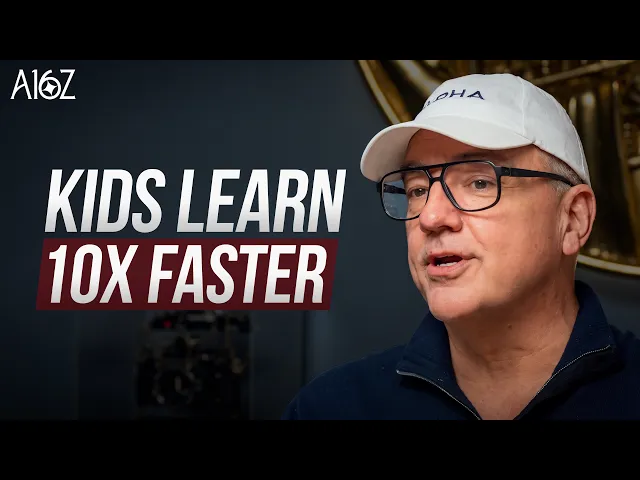
The AI School Kids Love More Than Vacation | Alpha School's Joe Liemandt: transcript
- a16z
- Published
- Added
- 56:00
- English
- auto-generated captions
AI summary
AI-generated from the transcript below. Check anything that matters against the video.
This a16z podcast episode features Joe Liemandt, principal of Alpha School, in conversation with Erik Torenberg and Gagan Biyani of the Horowitz and Andreessen Academy. Liemandt describes Alpha's redesign of the K-12 school day: students spend about two hours daily on core academics using an AI-driven learning engine that he says lets them learn roughly twice as much as a traditional six-hour day, with the rest of the day devoted to life skills such as leadership, teamwork, entrepreneurship, financial literacy, public speaking and grit, taught through group projects. He cites survey results where over 90 percent of students say they love school and about half would rather attend school than go on vacation. Alpha has grown from one campus in Austin to 50. The group discusses motivation, personalized lessons in the 80-85 percent correct zone, parent adoption, a 1910 tractor analogy for educational disruption, and Founder School, which guarantees students a million dollars of business profit or tuition back.
Key points
- Alpha students spend about two hours a day on core academics and the rest on life skills and projects.
- Liemandt says the AI learning engine lets kids learn twice as much in two hours as a traditional six-hour day plus homework.
- Over 90 percent of Alpha students report loving school; about 50 percent say they prefer school to vacation.
- Alpha grew from one Austin campus to 50 campuses, with demand described as very high.
- Life skills are grouped into five categories: leadership and teamwork, entrepreneurship and financial literacy, socialization, storytelling and public speaking, and grit.
- The learning engine targets an 80-85 percent correct zone, giving scaffolding when work is too hard and faster progression when too easy.
- Liemandt compares today's education shift to 1910, when the tractor pushed farming families to fund high schools.
- Founder School guarantees students will build a business earning a million dollars in profit during high school or get tuition back.
Chat with AI
Ask about this video. Answers come from its transcript, with links to the moments they use.
Free with a Google, Telegram or email account.
Sign in to chatTranscript
- 0:00
Are you willing to redesign your school day so kids love it more than vacation? With cognitive [music] science and learning science plus the advent of LLM's, you can build a learning engine that teaches kids [music] 10 times faster. >> The shift that I think you've been able to make is the believability of it. Pretty soon people are going to ask, why would we ever do it any other way? >> I [music] want this next generation to be the ones who are optimistically capable with AI and saying, we're going to build an awesome future. [music] That's what our job as educators are is to go build that world.
- 0:29
>> What would you say to the parent who's saying, [music] I'm sending my kid to Ivy League school. I know it's not perfect, but this is a new institution. Why should I take a risk? >> So, >> Joe, welcome to the podcast. >> Thank you very much. >> So, we've had the luxury of spending some time together this year and to touring the schools and what you've built with Alpha is just incredible and it's inspired us at HA. We're grateful to have your your involvement and for for people who are unfamiliar, what why don't you just briefly describe what you think of as this the central innovations or what what you've really brought to to the space with with Alpha?
- 1:04
>> Sure. So, we're reinventing how K-12 school is um uh you know, the the school day, right? How kids spend their six or seven hours that they're in class um uh or in a school building. What is that like? And sort of the the first part that you have to understand and buy into is that uh you know, instructional design and delivery hasn't changed for 100 years, right? You throw a teacher in front of the classroom and what's the right way to do this? And now, if you look, you know, over the last couple decades with cognitive science and learning science plus the advent of LLM's, you can build a learning engine that teaches kids 10 times faster. Right? And so, as soon as you have that ability where kids can learn 10 times faster than they could the last 100 years with the teacher in front of a classroom model, the question is, what do you do with it?
- 1:56
And so, that's what we're doing at Alpha, which is how do you reinvent the school day? And so, you know, in our model um you know, we make three commitments to the kids, which the first is they love school. Um and I just got the surveys back uh last week. 90-some percent of our kids say, "I love school." 50% of the kids at the school said, "I would rather go to school than go on vacation." I actually have one campus where it's at 65% of the kids are like, you know, uh I'd rather go to school than vacation. Um and so, you know, build a school where kids love it if you're going to be there for 12 years. But then the second part with this engine, what we do is the kids learn twice as much in 2 hours a day as sitting in class for six and doing homework. And so, you know, it's it's 2 hours a day, right, of the academics and they learn more, which, you know, if you're compounding and learning twice as much as you would at your other school, right, you're going to get to top 1%, you know, sort of no matter where you start given time.
- 2:54
And so, the kids crush it in all, you know, the best on standardized tests for the best academic performing school. And then the second and the sort of the third commitment is, "Well, what would you do the rest of the day?" And I think that's a whole thing of what we're talking about now, which is I believe now every school, it doesn't matter K-12, university, has to say if the traditional way and the traditional curriculum is now 10 times faster, well, what do you do with the rest of the day? And I as a principal, I can definitely tell you the one thing parents would hate is if I sent the kids home after 2 hours. Right? You got them all day. You six six seven hours a day, right? And the kids want to be there, right? And they love it and and you make it. So, it's what we do is it's what are all the life skills that we consider critical to thriving in the world that's coming, right? The world's changing, right? What do we do? And so, we have we have five categories uh of life skills, leadership and teamwork, entrepreneurship and financial literacy, socialization relationship building, storytelling public speaking,
- 3:53
grit, hard work. Right? And so then you're doing projects, you know, in a group with all your friends, with an adult, right? Who's Who's Who's writing them. And that's how you spend your afternoons, right? The rest of the day. And so we've, you know, so Alpha, you know, we started we had we were just in Austin, then you know, we had a 12 campuses last year, we're up to 50. You know, demand's insane that, you know, people want this this new thing. But I think it's, you know, we're we're sort of first. But everybody's going to have to look at this. That is, you know, today no one believes, oh does it two-hour work and we have to get scale and and more proof points. But once you realize, wow, kids could learn, you know, everything they need to in two hours.
- 4:33
>> Yeah. >> Every family, you know, every head of school, everybody, every, you know, education minister around the world's going to say, how do we rebuild the school day, right? For the next 100 years, cuz we don't need to do it like we did the last 100. >> Yeah, I I remember visiting Alpha six years ago. This is before you were full-time on it. And I immediately got it cuz I've been in learning science and sort of education for for 15 to 20 years. But I will say that the shift that I think you've been able to make is the believability of it. And I think you've done a great job of figuring out how to show that not only does this work, but pretty soon people are going to ask, why would we ever do it any other way? Um and that's really the brilliance of from a business standpoint what you've accomplished over the last five years, I think.
- 5:23
>> Yeah, I think I you know, I became principal four years ago and my background's product, right? And entrepreneurship. And this just needed sort of product packaging, right? >> Yeah. >> What is How do you productize this into something that is understandable and scalable, right? That's the other part is it's really hard to scale schools, how do you scale them in quality? And so that's for my first three years, right? It was is how how to do that. And that's actually one of the big benefits of, you know, bringing AI is it helps you scale at at high quality. Um you know, our phrase is we get better as we get bigger. And if you look at anything over the last 4 years, our test scores, customer sat, you know, employ student happiness, the quality of the workshops, all of those get better every year because the system gets better as it gets bigger.
- 6:10
>> Yeah. We have a number of, you know, teammates, colleagues, friends who send >> their kids to Alpha and just they Do you see the kids love it? What is it? And I remember, you know, hating my, you know, getting a total experience. What is Is it this 2-hour, you know, sort of arrangement? Is it like what is it that you find is most contributing to kids loving it that other schools should should be adopting it? And similarly, we were also talking off camera about how motivation is is underrated or or or maybe, you know, nearly like one of the biggest elements in terms of what is separating outcomes for kids. How How are you tackling that as well?
- 6:45
>> Yeah. I I think the biggest thing is, you know, edtech historically hasn't done well in in schools, you know, hasn't had the impact that people wanted. And if you look at this learning engine and say, "Oh, this is like edtech and I'm just going to put it into a normal school day," it'll fail. Right? It'll be just like everything else. And, you know, when I talk to somebody who hears about Alpha and they hear all this learning engine, I I have one question, and this is the core of everything, which is are you willing to redesign your school day so kids love it more than vacation?
- 7:15
And if you have a head of school who says that, right, then you're all set. Right? But that that leap, right? And that motivation falls under that, obviously, which is if you are waking up and saying, "How am I going to make kids love this?" >> Yeah. >> Right? That is the core of what allows us to do everything else. And people are worried, you know, when they hear that of "Oh, it's Disneyland and they're just running around and they're not learning or it's not rigorous or games or TV >> Yeah, all these things." And it's literally just the opposite, which is you know, one of the things we talk about is, you know, the key to your child's happiness is high standards.
- 7:48
Kids want to go do hard things, right? They love to do hard things, and they love to do hard things with their friends, right? If it was just playing video games all day, they can go do that at home, right? And but to sit there and say I want to do this instead of vacation, it's because they're doing challenging things with their friends that they love. >> Yeah. >> Um and it's and it's just it's not hard. Like an example, like an easy example is, you know, so like teamwork, right? And you know, uplifting your classmates as a as a team. You know, in traditional school they don't teach this, right? After school sports, absolutely in America, teamwork, leadership. But in schools they don't. Actually, most team projects in school, group projects are terrible.
- 8:24
One person does it, everybody else just sits around, right? You always remember those. They were terrible, right? And so you learn the opposite of teamwork. You learn like the anti-pattern. And you know, in our school actually, a good indication of that is, you know, the Wharton has an MBA challenge where they have a simulation that you take and it's go up Mount Everest. 50% of MBAs fail the teamwork because they never were taught teamwork sort of the whole, you know, stack through through school. We take every third grader, right? And we mic them up, and we throw them into an escape room, >> [laughter] >> right? And they're all getting through the escape room. And at the end of it, we have AI analyze the transcripts.
- 9:03
What percent of your language, right? Were you team oriented? Were you helping? Or were you And the answer I can I can give you is >> less than 20% of the language is uplifting. >> Fighting and pushing and my idea, right? All these different things. And so we have an 8-week, right? Our 8-week, you know, workshop for this. And they go through it, and they keep going back to the teamwork. And to graduate, right? To pass the class, they have to get up to 85%. >> Yeah.
- 9:29
>> Right? Of right? Team team behavior. And you know, we also show them that they finish the escape room three times faster, Yeah. Right? When you're doing team environment. And that's just a great fun way. Kids love it. It's a life skill that every parent's like, "Oh, that's the stuff I want my kids to learn." >> Yeah. >> And because they don't have to sit in class all day, they can do that. And then fourth and fifth grade, right? Our life skills curriculum is as rigorous as our >> Yeah. >> you know, core, you know, pass the physics test or math test is, you know, you have to get past, you know, the escape room test. You know, in fourth and fifth grade, we actually make them pass the Wharton MBA challenge. Like 50% of the MBAs can't. And you take a fourth and fifth grader and they pass it, right? That back to being proud and excited and wanting to do it. Right? You can engage them and teach these skills much younger. And I believe as we look at the world, you know, we haven't had the capability to teach kids, you know, all this at a much younger age um cuz you're sitting in class all day, but now that we can,
- 10:27
of course, you know, we must. >> Yeah. So so the reason they're they're enjoying it is cuz they can feel themselves learning faster, growing faster, building deeper relationships, and just overall, uh you know, that that's something you can't get on a vacation. >> Yeah. Well, and it's well, it's like that. Would you that escape room I it's it's a high bar for your parents. The second is to your point of what else kids you know, kids don't like school. A lot of kids Let's talk academics versus life skills. They're sort of two different different. On the academic side kids don't like to do things they fail at. That's true on academics, that's true on anything. It's why in America we hold kids back on sports, right? Cuz you want to give them their bigger, right?
- 11:05
Then all of a sudden they're playing better and they win and then they get the accolades and >> Yeah. >> Okay, right? And you get them on that path. And then academics in America, because we're a time-based system right? Once you fall behind right? Then it's just now it's torture the rest of the time, right? Wherever you fall behind, right? And it's just it's your end in our system because our learning engine will give you a personalized lesson >> Yeah. >> right? It doesn't matter what your age grade is. You can be in eighth grade and if you need a fifth grade lesson cuz whatever before you came to Alpha you missed it, it's going to give you the fifth grade lesson, right? And you're going to be able to do it and you're going to be able to get it you're going to be able to pass it and then move forward. And so, you know, we engineer wins for the kids in the academics that, you know, if you had to say the core value of what the engine does is, you know, for the kids you you basically want kids in this 80 to 85% correct zone, right? Like just what percent of the time if you're engaging
- 12:05
with something is it too easy or too hard? If it's 100% correct, it's too easy. You're not even learning anything. You're just regurgitating what you know. And any video game developer will tell you if you drop below two-thirds and you're failing more than two-thirds of the time, you're going to disengage. So, one of the things that, you know, a learning engine can do that a teacher in front of the classroom with 30 people can't do is make sure the kid gets an unending stream of lessons and questions that's 80 to 85% accurate. Right? And we can just do it and if it gets too hard, right? We can give them scaffolding lessons to catch up, right? Too easy, you progress them faster through the material. And if you keep kids engaged because you're giving them work they can do, right? Then they like that. And when kids actually do well, right? And you hold them to high standards, right? They get very excited, you know, and just they see themselves crushing their academics instead of struggling with it.
- 13:02
And when they're doing well, right? They Yeah, they love that. >> Gagan, I'm I'm I'm curious how you think about this conversation and what Alpha's doing, you know, in well, and how that informs what we're doing with with AJ. >> Incredibly inspired. I think that I've been inspired by Alpha schools since I first visited. And it proves, I think, the thesis that we have at the Horwitz and Andreessen Academy that if you redesign the system for the modern era with modern tools, that you can have everything that you want in terms of outcomes. You can have more network. A lot of people say you go to school for network, we're going to take your network and make it 10x better.
- 13:44
Everyone says you're going to go to school to become a better person. Like Horowitz and Andreessen Academy absolutely wants you to become a better person. And we're going to engineer the system so that you're more likely to become a positive sum human. You want to have high agency and you want to do hard things. Like Alpha has given me a lot of inspiration on how to ensure that students get that. I think the one difference is that at every age range, you have to do something very different. So if you actually listen to Joe talk, K8, high school, very different. When you go from high school to college era, very different. And so now all of a sudden you have to make the right changes. You can't just copy everything over. That is And so ultimately, if you have a student-centric mindset, you know, if you just told the leaders of any major university in the country that their number one job and no other job was to make sure that the students were like succeeding, I'm sure that there would be many great
- 14:43
schools in the United States. Um unfortunately, there aren't many. Uh because most university leaders are required to spend 90% of their time focus on all the adults around them and not enough on the students. And one of the things you see with Joe is he's always talking about the kids. >> Yeah. Joe, I'm curious, you've, you know, very generously gotten involved with the HJA as an investor and an advisor. What um what excited you about what what what we're up to and how have you thought about the differences between, you know, college and and high school?
- 15:14
>> So I'm I'm super excited because I absolutely believe that university needs to be reinvented just like we have in K-12, right? And so I'm focused on K-12, and I'm very excited uh that you guys jumped in and and said, "Let's do this." So, anything I could do to help I I I want it One, I need places for Alpha kids to go. >> Yeah. >> Right? There's, you know, there's going to be a whole set of kids who are like >> Can't wait. >> I want I want to go there. Um and uh you know, and so what what have we done, you know, what have we thought about? To your point, it's completely different, right? Each Each our high school's very different than our K-8. Um and I believe university needs to be different. And I don't believe the whole concept of, you know, is university, is everybody just going to come out of high school and not go to university anymore?
- 15:56
I actually don't think that's true. I believe there's huge opportunity to reinvent university and make it awesome. No one wants to go to a bad school, right? And where it's terrible and it's not getting the kids ready. You know, as an example, we got we had um uh we had uh over 70 MIT and Stanford kids and UT came to Alpha this summer um as interns. And part of what we were saying is that tell us about university, how's it going, you know, what do you think? And I was like, "How many of you guys expect that, you know, this university getting you ready, whatever one you're going to, is getting you ready for the world when you graduate?"
- 16:32
And one kid raised their Like it was just like I was like, "Seriously? Like none of you?" And they're like, "We're terrified. We do not feel, you know, we worked, you know, our 12 years really hard to get into these great universities, and now we're terrified that, you know, when it comes time to graduate, there's not going to be those jobs that you used to get coming out of it, you know, those first one and two-year jobs aren't aren't there, you know, and AI's going to be doing it, so what what do we do?" Um and so we they spent a lot of time this summer as interns, you know, coming up with what they thought, you know, would be um you know, reinvention of university and what they would want. Um and you know, and back to kids wanting to do hard things, right? You know, these they were interns and they came in and they came up, you know, we're going to build this educational LLM, you know, so we can make it free for everybody in the world cuz every sovereign is going to need its own, you know, uh LLM educational LLM small language
- 17:31
models, you know, so now small language model that sits on a on a device. >> Mhm. >> And those kids worked 80 hours a week, right? Figuring out, doing research, figuring out the concepts of learning right? They're going to be published, right? Um and you know, at the end of it they're like, this is what we would love university to be. We're all working together on the super hard thing, right? That has meaningful impact to the world, right? That could could really help change the world. Like, I wish these could be classes at, you know, >> Yeah.
- 17:59
>> MIT and Stanford and UT. Um but they're they're not. Right? And that's when I think about what you guys are doing of reinventing it and letting kids really build, right? It's not just about the classes, it's about getting ready for the real world and all those skills you need. I believe those are different at university, but I'm very excited about what you're you're building around that. >> Yeah, I think it's really important to uh understand that an average student who's going to university, who's really ambitious, they need to get their hands dirty.
- 18:34
Like, they are entering the real world in three to four years, and it's super critical for them to be going and building things and understanding what it's like and making mistakes and dealing with the challenges. And you know, I really loved that you said that they were studying as part of the 80 hours. So they they're in they're in Austin for an 80-hour week internship, and you mentioned studying. And I'm guessing you didn't assign any textbooks.
- 19:03
>> No, they and back to this, they had to go do all the research to build an LLM. So they literally are researching learning science, researching it, the you know, we have this data structure called the brain lift, you know, that they and they were working hard, right, on what would be considered classical, you know, stuff you need to do at a university, but it wasn't just the studying part. It was how do you apply it and be a builder, right? And I think your point of getting ready is is it's both. >> Well, you talk about learning as being 90% motivation. And when you're 18 years old, you're motivated by building things that people will use. You're motivated by revenue and getting a job and that kind of thing. And so why not make the entire learning experience uh driven by that motivation and using that motivation actually go and learn things? Cuz my my concern with college is I I mean, I know Eric and I had this experience, we've talked about it like I didn't learn very much because I did not like the format.
- 20:03
And to be honest, now I go to Stanford's campus or someone other someone else's campus, no one seems to like the format. So 20 years ago, I was a little bit in the minority, maybe 20% of students agreed with me. Um our classes were about half full, I would say in attendance. I hear they're now way under 10% full. You know, people are students are not finding the format to work. You need to reinvent the format in order to create motivation so they actually learn things. Um and that's one of the main focuses of the academy.
- 20:33
>> No, I think another example is, you know, our first graduating class from Alpha high was 3 years ago. And so at Christmas, after they'd all been, you know, at university, I you know, I got them together. I was like, "How's it going? Like, how do you do in real" cuz that's number right? How do you do in university after you come out? And they're like, "Okay, we love it." They all had 4.0s, they were crushing it. And but they were like, "These 100 series lecture classes are a complete waste of time." Five of them had written editorials to their school paper about how it's just a charade, how the kids come in are like scrolling TikTok or you know, on their computers not paying attention or not showing up. And the teachers are, you know, teaching and they're just like that those don't need to exist anymore, right? Now, I was like, "Well, what do you like?"
- 21:17
And they're like, "Oh, there's all these great small group seminars we're working on, you know, uh >> Clubs. >> clubs and and all the activities around it. The you know, a university is a bundle of products, right? And they liked, you know, the bundle, but the actual academic part of like these big lecture classes and stuff, they're like, "That needs to go away." >> Yeah. And what's crazy is that that academic part that you're talking about is the only thing the university formally uh provides. So, it's actually the the the rest of the bundle is student-driven.
- 21:48
Um and the academic stuff takes up about 50% of the time. Right? >> Well, so I just right I dropped out of Stanford, right? And I was this kid. >> Yeah. >> Which was it didn't take up 50% >> Fair. Me me neither, frankly. >> But if you go if you go to the classes, it takes what you said. But back to I my experience there and, you know, for the couple years I was there, it was great because of all the other things. The people I met, you know, Steve Jobs came down, right? Was giving a talk and one of my friends went and was working with NeXT and, you know, uh Bill Joy and Scott McNealy would come and and and talk and you'd go spend time with them afterward or have lunch. All of those experiences that you had of who you met and, you know, seeing the real world plus building stuff with my friends, right? Uh that eventually became our company. Right? That was what was great about the product to me and sitting in these lecture classes were, you know, uh the opposite of that.
- 22:42
>> Yeah. What what then we've talked about is how to make the students love it, but of course, you know, even more important uh consideration in terms of where where the kids go to schools is their parents. >> Yeah. >> And so, talk about how the conversations you're having with parents are evolving where it relates to, you know, early education or higher education and some of the advice that you give them. Great. So, you know, yeah, so I I talked to tens of thousands of parents now, you know, sort of in the K-12 >> Yeah. >> K-12 range. And I've been shocked actually at the at the switch, which is there's still some families who are like, you know, I'm a kindergarten parent and I I want to see the direct path right into the Ivy League. Um but an equal number, maybe even more, of parents who went to Stanford or Harvard who are like, "No, I know I don't want my kid on that path. How are you going to get them ready for a world that's not that?"
- 23:35
>> Yeah. >> Right? And they absolutely want to see this alternative path cuz when they look, especially even in kindergarten, they look forward 12 years from now and they're like, you know, "What am I going to do, you know, and how are you preparing my kid for the world?" And my their vision of the world is, "Yes, I went to the Ivy League, but that's not going to be for my kid. I don't think that's going to get him ready. And if you're telling me that, I don't I don't want your school I don't want your K-12 school." >> Yeah. >> we're that that's happening a lot now. Um and they're they're looking for what what are they? Cuz I I think there's recognition now, you know, versus maybe last 30 or 40 years, that the world is really changing, right? And, you know, if you're an 11th grader or 12th grader and I'm talking to you, the parents are sort of done. They're like, "Just get my kid into college, right?" Or, you know, they're sort of like, "I've I've been on this route and I'm at the five-yard line. I'm not throwing all the cards up in the air." But when you look younger, right, those parents are like, "There's just no way that the current path is
- 24:33
going to going to be the right one." And so when I think, you know, of of this, I would expect, and I don't know when you get your demand, you're going to have massive demand from all the kids, right, who are going to be like, "Okay, I have to go do this. It's so obvious. This is awesome." And then you will have to have a separate sales job, right, with the parents, right, to show them, "Look, while it wasn't the way you did it, right? This is the way. And, you know, um you know, there's there there there's a historical precedent for this that, um you know, might be useful for you, right? If If you want to go through it, which is, you know, in 1910, you know, 90% of America had an eighth grade education.
- 25:14
Um there was no high schools basically, right? And over 30% of America is a farmer, right? And so, everybody's on the farm, eighth grade was enough. You're working the fields, right? And not high school. And then, um in 1910, the tractor, Case tractor, rolled up on the American farm, right? And literally, you can go look at the ads, it literally looks like an anthropic ad, you know, does the work of 50 programmers, does the work of 50 farm hands. And literally, everybody in America realized 30% of the jobs are going away, right? My kids and grandkids, we've been doing this for generations, it's gone.
- 25:49
That path is gone. And we have to get our kids ready for this new future. >> Yeah. >> Um and it was that same recognition, I think, that parents have today. The the traditional path is those jobs, it's like the 100 the kids coming in this summer, where they're like, I'm going to get out of Stanford MIT, I'm not going to have a job, right? And um but what America did back then is 130,000 towns, right? We used to have a it was it was um they voted to actually raise their taxes. And this is the key part, fund an education that they'd never experienced. They'd never seen a high school curriculum. They'd never been to high school, right? They had an eighth grade education, but they knew they had to do something different than their background, right? They had to see the world differently to get their kids ready, right? And get them the good jobs, which back then, that school system became the industrial system we've had the last 100 years. It It served us really well for 100 years, but now it's time for the next change. And you're going to have to convince the
- 26:48
families to be like those 1910, you know, uh rural farmers who realized while I haven't experienced and it's different than what I did, this is what my kid needs to thrive in the future. >> Yeah, and and what would you say to the parent who's saying, you know, "Hey, I I'm sending my kid to Ivy League school. I know it's not perfect, but this is a new institution. You know, why why should I take a risk? Why why would you consider taking a risk on uh the academy?"
- 27:21
>> Yeah. Um so I've been living this actually at the K-12 level now for 4 years. >> Yes. >> And it it is one where, you know, back to the lucky part is you don't need everybody, right? It's there's going to be that set and when we would talk when I talk to families, you know, it's there's a, you know, it's an adoption curve just like any other one and there's a set of families who absolutely realize the current system's just not there, right? Or the people who sit there and say, "I feel it, but I just need to be, you know, moved over."
- 27:54
>> Mhm. >> Um you know, the number, you know, I both my daughters, right? You know, we're told they're not going to get into college, you know, when they were in eighth grade, you know, if they went to Alpha and they had to go to a traditional school, right? And there was just no chance that, you know, uh that would occur. And so you're there there is that, you know, dichotomy, but for parents, you know, if you look, you know, sort of across the families who went to Alpha 4 years ago, right? And the ones who didn't, you know, went to Alpha high versus not, there's a lot of more families who are like, "I totally should have sent my kid to Alpha, right?
- 28:32
That I went the traditional path, right? I thought it was the safe path and it totally wasn't. And look at how those Alpha kids are thriving and I thought those guys were crazy and risky, but now looking looking at the reality of what happened with my kid who didn't go to Alpha versus those, they regret it. And you know, I believe that you have to get through the first year because you don't have any data, but one year in people are going to see that the students are thriving, right? And once you see that, then you that's the comparison. And I'll even go back to my own experience on this, which is I sort of I'm talking very positive and optimistic, but I I didn't start Alpha 12 years ago, right? McKinsey Price and and Brian did. And you know, I had my I went to Catholic school, my kids were in Catholic school. I didn't like it, but you know, parents want their kids educated the way they are. That's the legacy, that's the problem, right? That's what we have you have to overcome. And so my kids are in Catholic school. And now you know, and and McKinsey's like, "Well, come to my
- 29:31
new school." Right? And I I dropped out of college. Like I I started a startup in a garage. And I'm like, "Schools shouldn't be in a garage. Like it's so weird, right? You have a janky weird school, McKinsey." And I was totally right. I was right. And then it took two years for me. So I was the slow I right? It took me two years to move over. Um and and then finally that was 10 years ago and it you know, obviously turned out great for you know, our family. But I look at that and my my kids still yell at me for being slow those two years, right? They're like, "You should have started earlier, Dad." Um but that concept of you know, finding those families. And so we travel all around the country, right? We've opened 50 campuses, you know, and you get you know, a thousand people in the info session and you're like, "Who wants to be the first 10? Who wants to be the first 25 or 50?"
- 30:21
Right? And a year ago when we were opening the 12 campuses, literally thousand plus people in info sessions. And we couldn't get 25. Right? We would get you know, 10, right? We opened New York City with you know, 10 or 12. And now the campus is full. Right? 150, you know, total people. And you know, they had to go see the first ones that it works and then it's there. So, your first the first class is always those people who are like, "I know it's bad. I want to jump in." What you will see immediately and sort of what we're seeing on the demand is people just need someone to go first.
- 30:58
And you once you get that first and it works, the the demand just skyrockets. >> And the benefits of being first are are high. We you know, what I see in colleagues and friends are sending their kids to Alfalab or even you know, friends who've done something like the Teal Fellowship, um, which is also small application numbers in the beginning is those people who are applying early are of the courage of their conviction. It's positive self-selection. And so, you're around some of the most brilliant people, some of the most courageous people both on the kid level and the parent level. And uh, it's really just a phenomenal experience.
- 31:29
>> And I that is back to advice, audit. You absolutely want the families who are both side, right? All in. It is. There will be hiccups, right? There's just there's hiccups that happen. >> And for sure. >> And you know, it's just it's part of it when you're starting. And someone who's super skeptical and on the you know, the late adopter side, they're just going to not right there it's going to destroy them, right? Cuz they won't be able to handle it. The people who are over here who really want the product, right? We talk about magnet marketing. You want to attract the right people and repel the wrong. And people who want to be laggards. I don't like AI or screen time.
- 32:04
You know, that's a set of people in the infant position say that. I'm like, I you shouldn't come. I I you know, if you can't balance, right? What this offering is. It's being clear on your product definition is a a thing that I don't think most schools do. But if you're clear on your product definition, this is what we are, this is what we're not, it helps you find those right group and exactly what you talked about. When the right group's together, right? Cuz part of it's community, right? You're building the community there, all the kids who are there. And the parent community does matter when you're doing startup. Our founding families are one of our biggest assets now. yeah. Um, you know, uh, at our school and I believe it'll be the same for for what you're doing.
- 32:40
>> Yeah. Yeah, I think that that makes me think of two things. One is I think we're going to be pretty like strict about who gets in and less about class size. You've told me this, I've heard this. I think that's a very important lesson. The second lesson I think is that um this is the type of thing where you don't want most people to want it. You want the people who really want it to do it. Um >> [snorts] >> and then I'll actually I'll add one more thing, which is we did make it one year and it's not no tuition the first year.
- 33:15
So, it is also a little bit less risky than you know, you're missing eighth grade. And you can't repeat, you know, you don't want to miss eighth grade. But if you take one year detour from college, you can always go back. It's it's really no different. So, I do think that's one of the things we have the benefit. It's one of It's interesting to see the nuances of a college experience versus a high school experience cuz the stakes are different in different directions. >> I believe that is going to be one of your assets with the parents on the one year is there there's no downside, right?
- 33:47
There's no downside to trying it, right? And you can always defer at some other college or reapply and so you're not you're not, you know, shutting down other options. And you know, and just to the parent stuff, what you'll see is you know, when your kid loves it. Back to school is being 90% motivation. I I I just I you know, if I was talking to the parents here, they were their kid really wants to go. I just give you advice for all the stuff is just let them go do it, right? Let's even just say it doesn't work out for him, right? And whatever and stuff.
- 34:19
It'll be the best learning experience of their life, right? And they'll be right ready to do the other. And fighting that the other way it just is is a >> as riskier in the sense that >> No, it's it's much riskier and and we can go to a lot of stories I have of those at our high school level. >> Well, I I think that's actually if you if you think about the three of us and we're we're there are actually like many people we all know who are like us who didn't love school at some point. And what is the thing that that we disliked the most? And for me it was that I was being forced to do things that I was not bought into.
- 34:54
Like my agency had started to grow 13, 14, 15 years old and I started to you know see the emperor and I started to to believe like wait a second my teacher doesn't actually [clears throat] know how to teach math. Like this might not be the best way to teach math. Oh shoot. So I got to take this stupid test now, you know, and um and so I think that one of the pedagogical philosophies of the academy and of Alpha is that you design it around the student to increase the chance that you or to decrease the chance that you get that rebellion.
- 35:32
And instead if you have buy-in, they're much more likely to thrive and do things. And so you know >> No, and I think that's all and I'll tell the personal story on this which is you know, I during my K-12 I was always in trouble, right? I was skipping school all the time. I did the minimum to get into Stanford, you know, and then I dropped out, right? And when I dropped out my dad had a famous quote that was like on Forbes or whatever, you know, my son's a You know, [laughter] and you know, and it sort of and uh he was not happy and um you know, but then the part that didn't get in the article was you know, a couple years later. So I dropped out and then I started, you know, my company and it was awesome and then all of a sudden I'm working 100 hours a week and I'm sleeping under the desks and it's just you know, it's crazy crazy crazy and you know, two years later he's like, you know, I I got to change my mind. This was the greatest thing ever that you dropped out. He's like he's like, you know, I I have to admit, you know, I was really worried that you were going to be
- 36:30
a lazy little shit." You know, and cuz that's the was your academic career, right? And he was like, "As a dad, you know, I was just terrified that I had, you know, done poorly." And he's like, "Now I see that now that you're doing what you love, right? And you're fully engaged, golly, I should have, you know, gotten this done earlier." And I think that's the same thing. When you have a student, like when we talk about building a school they love more than vacation, you're engaging around stuff they love, right? And when you do that, that's what causes Well, all the parents who say my kid changed in a month, it's because we have them doing hard things that they want to do, right? And all of a sudden it does change, and it's that quick, right? And and having a a school where your kid wants to go to it because they're going to be doing hard things, right? Is, you know, is as as is it's a great thing, and I believe that's why, one of the reasons why I think this could be a home run, because you're going to get all these kids, right? Who are like, "I know it's hard. I want to go do this. I can coast through normal school, and I'm not going to pick that
- 37:30
path. Instead, I'm going to pick this." And this is going to be harder than all their schools, right? And what you're doing in all of those. And and that's the, you know, that's part of it. And and kids love it, you know, we have we have in our high school we have a world school where they're spending a year in Africa, a year of service. And they have to sign a contract that said, "I realize this will be the hardest year of my life." Right? And they all sign it, and they all love it, and they're super excited to go, right? And I believe this is sort of the equivalent uh of that. >> By the way, one note, I've spent a fair amount of time in Africa. I would send some kids to India or Sri Lanka. It's going to be much harder.
- 38:02
>> [laughter] >> There we go. Okay, well, that'll that'll be on the list. That'll be It's called world school, so they're going to be going going everywhere, but I love that. >> I I um I think Africa that's such an amazing thing that you're doing. One of our wishes that we've talked about, we we have a stipend. We don't talk about this too much, but we we've already allocated $5,000 per student to uh for a travel budget. And my personal goal and now they get to decide how they use the travel budget. I'm not going to force anything on anyone, but my personal goal is that a lot of them go solo to countries with less than $20,000 GDP per capita.
- 38:36
>> That's a great idea. Just to give you some perspective. No, I totally I think that is that's super valuable. >> Yeah, you you learn so much about yourself and about life and I think that it also will provide perspective that will help in business, of course. >> Yeah, no totally. You know, it's so funny going back to this idea of you know, kids who are you know, you mentioned your parents. It reminds me of kids like us when when we were younger and and others who are quote unquote lazy in school and that they you know, don't get 4.0 cuz they're just not bought in, but when when they find the thing, they're willing to put 100-hour weeks.
- 39:08
Um there's so many people like that and conversely there are people on the other side who will get straight A's, but once you take away the structure, they haven't really cultivated this inner desire or this ability to find what they love and when they get to work in the world in in which the skill is just remarkably different, they they can't they can't operate in in the same way and um yeah, it just strikes me that we're going to just create the space and you're you're creating the space you know, from much earlier age where people really get to get in touch with what they care about, be much more self-driven and um yeah, it's just really powerful.
- 39:37
>> Yeah. No, that you know, the correct that the those are What are all the life skills? That's what we talk about a holistic person. It's not just what their GPA was and and you can you can max, you know, uh score max on on just your grades, but that is not something that means you do well in the real world and I think parents actually realize that. You know, they need to be more well-rounded. They just don't have a path of of doing it and I believe that one of the things back to reinventing university, you're going to show them here's all these things that should be part of the university curriculum, not a club after after that the kids, you know, optionally do. Um and so I think that's going to be a great a great thing. I I think employers obviously would realize the same thing.
- 40:23
>> Yeah, I The employers seem very bought in, honestly. >> that part's That part of the whole thing is there's no there's no there's no problem on that pitch, which is right. The number of employers are like these kids coming out, right, don't have the skills and capability to do it. And it is that, you know, they uh well, if you had just taken me, you know, before I actually started my company, a video had looked at me and said, you know, are are you ready for a job? I wasn't. But then, you know, 2 years later after I was doing this outside project, right, this, you know, non non academic project, then I'm like, all right, I'm probably a pretty good employee to hire.
- 40:59
>> Yeah, yeah, it's funny actually because the issue that most employers have is not one of a skills gap in the like, do you know how to code or build products or design. It's I mean, what we hear more than anything is uh people skills, maturity, and systems thinking. You know, those things are the the actual skills. So, the only way to learn those things is to actually just interact with lots of people, have to build complex systems, >> Yeah.
- 41:29
>> right? Um and uh being able to forcing yourself to deal with the reality of rejection and sort of uh the maturation process of not having things structured for you, but having to structure them yourself. >> Yeah. No, those uh it's back to AI commoditizing intelligence, right? And scoring on this when you can ask it, you're like, well, what is what are the human traits you want, right? And it is it's leadership, right? It's team being able to work in a team, it's agency, right? It's ownership, it's receive feedback, as you say. All of those skills, right? Um uh that you have to have that you can get from doing projects, yeah, but you don't get from sitting in class.
- 42:10
>> Yeah. Yeah, know, a lot of questions about what is AI doing to coding, what is AI doing to math, you know, what's going to do to to physics. If if you were, you know, knowing what you know now, but if you were 18 years old today with with with your interests, how would you think about, you know, if you had the flexibility at something like HAA to kind of design your own education, how would you think about what you would be motivated to learn based on what where you see the world going and your own interests? >> Yeah, so I I sort of have this this this framework, right? And um of, you know, low there's sort of cognitive overload, right? And AI allows you to fill your head with knowledge 10 times faster, yeah, right? So, these these kids can can become domain experts in their field that they want to faster than ever, right? I mean, I I have kids in my high school who are rebuilding the time back software stack that I wrote, right? [snorts] And they're becoming experts in learning science and and and being able to do this, right?
- 43:04
Which wasn't able to be done before in high school. So, the cognitive overload part because 10 times faster you do it and it doesn't take that long, yeah, right? And so, I can get the equivalent of a master's, you know, while I'm you know, in a year, right? And, you know, do that part. But then the second part is the AI gives you a chance to be a builder, right? It gives you superpowers to build like no one else, right? And I believe that's the kids who are going to be at your university is they're going to realize, I want to build something and I'm going to learn faster than I ever have, whatever pre-req, just like those the the interns this summer were doing it, right? They were doing research, right? Learning all this stuff that they were doing it doing it to build. And I believe just, you know, if you talk to our high school kids at Alpha High, they're definitely not doomers about like AI in the future.
- 43:49
They're like, you adults are cooked, like, we're coming for you and we have superpowers, >> Yeah. >> right? And they do. Like, that is these kids who are No, these kids who are building like these apps, I'm like, you know, my you know, I'm like, two years from now, I absolutely expect most learning software is going to be written by students. You're Most students are going to learn from learning software written by their peers. Right? Because it'll embed all the learning science concepts, all these things, and they will make it more much more engaging.
- 44:20
>> Yeah. >> Right? And we have plenty of data around that already. You know, shout out to Austin who built our AP curriculum, and he built this crazy great curriculum, and all our kids who took it got a five on their APs. You know, and he built a world history one. But he did it cuz he built this geoguessing game where he took all these world history events and, you know, and did an S-tier ranking with a snarky AI. Anyway, all these things that I I'm throwing those words out cuz I don't actually know what he really, you know, what they mean, but every kid was like engaged and loved it and did it. And I'm like, okay, me and the old adult team are never going to be able to build that ever, you know? And so I think that's that's what these kids are going to be able to do is they're going to go build the future.
- 45:00
Right? And AI [clears throat] gives them the capability to build the future and start freshman year of college. >> Yeah. Um just to take a stab at your question, Eric, you know, I think the question of what field should I study so that I can be sure that I'm resilient to the future is is not the right question. So, the question is what field am I interested in? >> Yeah. >> And I think there's enough I have enough faith that if you're AI-native in any field, it does not matter. You know, a lot of people are concerned about coding or math.
- 45:33
Look, there's going to be a whole new type of coding and math that happens with the AI-native mathematicians. It's just that the old school ones who are still doing chalkboard and pen pencil and paper are cooked. But the new students who love math, they're going to do just fine. In fact, they're going to go and do things none of us ever thought possible. And so there's going to be a whole new era of mathematicians are going to be successful. So, I think And that's actually, by the way, something that we we were trying to screen for a lot at HAA, um, which is that we really don't want someone who's like, "I want to make sure I'm resilient to the future."
- 46:13
It's uh it's a very uh defensive way of approaching the world and we want you to be on offense. We want you to say, "What are you interested in? I'm going to go figure it out." You know, as an example, I work in education. Education has not been the most lucrative founder field of the last 15, 20 years, right? Like it just so happens that I built one of like four wins in education in the last 15 years, right? Like literally >> a terrible market. >> Yeah, it's it's been historically a terrible market. We're going to change that.
- 46:44
>> We absolutely are changing it. >> Um, but I'm still super happy and proud that this is what I work on and I still get to you know, I still feel like I know how to operate at the level and quality of someone who's doing something in AI or doing something in SAS or whatever. I've chosen a field, I love it. I have a very healthy and fulfilling life. I'm not a billionaire, but I'm I'm doing well and you know, I think anyone who gets to that level in any field, if they're in the top 1% of their field, it's it's going to be fine.
- 47:15
>> Yeah. And I love what you said, which is I I actually believe very much what we have to do with with, you know, back to raising kids, right? And building high character, you know, kids uh for the future. Your point of they're not This isn't passive, right? This back to what is going to happen to the world and it's going to be imposed on me. It's like, "No, we're going to go make the world, right?" These kids are the ones who are creating it, right? And you can you can have the passive view of what happens, right? And oops, it's going to be bad or you can be the other, which is, "No, I'm building it, right?" And we need to create a generation of builders who look at this optimistically, right?
- 47:56
All our kids read Rational Optimist, right? And they sit there and say, "Yes, I'm in control of it, right? And we need to build our future." Um and we need to raise the next generation and have our kids coming out of university, sort of you know, as they they I look at the world and I'm like, "I want this next generation coming out of university to be the ones who are optimistically capable with AI and saying, 'We're going to build an awesome future.'" Right? That's what our job as educators are is to go build that world.
- 48:27
Um and uh make sure that our universities do that. >> Uh Joe, this was amazing conversation. I think the last thing that I'm thinking about is you're actually building an entrepreneurial school, right? For high school students called Founder School. Can you tell us a little bit about why you built it, how it how it works, and and why you think it's a good model for us to be inspired by? >> Sure. I mean, I back to skills, you know, one of our our life skill stack is entrepreneurship and financial literacy.
- 48:56
You know, we actually have a very strong point of view of when we look at the jobs of the future, you know, big Fortune 500 comps are going to be smaller, you know, because of AI, but I believe it's going to be lead to an explosion of entrepreneurship, right? AI gives entrepreneurs this great opportunity, and it's something we just don't teach, right? We just don't teach kids this. So, we we teach it. We have a stack starting in kindergarten, right? We literally teach every kindergartner, you know, how to earn, and save, spend, invest, donate, right? Get a get that foundational going, right? We have a currency called alphas to to start teaching them this. Um but back to it's a entrepreneurship is not, you know, a bolt of lightning and it just happens.
- 49:35
It's a set of skills, right? That you can teach people. And so, uh you know, we teach them, but by the time you get to high school, we have a high school founders, uh which is sort of our peak specialized school for that. This is for kids who want to spend their high school building businesses. Um you know, the part that's crazy that parents don't believe, you know, is we you we guarantee that you'll start a business that will earn a million dollars of profit while you're in high school or we give you all your tuition back. >> Huh.
- 50:05
>> Right? That we absolutely believe that these are skills that can be taught, right? Repeatably and reliably where I actually can build a business on that. And, you know, so it actually opened in August. We actually have from Alpha high kids, right? People who've been able to build businesses over the last four years. So, we have data points, but this is now a specialized school for that. And, you know, we it's scaffolded. You know, they come in and they have to earn $100 and there's a set of skills they have to learn, then $1,000, then $10,000, $100,000 and and a million dollars. And, you know, we're only a couple months in, you know, to where the process is and kids are speed running it. And we're like, "Okay, they're going to earn a million dollars in the first year." Like, I'm out of here. I'm going to kill >> in their freshman. Right? And I'm like, "Okay, well, you know, and the the the kids are like, "Okay, well, I'm going to then obviously just do a bigger one after that." But, that concept of can they do this, you know, can you build it?
- 51:00
And I believe a lot of it is just, you know, there's a set of skills around it. Um, there's also the the relationships and networking, right? And I think that's, you know, one of the things that uh I believe that you guys are bringing at the university level that we're trying to bring even down to high school level is just is is um networking, relationship building. You know, on the networking side, a lot of it for kids, you know, I always thought a lot of the magic of Stanford was you had all these luminaries come and then you'd meet them.
- 51:32
And you'd be like, "Oh, this is like a normal human." >> Right? >> Yeah. I mean, they're obviously really impressive, but they're just like a normal human and it makes it accessible to you be able to say, "Well, I can do that, too." >> Yeah. >> Right? Especially when you're young and dumb and super arrogant. You're like, "Oh, I could do that." Right? [laughter] And that is that is part of it. And, you know, we're doing the same thing here at the high school level where they're able to build up relationships. You know, actually one of the stories is what for 14-year-olds cold called Jensen. Right? Literally, and you know, he was having a cold call thing, and he literally called him. And, you know, and uh Jensen returned the call.
- 52:07
>> [snorts] >> And uh you know, realized it's a kid, you know, gave him 90 seconds, right? For his pitch. And then he end gave him like really good feedback. Which basically, if I had to summarize, was, "You know all these qualification questions you're asking me, you could have done research or asked other people in my organization about it, and you just used your bullet with me. And you should have done your prep work, and it would have been much better, right? Instead of wasting it by calling me. So, you know, kudos for, you know, aggressiveness, but mm you get an F on on call prep. Yeah. Okay, that call Okay, that kid, right? He's tweeting about it, right? Everybody in the school It's like the best learning lesson in that kid's life. And, you know, the the the you know, adults, right? Successful adults are wanting to invest in the next generation. And um I believe that kind of of networking and relationship building that they're going to get um uh at HA is just going to be
- 53:06
awesome awesome and more valuable and what normal universities traditional universities don't do. >> Yeah, it's something that, you know, Eric is is a true expert at, if I may say so myself. And uh you and have helped us galvanize this really large network of amazing people from all disciplines um to come and help the the uh HA students like succeed. And I think it's really cool what you're doing with Founder School as well, because I actually know a bunch of people who are speakers or coming in and investing time at Founder School. And it's just completely invaluable for a student who's in high school or college level to have the opportunity to get access to that.
- 53:48
>> Yeah. No, that is that back to for me that's always that's the most valuable thing and you guys are putting it intentionally at the center of what you guys do and I that's really important. >> Max Levchin was in this chair a few weeks ago and he was talking about how hey, you know, he was inspired to think so big and so ambitiously because he you know, worked with Elon, he worked with Reid Hoffman, with David Sacks and >> he saw that they you know, sort of went through the ups and downs. They were just like him. Um and yeah, hopefully us having, you know, Jensen and Sam Altman and you know, Satya and all all these legends come and share war stories with the kids, share share their ups and downs will also yeah, elevate their ambitions as well.
- 54:28
>> It does and that the point he also made which is your ambition is set you know, when for kids >> Yeah. >> somebody has to you know, there's um I think it was Tyler Cowen who's like the number one thing a teacher >> can do >> is raise a student's ambition for themselves. Right? We try to live that at Alpha >> Absolutely. >> and I believe that's very much when you sit here is that it's intentionally in your guys' design >> Yeah. >> of the people you're getting, the culture you're building that you're going to be raising their ambition for what they can do in life and I think that's just so important.
- 54:59
>> Yeah. Well, lastly I'll say from my end, you know, we've been talking about some major differences between you sort of K-12 and and college but one similarity is that you know, you mentioned 1910 in the last 100 years there hasn't been a ton of disruption in the model. There hasn't been a ton of major new entrants only on the on the on the college side and what you guys are doing uh in K-12 and and and college and we're all doing is elevating the ambition of what's possible in in education and you guys are are are pioneers of the work that you've been doing uh the last few years and and and decade plus so so I'm inspired to to be part of your respective journeys and yeah, thank you.
- 55:33
>> Well, kids are kids are awesome. They can do way more than all of us expect and I believe that coming out of yours, you're going to just raise that to the next level. >> Proud to do this with y'all. >> Yeah, it's Radio Tent On. Thank you.
Questions
AI-generated, and answered only from the transcript.
How much time do Alpha students spend on core academics each day?
About two hours a day. Liemandt says students learn twice as much in those two hours as they would sitting in class for six hours plus homework.
What do Alpha students do with the rest of the school day?
They work on life skills through group projects with an adult. The five categories are leadership and teamwork, entrepreneurship and financial literacy, socialization and relationship building, storytelling and public speaking, and grit.
What percentage of Alpha students say they love school?
Liemandt says 90-some percent of students report loving school. About 50 percent say they would rather go to school than go on vacation, and one campus is at 65 percent.
How does the learning engine keep students engaged?
It aims to keep students in an 80-85 percent correct zone. If work is too hard it provides scaffolding lessons, and if it is too easy it moves students faster through the material.
What is Founder School?
It is Alpha's specialized high school for students who want to build businesses. Liemandt says it guarantees students will start a business earning a million dollars in profit during high school or they get their tuition back.
Why does Liemandt compare the current moment to 1910?
He says the tractor pushed many farming families to fund high schools they had never experienced. He argues parents today similarly need to prepare kids for a changed world rather than repeat their own path.
Related transcripts
Inside the “Play Labs” Helping Refugee Kids Heal | Erum Mariam | TED
In this TED talk, educational leader Erum Mariam describes how her team at BRAC created "Humanitarian Play Labs" for Rohingya refugee…
Résume de la 1ere phase PIE خلاصة أربع حصص لأولى لبرنامج ريادة لأعمال
يسجل هذا الفيديو خلاصة أربع حصص من المرحلة الأولى لبرنامج «PIE» (برنامج ريادة الأعمال)، وهو مشروع تعليمي يهدف إلى تكوين الشباب في مجال ريادة…
[BIO] Endogamia e Deriva Genética
A aula 6 da disciplina de Evolução, com a professora Luciana Machado, trata de dois fatores evolutivos que desviam as populações do…
1 ноября 2026 г.
This is session 15 of a university course called Disruptive Technologies for Innovation and Change, taught by Sofia Tokareva, and it focuses…
Is the Electoral College Broken?: Crash Course US Government #5
This Crash Course episode examines the Electoral College, the group of people who actually cast votes for president. It traces the system to…
The Joy of Foraging Your Own Food | Alexis Nikole Nelson | TED
This TED Membership conversation features curator Whitney Pennington Rodgers interviewing Alexis Nikole Nelson, a forager, cook, outdoor…


Latest transcripts
The Work of the Co Creator: Visualization II - Hugh McCague
In this RosicrucianTV presentation, Hugh McCague continues a series on mental creation or visualization as a central Rosicrucian exercise…
The Work of the Co-Creator - Visualization - Hugh McCague
This RosicrucianTV presentation by Hugh McCague explores visualization, or mental creation, as one of the central Rosicrucian exercises for…
Rosicrucian Exercises: A Foundation for Daily Living VI - Hugh McCague
In this sixth installment of the Rosicrucian Exercises series, Hugh McCague of the Rosicrucian Order, AMORC, guides viewers through an…
Rosicrucian Exercises: A Foundation for Daily Living V - Hugh McCague
This video is the fifth installment in a Rosicrucian Order AMORC series on Rosicrucian exercises as a foundation for daily living, presented…
Rosicrucian Exercises: A Foundation for Daily Living IV - Hugh McCague
In this RosicrucianTV session, Hugh McCague guides viewers through a series of Rosicrucian exercises as a foundation for daily living. He…
Rosicrucian Exercises: A Foundation for Daily Living III - Hugh McCague
This RosicrucianTV video, presented by Hugh McCague, is the third installment in a series on Rosicrucian exercises as a foundation for daily…


