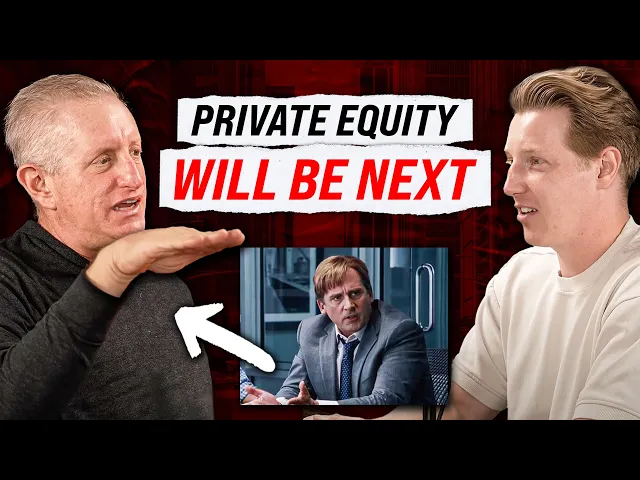
The Next "Big Short" Moment (Steve Eisman Interview): transcript
- New Money
- Added
- 1:13:07
- English
- auto-generated captions
AI summary
AI-generated from the transcript below. Check anything that matters against the video.
This New Money interview features Steve Eisman, the investor made famous by The Big Short, explaining how he anticipated the 2008 financial crisis. Eisman describes covering the first generation of subprime lenders at Oppenheimer in the 1990s, watching that industry collapse in 1998, then recognizing the same people running a second generation of lenders in 2002. He explains how the industry grew from roughly 50-60 billion dollars in annual originations to 600 billion by 2006, which required loosening underwriting standards to the point of 'can you breathe.' He details how he used Moody's and S&P credit databases to spot rising delinquencies, describes teaser-rate loans that trapped borrowers in endless refinancing, and explains credit default swaps as insurance he bought without owning the underlying mortgages. He also discusses ratings agency incentives, the failure of due diligence firm Clayton Mortgage reports to trigger action, the bailout, and why almost no one went to jail. Later he covers his post-crisis career, his podcast, passive investing, US debt, Bitcoin, Tesla, Canadian banks and private equity risk.
Key points
- Eisman covered the first generation of subprime lenders at Oppenheimer; the industry blew up in 1998 and most companies went bankrupt.
- In 2002 he saw the same people running a second generation of subprime lenders and expected the same three-act play to repeat.
- Subprime origination volume grew from roughly 50-60 billion dollars a year to 600 billion by 2006, forcing underwriting standards to collapse.
- He bought access to Moody's and S&P credit databases and tracked rising 30-day delinquencies across securitizations as an early warning sign.
- Typical subprime loans had two-year teaser rates around 3% before resetting to about 9%, with lenders refinancing borrowers repeatedly for new fees.
- He bought credit default swaps on subprime securitizations without owning the underlying mortgages, effectively a naked bet they would fail.
- Ratings agencies were paid three to four times more for rating securitizations than plain corporate debt, creating an incentive to keep the game going.
- He says the banking system is safer since Dodd-Frank, but sees unknown risk in private equity lending outside the banks.
Chat with AI
Ask about this video. Answers come from its transcript, with links to the moments they use.
Free with a Google, Telegram or email account.
Sign in to chatTranscript
- 0:00
Hey, there's a bubble. It's time to call Iconic levels of dynastic wealth are going to be created. He was one of the investors who shorted the housing bubble before it crashed more than 10 years ago. And Steve Eisman, he is host of the Real Eisman Playbook podcast. Mortgage defaults have gone through the roof. Is anybody jumping off the buildings yet? [Music] People thought I was a raving lunatic only because I was a raving lunatic. Have you ever felt this way before? [Applause] Zero.
- 0:30
There is a 0% chance that your subprime losses will stop at 5%. As early as 2002, I said to myself, I've seen this play. It's three acts. Act three is a tragedy. It's the same people. It's going to happen again. Wall Street took a good idea, turned it into an atomic bomb of fraud and stupidity that's on its way to decimating the world economy.
- 1:01
So we doubled the size of the portfolio again. And then what happened was by the summer of '07 a complete fall apart. I have a very different view than most people. >> yeah. Hit us. So, we're talking about The Big Short. The movie starts um with a quote saying, "In the end, Louis Ranieri's mortgage-backed security mutated into a monstrosity that collapsed the whole world economy and none of the experts or leaders or talking heads saw it coming. And while the whole world was having a big old party, a few outsiders and weirdos saw it coming." These outsiders saw the giant lie at the heart of the economy and they saw it by doing something that the rest of the suckers never thought to do. They looked. So my question to you is, how did you first encounter the possibility that there was something going wrong in uh the American housing market? So look, everybody's a product of their own history. I I have a sort of a weird history relative to the subprime uh mortgage industry, which is kind of unique.
- 2:00
So I I was a sell-side analyst at a firm called Oppenheimer in the 1990s. I covered a crazy amount of stocks. I covered investment banks, asset managers, Fannie Mae, Freddie Mac, Sallie Mae, credit card companies, subprime mortgage companies, subprime auto companies. At one point I think I was covering 60 stocks. Wow. >> the sell-side as an opportunity for me just to learn. So, I was covering what you would call the first generation of subprime mortgage companies. Right.
- 2:30
>> Companies like back then there was a famous one called The Money Store, which people in the United States would know about. But this was like a cottage industry. I I don't think the subprime mortgage industry originated more than 50 to 60 billion dollars worth of volume a year. So there I was covering this industry and then 1998 comes around. And in the office sitting across from me at Oppenheimer at the time was Henry Blodget. He was the the first great internet analyst. And he was getting on the op And eventually he went to work for Merrill Lynch. And he got he would get on the Oppenheimer floor and he said something amazing. He said, "Iconic levels of dynastic wealth are going to be created." He said this.
- 3:10
>> Right. >> And he was 100% right. And then eventually he left and went to Merrill Lynch. That's his 1998. My 1998 was for various reasons that, you know, we could probably talk about for the next 3 hours, which we're not going to, the entire subprime mortgage industry blew up. Mhm. And most of the companies went bankrupt. This is a very complicated story. It's got to do with accounting and, you know, lack of capital. But that's what happened. Now, when you're a sell-side analyst and you cover a group of stocks that literally go to dust in like 6 months, you don't forget that. By the way, funny story. I I was kind of crazy as a sell-side. I did stuff that nobody would do. Like what?
- 3:51
>> Like I got up on the sales floor floor one day in early '98 cuz I saw this coming. And I got onto the sales floor and I without a note, no report, I just rushed to the podium and I said, "The following eight companies are going to go bankrupt." And I listed them and I walked off. That That was it? >> That was it. That's all I said. And they did. They went bankrupt. Really? Wow. Wow. >> So, so that's '98. It's a good track record. >> That was good. How'd that end? Fast forward, it's 2002. Mhm. I have left Oppenheimer. I'm now at a hedge fund.
- 4:23
And interest rates have come down very, very hard because of the recession. And the second generation of subprime mortgage companies go public. And the funny thing was that most of them, not all of them, but most of them were run by the same people who ran the first generation of subprime mortgage companies. >> Right. >> They just changed the names. >> So it smells a bit off. So, as early as 2002, I said to myself, "I've seen this play.
- 4:53
It's three acts. Act three is a tragedy. It's the same people. It's going to happen again." Right. Okay. >> What I didn't see was how big the industry would get. So you remember what I said at the beginning that the industry was making 50, 60, 70 billion in volume. >> Mhm. So in 2002 they basically started again at the same level. By 2006 they were originating 600 billion in volume. Wow.
- 5:21
>> of the entire US housing market. Wow. Okay. So it just starts ballooning. >> Now, what happened was, you know, when you if you have a cottage industry that has very tight underwriting, that's making 50, 60 billion a year, to get 10 times bigger, there's only one way to do it. And that's to loosen underwriting standards. And you know, it always takes time for losses to show up. So it took years. So by 2006, the underwriting standards in the United States were, "Can you breathe?"
- 5:53
Literally. >> Yeah. >> If you can breathe, here you go. Yeah. >> So, the canary in the coal mine of the of the story is that there's a lot of data. Because all these loans were securitized into securities and sold all over planet Earth. Mhm. Um for various reasons, all the securities were were rated by Moody's and S&P. Yes. >> And part of the deal of being rated by Moody's and S&P is they had to report all their credit data to Moody's and S&P.
- 6:27
Now, if you were willing, like we were, you could buy that database. Okay. So, is that an an accessible thing for the layman? >> Not for people like you. >> No, but the what But but for Wall Street people who were willing to I think it cost like $10,000 >> Right. >> a year or something. Okay. Don't quote me. Yeah. So something, yeah. But it cost something. Right. So you'd call up Moody's, you'd say, "I want access to the database." They'd send you a bill. You'd you'd pay the bill. Maybe they'd email it to you. Mhm. So this this world would report all its credit metrics on every single securitization every month over 2 days during the middle of the month. Okay.
- 7:09
>> So imagine here's this marketplace that's trading like crazy. And usually it was like the 15th or 16th of the month. On the 15th or 16th of the month the market stopped. There's no trading. They stopped. Because it was like Moses had come down with the tablets. Oh, we got to see the tablets. So they would go you would do an a massive data analysis. Right. >> what you would do is you would let like let's say you would look at one issue, New Century. And New Century would do one securitization a quarter.
- 7:42
So four securitizations a year. So what you would do is you would line up all the securitizations, you know, 2004-1-2-3-4, 2005 1 2 3 4, 2006 1 2 3 4. And you would line them up by month. So the older securitizations obviously had more months and the newer securitizations had fewer months. It was like a waterfall. Mhm. And what you would do is you would compare like let's say it's month six. You would just read across. What are the What were the 30-day delinquencies in month six for each of the securitizations? You follow?
- 8:18
>> Yeah. Yeah. >> And what you saw is that over time they were higher. >> ticking up. >> And then by and by 2006 they were exploding. Okay. Okay. What What does exploding What >> So in other words, maybe the 2004 securitization 30-day delinquency in 6 months might have been I'll just make up a number. >> Yeah. 3/4 of 1%. Okay. Low. >> Maybe the 2006 one was 4%. Right. So it's very obvious. It's very obvious.
- 8:46
>> Yeah. So that was the canary in the coal mine that something seriously was going wrong. The other thing that was that was obvious was we did this big data dump to find out like what percentage of a pool the loans in the pool were were were called no doc low doc. What does that mean? >> Okay. So if you go back to the first generation, you know, I remember sitting in loan committee with a company I was taking public. Mhm. And I was sitting with the chairman and they'd be they'd be they'd be underwriting a a borrower.
- 9:19
The low doc sheets would be this high. Okay. Okay. And I would say to the chairman, "Why so many documents?" And he would say, "Well, who do you think we're lending to? You know, these people have trouble. So we got to know what all the trouble is." You got to go through everything. Count everything. Right. Make sure it's okay. >> doc low doc loan would be they'd ask you, "What's your income?" Mhm. And you would say, "I'm making $35,000 a year." And they'd say, "Okay." That's what it That's what it became. >> That's what it became. So from from here to here, okay? That's what it That's what no doc low doc. It's They used to call it stated income loan. You'd ask the borrower and he'd Now, what actually happened Mhm. which was even worse was the borrower would come to the lender and the lender would say to the borrower for this loan for you to fulfill the underwriting requirements you need $50,000 in annual income.
- 10:15
How much money do you make? And the borrower would say I make $30,000 and the lender would say no no you didn't hear me. Let me repeat what I have to say. [Laughter] For you to get this loan you need to have earn $50,000 a year. What's your income? Oh, $50,000 a year. This literally went on all over the United States of America. So by 2006 like I said the underwriting standards were can you breathe? And it just became the wild west.
- 10:45
>> And that was wild west. And and the reason for that was because >> it was there was an insatiable demand. So if you go back when Greenspan cut rates to one in the the the tech recession. Yep. You got to understand something about the fixed income world. The fixed income world is like three or four times bigger than the equity world. And you know if you're a defined benefit pension plan you know for General Motors or something most of your assets are going to be in bonds of some type or another because you have to be sure that when the when when Joe Smith retires you got the right amount of money to pay him. So you're going to have a certain amount of money in equities but most of your money is going to be in bonds.
- 11:28
>> Right okay. The problem is that if rates are too low you can't meet those obligations. I see. >> So Wall Street went and looked for we got to find something that has more yield so that we can satisfy our clients needs for yield so they found subprime mortgages which has a higher yield because it's a riskier loan. Ah. That's why the industry was got so popular. I see. So these commercial banks could just pass it on to Wall Street. >> Not just commercial no so it would be a um a specialty finance company Mhm. would make the loan >> Yep. a New Century and Ameriquest Mhm.
- 12:04
they would sell the loan they would they would charge three to four points to the borrower to take out the loan. Mhm. That's a lot. Mhm. And then um they would sell it to Wall Street probably for a point and a half on top of the three to four points. They'd make like five points just to make the loan and they would die. And Wall Street would take that loan tranche it up into securities which we could talk about. >> Yeah yeah. Um Sell all those various tranches all over the world. And in the process of of selling all those tranches the amount that they would sell all of them for would be more than what they bought it for. They might make two points in addition on top of it. So everybody was happy because the bought the the the buyers as Lippmann and and was played by Ryan Gosling who I said who is this guy he goes Dussel Dorf. He said Dussel What's a Dussel Dorf? He goes they're banks in Dussel Dorf they buy this stuff.
- 13:00
Okay yeah. So so Dussel Dorf bought this stuff but actually it was everybody all over the world. >> Yep. And they were happy because they were getting more yield than they would get from other stuff. And Wall Street was happy because they made money packaging it and the New Centurys of the world were happy because they were making so much money creating it. And nobody and everybody ignored the fact that the loan was disgusting. Mhm. Which I want to talk about. Yeah that's >> Because because nobody ever talks about that. That's that's what I want to ask you about because by the sounds of things it seems like you could see it you know you could see it coming obviously hindsight's 20/20 but you were talking about how these delinquency rates were rising. But they only started to rise in they really only took off in '06. Before that they weren't that bad. You had to really get the underwriting standards bad. Okay.
- 13:48
But the thing that nobody talks about is is how immoral it was. Mhm. So I I really want to talk about that. >> Yeah yeah let's do it. So the typical subprime mortgage loan that was made between 2002 and the summer of 2007 was basically a teaser rate Mhm. for two or three years and then it go to rate. So simple math you know let's not make it too complicated. >> Mhm. Uh someone would take out a loan and for two years they would pay 3%.
- 14:19
Yep. And then for the next and then the go to rate was LIBOR plus 600. And since LIBOR was 3% 3% plus 6% is 9%. So basically what that meant was the borrower paid 3% for two years Mhm. and then after two years or sometimes it was three years but let's keep it simple and call it two um the borrower would pay nine. Right so you suck them in lock them in with the low rate and then worry about the high rate later. Worse than that. Okay okay.
- 14:49
>> If only that were true. >> Okay that's step one. >> So that's step one. Step two is that the the lender going to be very specific here in my language the lender underwrote the loan to the teaser rate meaning that the lender when he underwrote the loan knew that the borrower could only pay the teaser rate. The borrower could not pay the 9%. Now first question obviously is why would you make a 30 year loan to someone if they can only pay for two years that sounds like a disaster.
- 15:18
Sensible question to ask. >> Yes well here's the answer. >> Okay. So when the two years was coming up now remember the borrower took out a loan with three to four points. They actually never really paid the three to four points. The three to four points was rolled into the principal. So if it was a $100,000 loan it would really be a $103,000 loan. Right. You follow? Yeah. Okay. So now you got this $103,000 loan you're paying 2%. It's only two years so you've barely paid down any principal obviously.
- 15:47
>> Mhm. And then few months before your your loan's going to get repriced you get a call from your underwriting officer to to remind you that your loan is about to reprice to 9% at which point of course the borrower freaks out. So the lender says don't worry we'll refinance you again. Right. >> they would refinance you for another three to four points for another two year teaser so now your loan's not 103,000 it's 106.
- 16:18
And so basically what you've done is put people on a treadmill where they could never pay off their loans so they're constantly refinancing and everybody who is in the chain from the lender to to Wall Street is paid on volume. Mhm. And that's what happened. Right. >> That's what was immoral and unethical about the loans. And then it just just snowballed. I mean that's So so so what happened was and then the loans start to go bad.
- 16:47
>> Yeah. And so remember it's it's the lender makes the loan Mhm. the Wall Street packages it sells it to Dussel Dorf and as long as Dussel Dorf is willing to buy this guy gets refinanced every two to three years and it keeps going. Yeah. If something were to happen so that this guy couldn't refinance as bad as things were going then all of a sudden everybody would get repriced to nine and the credit would get even worse. Okay so what happened was that by the summer of 2007 credit quality had gotten so bad Mhm.
- 17:24
that Dussel Dorf went on strike. And so there were no buyers anymore. >> Oof. So if there are no buyers Wall Street can't sell it and if Wall Street can't sell it Wall Street's not going to buy it from New Century and if New Century can't sell it to Wall Street New Century's not going to lend to anybody and if New Century's not going to lend to anybody the refinancing stops and everybody is >> And that's the house of cards. >> And that's the housing crisis right there in in crisis. That's unbelievable. And so you saw I know that the movie introduces I don't know the way you and your team found out about this That's a funny story. as a missed call from or a wrong call from Lippmann.
- 18:04
The entire story that I'm telling you >> Yeah. we knew Yeah. >> from an equity side. I see okay. >> were short what happened was we were short some of the companies that were public on the equity side cuz we were equity guys. >> Mhm. But um a lot of those stocks were very illiquid. Okay. And they were very hard to borrow and the borrowing costs were huge. In some cases the borrowing costs were over 20%. It was so it was you were you were dealing with illiquid stocks that were heavily shorted you were subject to short squeezes it's kind of nerve-wracking. Mhm. So we were sitting there basically saying okay we can't apply we have this great idea but we can't apply the capital that we want to apply to it because it's like putting a needle an elephant through a needle. Okay.
- 18:50
So we're thinking literally we're like having these conversations like me Danny Vincent and Porter like like we need to figure out how to short subprime paper. That's what we're saying and then the phone rang. THAT'S BASICALLY WHAT HAPPENED. RIGHT. >> The phone rang or what had happened was there was another firm there was another group at FrontPoint that ran a separate hedge fund that just did fixed income and Lippmann was looking for them. They called us by accident. >> That's hilarious. >> well yeah we'll take the meeting. Okay. >> And so we sat in that meeting in the movie Lippmann basically taught us how this how this thing worked. Now we didn't do it immediately we did research for another six months. That meeting took place in the spring of 2006 probably May.
- 19:32
>> And that's got to be that's surely that's depicted as the classic Jenga scene. That's the Jenga scene. Right. >> But we didn't actually short subprime paper till October of 2006. Okay I was wondering if maybe for those following or have just watched the movie maybe found this interview if you could potentially explain the Jenga scene what's going on cuz he's stacked up all these Jenga blocks. >> Very important. So, this is how So, you have to understand that in the fixed income world most fixed income investors will only buy something rated AAA.
- 20:04
Now, there are people who will buy things as rated less than AAA, but the big money buys AAA. These are ratings from Moody's >> from Moody's and S&P. Yeah. And AAA basically means no losses. So, As in the other stuff takes losses before Well, we're going to come to that. The The rating AAA for anything basically means no loss. Okay. >> That's what it means. Sweet. Tick. Yeah, I'll take it. >> Tick. I'll take it. Whatever the yield is, I know I'm not going to have any credit losses. I'm just going to make the yield, whatever that is.
- 20:37
So, if you're going to create a a securitization out of subprime mortgages, one thing you know for sure is that there are losses. Mhm. I mean, generally cumulative losses historically prior to the crisis sums a pool of subprime mortgages would be at least 7%. Okay. Right. Maybe 10. So, how do you create something that is that has that has that's rated AAA when the inherent loans are going to have, let's say, 10% losses?
- 21:08
That's a difficult question to answer. This is where the This is where the Jenga blocks come in. It's called trunching. And so, what you do is you create different securities. Okay. out of the pool. Okay. Okay. So, think of the pool as a building. Mhm. And let's say it's a billion dollars in size. Mhm. The building is a billion. So, the first security at the very very bottom of the building, floor number one, and most of the floors at the bottom of the building are 3% of the billion. Okay. So, think of a a building floor, 3% high. loss Yeah, that's a slice. Mhm. So, the bottom floor was called the residual.
- 21:52
And and let's say, for example, every single loan for simplicity's sake is paying 7%. The lower you are in the building, think of losses like a flood. As the water comes in, the water goes up. So, the lower you are in the building, the riskier you are. I see. Yeah. So, out of the 7%, if you're on the bottom floor, you might make 20%. Right. >> Okay. The top floor might make only three.
- 22:20
So, the bottom floor is 3%. It's going to make 20%. And as losses start to build, if losses get to 3%, the bottom floor is wiped out. Okay. >> Yeah. Yeah. >> The second floor would be cash that they would put in. And that would be another 3%. So, now we're at 6%. The next floor, this is where I started to short stuff. That's rated by the rating agencies at triple B minus.
- 22:48
And that goes away when you get to nine. All right. >> Three, six, nine. Then triple B 12. Then triple B plus 15. Mhm. So, as you're going up the building, the losses have to keep going higher and higher. So, basically, what happened was AAA attached at 30%. Okay. So, you had 30% of the building of these lower ranked tranches to protect AAA. I see.
- 23:18
>> Now, the AAA might make only 3%, but it's got 30% what's called subordination protecting it from losses. Now, what happened in the crisis was that losses went to 50%. >> Oof. So, the entire building got wiped out and even part of the AAA got wiped out. Wow. That's what happened. And they just all Yeah. So, everybody lost. >> So, right. So, well, eventually people made money because they were trying to figure out how high the losses were going to go. So, even the AAA got priced, let's say, at 20 cents on the dollar. But if losses are only going to go to 50, it's probably worth 50. That's That's kind of what happened. And then so, you guys figure out independently that this is gone This is not looking great. Right.
- 24:00
>> And then you meet Lipman who explains >> how it works. >> how it works. The movie depicts you and your team doing a lot of scuttlebutt research on the ground. Firstly, is that true? And how did you guys go about obviously noticing that this is destined to fail? Well, my guys did a lot of groundwork, you know, looking at various neighborhoods. Um we did a lot of analysis of the securitizations. I mean, the numbers really told the story. And then, you know, it's funny. I remember we we did we we shorted paper first in October of '06. Then we went to the Vegas conference that is depicted in the movie, and that was January of '07.
- 24:36
Right. >> And the day I got back from the conference, I doubled the size of my portfolio. Really? And then And then what happened was in March and April, there was a rally in the prices. And the reason why there was the rally and we just thought this was amusing. Mhm. was um you know, me and my guys, we all had backgrounds in consumer finance companies. And one thing we always knew, cuz we always looked at securitization data, was that March, April, the data always gets better because people get tax refunds.
- 25:06
So, they have money to pay money stuff back. So, I mean, it always looks better in March. But But the the people the market was so hysterical dying for the data to get better that there was an enormous rally in prices in March and April because because of this God, it's Thank god it's over. And so, we doubled the size of the portfolio again. Wow. >> And then what happened was by the summer of '07, it completely fell apart. Crazy. I have to ask you, on the trip to Vegas >> Yeah. Zero. That happened. That happened?
- 25:36
>> It did happen. >> What did What did people think of you at that conference? People thought I was a raving lunatic only because I was a raving lunatic. Yes, sir. Zero. Zero. There is a 0% chance that your subprime losses will stop at 5%. Zero. Excuse me. I have to take this on the phone. >> What happened at that conference is we were meeting The movie makes it like it was like this big big like meeting. It was actually a smaller meeting. Okay. It was a meeting of an a company called Option One, Mhm.
- 26:11
which was a subprime mortgage lender that was owned at the time by H&R Block, Right. >> the tax preparer. >> Yeah. We were in that meeting and the guy was talking and the dialogue that was in the movie where I go, "Zero probability." I did do that. At which point? I was sitting next sitting next to Danny Moses. Danny literally was trying to crawl under his chair. >> Oh, just embarrassed. My phone My phone rang and it was my wife, and I always take my wife's phone calls, and so I just got up, I took the phone, I left. And then the And the movie um Gosling says That really happened. He took the call. You see what I'm dealing with. Well, obviously, that didn't happen. But But But that that that scene did happen in real life. So, what did you think of Steve Carell's portrayal of you in the movie? So, first of all, it's a wonderful portrayal. Yeah. You know, as I said to my wife Very entertaining.
- 26:56
the the distance between playing me as a good person and a complete and utter jerk is a very short rope, and I thought he did it really well. Yeah. Um the only caveat I had about it at the time was I said to people They said The people would ask me, "What do you think?" I said, "Tremendous." I said, "But I I don't think I was quite that angry." That's what I would That's what I said. Fair enough. >> And then what happened was um in 2010, President Obama created the Financial Crisis Commission, and I was interviewed for like 2 hours.
- 27:31
Um and I'm My And they published a book and I'm in the book. Um but I hadn't thought about that thing in forever. Mhm. So, the movie came So, that was 2010. The movie came out in 2015. I would say early 2015. I would say like April 2015, uh the Crisis Commission did a data dump Mhm. where they literally just dropped every single piece of paper that they had. So, if you Google Steve Eisman Financial Crisis Commission, you could read my transcript. Right. Okay. It's all out there. So, I So, I read it for the first time um ever. Okay.
- 28:07
>> And I And when I read it, I said to myself, "No, he was right. I was that angry." He got it right. >> He got it right. That's That's unbelievable. So, you start after that war you start uh buying these um financial derivatives called credit default swaps. Right. I think the movie tries very hard to explain it. >> It's very hard. It seems complicated. >> complicated.
- 28:36
When people ask you So, make an attempt >> Yeah, that's what I was going to ask you. If people ask you how >> history of it and it's It'll take a while, but you'll get it. >> Okay. Okay. The The best analogy I've heard is that it's like insurance. >> It is. Well, let me explain. >> Okay, I'll leave it to you. >> Let's imagine I'm a big pension fund. And I own I just And GE is doing a new bond. It's a 5-year bond. It's going to pay 6%. And so, I So, I say, "Yeah, GE is wonderful. I'm going to buy it." And I buy $100 million worth of You're a big pension fund. I buy $100 million worth of GE bonds, 5 years.
- 29:10
I pay par. 100. So, what does that mean? That means that every year GE is going to pay me 6% Mhm. and at the end of those 6 years, they'll refinance and they'll give me back my $100 million. Okay. The most I can make is 6% per year. Yeah. It's written on it. Then one day I go to sleep and I wake up, I have a nightmare, and I say to myself, "Oh my god, what happens to me if, god forbid, GE goes bankrupt?" GE goes bankrupt, I may get nothing. Possibly. I'd like to buy some insurance on that on that crazy possibility.
- 29:44
So, I I Sachs and I say to Goldman Sachs, I would like to buy what is called a credit default swap, which is insurance on GE for a hundred million dollars notional amount because that's what I own. What will it cost? So Goldman has some way of figuring this out and let's say they they say, it'll cost you half of a percent per year, okay? You with me? Okay, so now what happens is GE pays me 6%.
- 30:16
I take half of a percent of that 6%. I send it to Goldman. So now I only make 5 and 1/2% but I know that if God forbid GE goes bankrupt, Goldman will write me a check for a hundred million dollars. >> Okay. I over simplify. It's it's more complicated than that but that's the gist of it, okay? Okay. So let's notice a couple things about that. Number one, Goldman is going to write me a check for a hundred million dollars.
- 30:45
My balance sheet is now tied to Goldman Sachs's balance sheet. Yeah. Because I they got to pay me. Number two, if on the day GE goes bankrupt, Goldman goes bankrupt, I didn't get paid a hundred million dollars, okay? So here's the way I the way to think. So now let's go to subprime mortgages. Now I could do the same transaction with Goldman and not own the bonds. I could just call Goldman and say I want to make a naked bet on Goldman on GE going bankrupt and pay the same 50 basis points. So that's the you don't actually you can just buy the insurance.
- 31:20
>> You could just do the insurance. Okay. So what I did was that Right. on subprime mortgages. I didn't own the subprime mortgages. I bought credit default swaps on subprime securitizations betting that they would go bad. Wow. >> That's what I did. Now, the reason why this is so important is that you know, getting back to the example of GE in my this this and and instrument was invented by JP Morgan in the 90s.
- 31:48
It was designed to reduce risk. So in our little example, my risk in GE is obviously much lower because I have a credit default swap with Goldman Sachs. However, Mhm. most credit default swaps were not written between like people like me and Goldman. Most credit default swaps were written between Goldman and Morgan Stanley and Morgan Stanley and AIG and AIG and Deutsche Bank and Deutsche Bank and Bank of China and etc.
- 32:15
etc. etc. And my little hundred million notional, they did in the trillions. Okay. >> Okay, so now what's happened is now remember what I said that in my example, my balance sheet is now tied to Goldman Sachs. Yeah. Take that, multiply it by trillions and now what you have is an interlocking web of credit default swaps between major financial institutions all over the world that is so intricate and so complicated that nobody knows where it begins and ends.
- 32:45
And that was part of the crisis. And that's where it really becomes >> it got really complicated. >> Like just exponentially worse. >> had to bail out AIG in the end because AIG had written a whole bunch of credit default swaps on subprime paper with like everybody and they were worried that if AIG went down, they would take other institutions right with them. Right. And from my understanding just reading the book, watching the movie, there was a period where the mortgage backed securities and the default rates the default rates were going up and the bonds were clearly getting worse.
- 33:17
>> Yes. Yet the prices depended on the firm. Okay. >> complicated. >> Okay. You know, when you bought these things, it's not like you know, you went on your Bloomberg screen and you say, hey, there is the price. Mhm. >> screen. Right. You would call Goldman and you would say, hey, I'd like to do this, what's the price? And they would quote you higher. >> And they would tell you a price. No, there was there was no screen. They would tell you a price. So then you'd call Citibank and you'd say, hey, what would you give me for that? You'd compare. You're like you're comparison shopping. Right. And then you would buy from somebody.
- 33:45
The thing was that okay, so now let's say you did a credit default swap with Goldman, you would get a price every day from Goldman. They made the price. I see. So there were periods where there were funky things going on in pricing. Eventually they collapsed anyway but there were definitely periods like like why are these prices moving? Things are getting worse. That happened a lot. There's an element to the the story as well that implicates the ratings agencies.
- 34:15
Yes. And that's a big focus as a big scene of I think you know, your character Steve Carell talking to I think it's S&P I I think. Yeah. And can you can you explain I mean basically what happened was the rating agencies Wall Street would take the paper. They would go to the rating agencies. They'd show the rating agencies the paper and then the rating agencies would dictate how much subordination there would have to be at each level and then they would rate the the rating agencies were paid if you were to compare let's say what were the rating agencies paid to just rate straight GE debt versus rating a securitization, it was like three to four times Right.
- 34:57
>> more. So they had an enormous incentive to keep the game going even when it became clear the game shouldn't be going on anymore. I see. So there was some dodgy activity through the ratings agencies as well. Dodgy. Dodgy. Don't want to use too strong words. >> Yes, we don't want to. There was some questionable questionable ethics. >> Yeah, okay. And and so the whole thing blows up and how how big was this bet that you had on the collapse of the housing market in in total? Like how >> Mine? Yeah, like you and and your >> Look, we were not a big hedge fund.
- 35:31
Yeah. It was like 750 million dollar just bet on that. Now we had other bets as well but just in terms of that paper, I think it was like 750 million. Right. And then the movie goes goes through you know, the collapse starting to happen and you know, it goes through Michael Burry and the famous whiteboard scene right in the but it seems like you guys you held on for a long time. Is is that that's kind of >> we did we did hold on longer than most.
- 35:59
I wouldn't call that some heroic thing. >> Okay. Some dramatization. a little dramatization. We did cover eventually. >> Yeah. And I don't know if if you're willing to say how much did that bet ultimately make you guys in the end? >> I'm not going to talk. No, not going to talk about that so fair Fair enough. But suffice it to say an extremely successful >> year. Yeah. Let's leave it at that. >> Yeah. Okay. And then how how did it feel when the world was kind of catching on fire, the financial world catching on fire and you knew that you and your team were making a lot of money >> Well, it's not 2007 >> Yeah. was our big year. Okay.
- 36:44
>> 2008 we were basically flat. Okay. You know, we the mistake that we made in 08 was we knew how bad things were but we actually thought the government must know too and so the government's going to step in anytime and bail everybody out because they're going to have to. And what we didn't know until much later is that they didn't know. Crazy. How how did they not know? You know, I don't know. Ignorance. >> There's a there's a very funny scene in Too Big to Fail, the book by Andrew Sorkin, where Lehman has fallen, Merrill Lynch has been bought out by Bank of America. That was Sunday.
- 37:21
And then Tuesday, they're all like in a meeting and somebody comes in and says AIG's in trouble. And they're like shocked. Like I was like, what do you I was like, what do you mean you don't don't you like you guys read the research? Like where have you been? It was all weird. They didn't know. They honestly didn't know. And so there was a the result is a massive bailout. There well, there had to be a bailout unfortunately because you know, the difference between let's say let's say General Motors when it was much bigger went bankrupt. Mhm.
- 37:56
That's bad. You know, so so General Motors goes bankrupt, people lose their jobs, all the companies that supplied General Motors may go out of business, those people lose their jobs. Maybe that causes a recession. Maybe not. I mean it depends. If you can't get your money out of JP Morgan, the world ends. That's no good. >> It's a total other ball game. You know, if the financial system collapses, it's a depression. You know, that had to be avoided at all costs.
- 38:25
Right. And the movie goes on to say that after all was said and done, only one poor schmuck went to jail. >> Yeah. Is that That's basically true. Right. How how how how is that possible? You know, I I'll tell you a story which I think is where they should have gone to jail but they didn't anyway. Right. And I you know, I I think they had tremendous political ramifications. Created the Tea Party. So this is actually not a well-known part of the story but it's but it's but it is true. So if you're a Wall Street firm, you bought you don't originate subprime mortgages, you buy them from an originator.
- 39:02
And what you do is you go to the originator and you say, I will buy from you any loan that has the following characteristics. Debt to income of X, loan to value of Y. You create like an underwriting grid and you say to them, I'll buy any loan that has those characteristics. Okay. So on the day that let's say Goldman Sachs buys a billion dollars worth of mortgages from Ameriquest, it buys them blind. Meaning They have at at this at this first second, they're taking their word that the loans that you're going to send me adhere to the underwriting grid that we agreed upon. Mhm. You with me?
- 39:45
Okay. A billion dollars worth of loans, the average size loan is about $200,000 for a subprime mortgage, so that's 5,000 loans, 5,000 files. Right. >> Okay? This subprime mortgage company emails you the tape of all the files. Now, Goldman Sachs cannot take those loans, securitize them, and say, "We have done no due diligence." Right. They can't though. Yeah. Okay? That'd be crazy. Okay, yeah. But going through 5,000 files is very expensive. I mean, think about it. It's 5,000 files, right?
- 40:18
>> Take a while. Yeah. So, every single Wall Street firm hired a due diligence firm called Clayton Mortgage. That was the name of the firm. And they would give Clayton Mortgage the exact same marching orders. Pull a statistically significant sample of the files, and tell us what you find. I saw these reports. Okay. So, a statistically significant sample might be 10%. So, 10% of 5,000 files is 500 files. And in in in dollar terms, 10% of a billion dollars is $100 million.
- 40:48
Starting in '06, when the underwriting standards went to hell, the reports started to come back very bad. 10, 20, 30, 40% of the sample is no good. Okay? >> So, red flag. It's bad. Now, contractually, the Wall Street firm has the right to put back to the originator any loan that they find upon due diligence is not adhere to its standards. So, you would get back the amount of money, the principal, and the points that you paid for it.
- 41:21
So, let's take an example. It's a billion dollars worth of mortgages, the sample is $100 million, the report comes back 30% of the sample is no good. So, the Wall Street firm would put back 30% of the sample, which is 30 million. Give back that 30 million to the originator and get back its money. Now, we got $970 million worth of loans left, right? Question. How many Wall Street firms then ordered due diligence in the remaining 90%?
- 41:52
Take a guess. I would say that they'd all want to know. Zero. There's a problem. >> Never. Right. >> What they would do is they would securitize the remaining $970 million worth of loans, and in the prospectus, when which which they would write to sell to the to Dussel Dorf, it would there'd be a risk section. And in the risk section, it would say, "There might be some loans in here that don't adhere to our underwriting standards." >> Might. So, I didn't discover this. This was discovered by the Financial Crisis Commission. And they wrote it up, and they sent a criminal referral of this to the Justice Department, meaning, "We think this is the our opinion, this is criminal. You should investigate and go do something about it."
- 42:38
And as far as anyone knows, nothing happened. Wow. Why nothing happened? Nobody knows. Why do you think nothing happened? Honest to God, I don't know. >> Don't know? I don't know. That's okay. >> I could make suppositions, but I have no evidence. I don't want to do that. Unbelievable. That seems like somebody's Sound like a fix was in. >> Yeah, so it's going on. But but I There is no but if there it was, they left no footprints. Unbelievable. That's a wild story. >> Yeah. And so, the whole thing blows up, you guys make a lot of money, and then what what what next? What what does Steve Eisman do after the collapse of the world economy? How did you get from there to to where you are today?
- 43:17
>> So, let's see. I started another hedge fund. Yeah. Uh it was starting in 2012, and it failed. All right. I ran it from 2012 to 2014. I had the same strategy. Mhm. I was long short financials. And what it happened was, uh because of all the increased regulation, capital standards, the correlation of all financials just went got really, really high. So, it became virtually impossible to extract alpha out of the financial group. Right, okay.
- 43:50
>> So, I shut it down. Okay. I then went to Neuberger the next 10 years until recently, and I spent years learning the rest of the market, which I found to be extremely educational. And now I'm podcasting. >> And now you're doing your own thing. Yeah, tell me about that. So, the Steve Eisman playbook, how long's that been going on for? >> Been going on since April. Right. I've been following along. It's it's quite informative, but it's uh are you enjoying it? >> I love it. Yeah. What sort of content do you enjoy making the most? So, we do a couple of things. So, once a week on Friday, I do a market wrap, which I enjoy just giving my thoughts.
- 44:24
Uh we do a lot of interviews. They kind of come in two-ish flavors. So, I'll couple of flavors, actually. I'll interview Look, and I've been around for a long time, everybody knows me. So, I'll interview uh Michael Nathanson, who covers Netflix, and we'll talk about like Netflix for an hour. Yeah. Um Next week, uh we're I have an interview with uh healthcare analyst to talk about what in the world's going on at United Healthcare, you know, which is you know, the the CEO of United Healthcare was murdered, the company's having tremendous problems, the stock's been cut in half.
- 45:00
Like, what the hell is going on with this company? And he he knows, and it's much more complicated than I could have imagined, but it was very interesting. >> Right. Um I interview I do a lot of book reviews. Yeah. You're a big reader? >> I'm a big reader. So, I interviewed um This was a wonderful interview. I interviewed many, many months ago. Well, not that many. I interviewed a guy named um Wolfgang Munchau. Okay. >> to interview a guy named Wolfgang Munchau. >> Yeah. And he wrote I cuz what was happening, I was looking at When I was starting the podcast, I I I took out a piece of paper and I said, "What topics would I like to cover?"
- 45:35
And one of the topics I wanted to cover is like, why is Europe so screwed up? Like, US grows, it's dynamic, and Europe does not. Like, why? And I couldn't find anything that was worth like There was no books. But I found this guy who wrote a book The title is wonderful. It's called Kaputt: The End of the German Economic Miracle. Right. >> was a wonderful book, and that really gave me insight into the rest of Europe. And so, I interviewed him. Then um I interviewed Gretchen Morgenson, who was a Pulitzer Prize-winning author. She wrote a book about the financial crisis and about the problems with private equity. I had a wonderful interview with a guy named Patrick McGee, okay, a book recently called Apple in China.
- 46:19
Oh, interesting. >> how is it that Apple ended up manufacturing everything in China? Like, how did that happen? >> Yeah. >> And that was fascinating. So, I It's a very eclectic podcast. You know, I interviewed a lot of sell-side analysts. We had one recently about Tesla, like, you know, what's going on at Tesla. That was fun. >> Interesting. And so, it's it's educational. Nice. Well, I wish you the best. I've been following it here and there for a for a little while, and I think you it's growing quite quickly.
- 46:50
Yeah, you're doing very, very well. And that kind of I guess segues into kind of what I wanted to ask you next, which is your thoughts on things that are happening more currently. >> Sure. Um and one of I've actually got a whole bunch of questions that were sent in from subscribers of mine. And one of the big questions was how you see the current state of the market, but a bit more nuanced than that. We've obviously, you know, we've got the Shiller P at 40. We've got the Magnificent Seven dominating 30, 40% of the S&P 500. Yeah.
- 47:25
P ratios 20, 30, 40, 50. Fan video 200 or something for Tesla. Yeah. What do you make of this I guess this kind of AI bubble phase that we're going through right now? And one of the questions specifically I had from a friend of mine called from the Plain Bagel, another YouTube channel. He asks uh market bubbles often take a catalyst to pop. What do you see as potential catalysts that could deflate an AI a movie um Finding Forrester with Sean Connery. Right.
- 48:02
>> It was a wonderful movie, and he used to have this slide where when when uh one of the other characters would ask him a very, very complicated question, he would say, "It's not exactly a soup question." Meaning a question you could answer while you're eating your soup. Right. So, it's not exactly a soup question. Um I think the AI thing is real. Yeah. I really do. I think there are two things you got to think about in terms of risks. So, if you go back to the internet bubble, you know, the people who were who were champions of the internet in 1999 said it was going to conquer the world, which it did.
- 48:40
>> Yeah. Along the way, some bad stuff happened. Right. >> had happened was there was there was dramatic overinvestment in too short a period of time, and so, the internet bubble cracked because all that overinvestment created a recession, and there was an enormous digestion period. And people don't actually remember, after the recession of 2001, tech stocks did nothing for years. The big issue for me right now is you you've got all these people spending a ton of money creating these massive LLM models, but it's still so early >> Mhm. that the returns that they're making on this stuff are is small. So, is it going to be the case that the ultimate returns are going to take longer than people think, and then we're going to go into a slowdown because people are going to say, "I I want to see the returns first before I will spend more money." That's possible.
- 49:34
The other thing is that um let's go back to that crazy Oracle day last week. So, Oracle came out and said that their, um, I forget what the word was, it's kind of like backlog, had grown to like 459, 460 million billion dollars, and it was up like 359%. And people went crazy. Then they actually gave, they had the wherewithal to give, um, five-year revenue projections based on those numbers.
- 50:04
So, then Oracle's a year, their fiscal year ends in May. So, their infrastructure, this is all infrastructure, um, cloud revenue was 10 billion dollars. Right. They gave yearly projections so that in 2030 that number will be 144 billion dollars. And they gave it by year. Pretty crazy. Um, couple of days later people started to really do digging and they the the the consensus now seems to be that out of the 460 billion in backlog, 300 billion comes from Open AI alone. Right. Okay.
- 50:40
Open AI has raised, I believe, 60 billion dollars over 11 rounds of financing. Now, it has a market, it has a valuation 300 billion, but the the amount of money that it's raised is 60 billion. But they promised to spend 300 billion. So, one thing I learned in school is that 60 billion is a lot less than 300 billion. So, Open AI does not have 300 billion dollars of money right now to spend.
- 51:10
They got 60 billion. They don't even have 60 billion cuz they're burning. So, the entire backlog, or most of the backlog of Oracle, is basically dependent upon companies like Open AI and Anthropic continuing to raise money. Which, given that if the world stays as it is, they will. But, if sometime between now and then there's a recession, they won't. Then it changes. So, that's kind of how I think of the risks right now. Right. Okay. And I guess at the same time you've also got a president that is is pulling some very interesting strings.
- 51:45
I'm I'm interested to hear your take, for example, on, you know, topics like Trump's trade policy and whether do you think another not a soup question. Yeah. Yeah. Well, I've I've got a lot of them. So, strap yourself in. With Trump's trade policy, do you think overall that will be a net positive or a net negative for America? Maybe not the short term, but over time. In the short term, it's a slight negative because of the tariffs. I think potentially it's a big positive cuz I think a lot of factories will come home. I don't know if your listeners know, but in the tax bill that just got passed, if you build a factory in the United States, you get to write 100% off, which is that's a lot of money.
- 52:30
Never heard of that before. So, I do think you could see a construction boom. But at the end of the day, there can't be a trade war with China. If there's a trade war with China, all bets are off. I'm sure that's like worst possible outcome, really. Do you subscribe more to the Charlie Munger mentality or philosophy where the US and China should instead focus on working with each other as opposed to being so combative? Is there a world where that can happen? We we could function separately, I think. It'd be better certainly to function together, but do I think China is our enemy? I I kind of side more to that side. Right.
- 53:13
Okay. Interesting. Do you think, in in that sense, I cuz I come more from a value investor, where I look up to these value investors, I remember a whole bunch of them a few years ago, they were piling into, say, Alibaba. And then pretty much all of them a few years later said, "Wow, I got burned real hard on Alibaba." Because because you're in China. And that's what I was going to ask. I'll tell you a story that's related to that. I remember I was at a conference. This is a long time ago. Yeah. And, Russia was hot. So, this is a long time ago. Maybe it was like 2010 or something. And so, somebody set me up with a meeting with some guy who was like the Russia guy. Okay. I didn't know who the hell he was, but I was told this is the Russia guy. If you want to invest in Russia, go talk to this guy. So, we had breakfast together. Now, thankfully for me, I know a lot about Russian history.
- 54:06
I know it cold. So, we were sitting talking and he was telling me about all the great things that are happening in Russia. And I remember after the breakfast, as I was leaving, I said to myself, "Sounds great, but there's no rule of law. Anything could happen to me. I could wake up one morning and my position could be gone and there's nothing I can do. Forget it. I'm not interested." China's a bit like that. You know, you're investing in Alibaba, it all sounds good.
- 54:38
He mouths off against the regulators and the next thing you know, "Where's our guy? WHERE'D HE GO?" HE'S HE'S IN JAPAN. SO, I HAVE A VERY simple philosophy. I only invest in countries where I know the rule of law is solid is is solid. And I actually only invest in the US. Okay. I don't invest anywhere else. Just keep it within your wheelhouse. People say my wheelhouse, you know, there's a beginning to the day, a middle to the day, and an end to the day and I go to sleep and I can start again.
- 55:09
You don't have to wake up at night. You know, when I was running my hedge funds, we used to invest all over the world. And now I was a much younger man back then. But I remember and this always happened. This I can't even tell you how many times this would happen. I remember I would wake up, it'd be 3:00 in the morning. My wife would be asleep. And, I would have I can't even describe it. This this uncontrollable urge to open up my laptop to see how I'm doing. Yeah. And so, sometimes I would resist, most times I would not, and I would open up my laptop to see how we were doing.
- 55:45
And it wouldn't matter if we were doing well or we were doing bad. I could never go back to sleep. Just my adrenaline was pumping. And you know what? Screw it. I'm sticking with the US. That's You're probably a really good person to ask. I I feel as though, and I I follow kind of the Warren Buffett philosophy, and Buffett has said a lot of times over the last few years, in the market today, it now feels more like a casino than ever before. For I guess for retail. They're coming in in their droves, Robinhood, zero commission, blah blah blah blah blah.
- 56:16
What what would you say to someone who, you know, have started investing over the last few years? They've been Maybe they hit COVID, they've enjoyed this run-up ever since. What would you say to them in terms of how to go about investing as a beginner? How to control your emotions? What what should these people, people like me or my listeners, be doing? Well, I'm going to flag my podcast for this just for a second. A couple of weeks ago I put out a an over hour, one an hour plus financial literacy masterclass. I thought it was pretty good. So, they should watch that. They should watch that.
- 56:51
But what I said was, look, for most people, what you should do is just invest in the indices. Buy the S&P. If you want to add some risk, put some Nasdaq in there. And take the emotion out of it. Don't try to market time. You know, buy some now, as you save more money, leg in more. Don't, you know, as as the money shows up, you buy. Don't don't try and be a genius because sometimes you'll be right, sometimes you'll be wrong. What do you need the aggravation for? You'll be fine. And just buy the indices. If you want to buy stocks, that's a different story. And I have heard a lot, actually, this is an interesting point from Michael Burry, another investor featured in The Big Short. This is going back to I think 2019. He was saying that he was concerned at the time, and I guess the issue still stands today, of this idea of a passive investing bubble.
- 57:45
The idea of this, you know, removed price discovery. There's so much passive inflows that it's just inflated share prices, particularly in, say, the S&P 500, not because of the fundamentals, but because they're in the S&P 500. What what what do you think about? Do you think that's a like a big future problem? Or do you give it much thought to it? I don't give it that much thought. I mean, the way I think about it, you know, having studied now the US economy as opposed to just financials, is that, um, I think the US economy is more dynamic than at any time in my lifetime.
- 58:18
Yeah. And, there are a lot of opportunities and you could play that through the indices or you could play that through individual stocks. And the only thing that's going to stop that is some sort of trade war or recession. I don't see a recession unless there's a trade war. Do you think the biggest thing we have to watch out for at the moment is the geopolitical? Yes. Okay. Definitely. So, that's if there's going to be one thing Right now, China is making noises. I don't know if you've noticed. So, today there was an there was an article in one of the Chinese press that the Chinese government is telling Chinese companies to not buy Nvidia chips.
- 58:52
So, you know, everybody's playing a little hardball. You know, it's we'll see what happens. Hey, I've I've got a few more questions that have come in from my subscribers. I was wondering if I could ping a few at you. Ping away. The first one is around US debt, which is a very, I don't know, controversial talkative topic at the moment. Do you think, the question is, do you think the US debt is a problem now? Does it become a problem? Is there anything that can be done? I have a very different view than most people.
- 59:25
So, people who've been complaining about US debt have been complaining about it for 40 years. It's not a new problem. >> a new problem. Okay. You know, when you complain about something for 40 years Yeah. and nothing happens. And yes, the debt levels are higher. I'll admit that. The question you should ask And by the way, rates are lower today than they were 6 months ago. Mhm. Even while all this deficit noise is going on. Mhm. So, the question you should ask is, if I think a problem is a problem for 40 years and it hasn't been a problem, why hasn't it been a problem? Right.
- 59:58
>> Right? And I think the answer to that question is actually pretty illuminating, which is it's much more than just that the US dollar is the reserve currency of the world. It's that if you understand how the financial system of planet Earth works, you know that the financial system of planet Earth functions on Treasuries. So, banks lend to one another, just as an example, overnight in what's called the repo markets.
- 1:00:28
The repo markets is I don't know how many trillions of dollars, but it's in the trillions. It's all on short-term Treasuries. If you're a sovereign wealth fund of Norway and you want to park your money in 5-year duration bonds, and you know, because you're the sovereign wealth of Norway, you're not buying two bonds, you're buying, you know, a gazillion dollars worth of bonds, you're going to buy Treasuries because that is the safest, most liquid market in the world. Right.
- 1:00:56
As long as that's true, the US can run a deficit. Now, if for some reason, 10, 20 years from now, there's an alternative to US Treasuries, whether it's Bitcoin or stablecoin or or China debt. I would I don't know. I mean, I'll probably be retired by then. Not my problem. But, um if there is an alternative, then you could start worrying about deficit. But >> until then, as long as US Treasuries is the only game in town, it's it's fine. Right. Okay. On that topic of Bitcoin, a lot of people asking you or just your thoughts on not just what you think of Bitcoin, but also what you think about um is it has the Trump administration and the financial sector now, regardless of what you think about it, really cemented its place in the fight in the here to stay?
- 1:01:52
>> regulated. >> Right. Um you know, stablecoins are going to have a role in the in the global payment system. I think it's here to stay. Okay. What it'll evolve to, I don't know. Yeah. Do you concern yourself with any sort of cryptocurrency or just >> a little crypto just to say I own a little crypto. >> Oh, okay. There you go. There you go. But nothing nothing that you're you're not betting the farm on. I'm not betting the farm on it. Fair enough. Um okay, another question. Um how involved were you in the making of Michael Lewis's book and the subsequent movie, The Big Short? What was that experience like for you?
- 1:02:27
>> The book, I was very involved with because he came to interview me many times. Mhm. Uh the movie, I had almost no involvement with at all. Really? Yeah. Wow. Okay. They just didn't call you? Well, I got, you know, I met Steve Carell once. Okay. >> He came over. We had breakfast in a diner. He wore He wore a baseball hat so nobody would recognize him. I >> took him to see my family. And um that was the only time I ever had a real conversation with Steve Carell. Right. >> length of time. Just once? Yeah.
- 1:02:56
Unbelievable. I think I had eggs. There you go. Um we already asked what you think of your portrayal in the movie. Um oh yes, that's the question I wanted to ask. Why uh wasn't your real name used in The Big Short? >> Um my wife and I had a real tragedy that took place in the '90s, which I don't want to go into. >> Yeah. And um the um the way the script was written, they they talked about it. And we told them we did not want that in in the movie.
- 1:03:25
And so, so Adam McKay, who was the author and director, said, "Of course." And so, he rewrote it. He wrote a different tragedy, which that hadn't happened to me. And so, we said, "Oh, that's fine. Just change our names." Okay. And that's why we did that. Cuz we didn't want anybody to think that tragedy had happened to us because it didn't happen. >> It happened to Mark, not Steve. >> Not me. Right. Okay. Very good. Um another question. Um do you think the sheer size and influence of asset managers like BlackRock creates new systemic risks that regulators and investors might be underestimating? I don't think there's a problem with BlackRock.
- 1:03:59
>> No. You know, the issue is is there something going on in private equity? Okay. >> that is under the table, we don't know, and I can't answer the question cuz I don't know. But, that's what people are People who think there might be a problem one day think it would happen there. But, I have no evidence that that that's so. Right. Okay. Um is Tesla stock a bubble? Is full self-driving enough to justify its price? >> had a whole podcast on that.
- 1:04:28
>> All right. There you go. But, that's not out yet. It's coming soon, is that right? Or it's already out? Well, the issue is when you compare Waymo to Tesla, so Waymo has what you would call a real belts and suspenders approach. They got radar and lidar and sonar and and Frodo Baggins. You know, they got everything in there. And it's a very expensive car. It's like $200,000 a pop. But, it works.
- 1:04:57
Tesla has taken the view that we're just going to use cameras. But, because we have so much road information from all the cars that we that we we have, we'll be able to do it much cheaper. Jury's out Mhm. on whether that's going to work. If it does work, and we won't know that probably for at least a year. I mean, they're they're testing it, but they're testing it in cities that don't have a lot of people. Um Probably a good place to test it, right?
- 1:05:25
>> a good place to test it. Um but if if they ever did get that That would That That's what people think is going to happen is why and it's why Tesla hasn't You know, it's It's funny. Lesson here, never never short a cult. Okay? So, Tesla's earnings peaked in 2022. Right. >> I think the earnings per share were like $4.55. Mhm. They've only gone straight down every year.
- 1:05:55
So, 2022, 23, 24, 25. This year, Mhm. it'll be like a buck 70. So, the estimate for 2025 is 60% lower than it was in 2022. Normally, that's a great short. I mean, imagine you put all this work into Tesla. You You went to your PM and said, "We We got to short Tesla because I I figured it out. I figured it out. My model says that by 2025, the earnings are going to be 60% lower than they are today." Steve And PM says, "How How much How big do you want to make this position? Sounds awesome."
- 1:06:35
And and now, for years the stock is flat. And now, it's like up 10% higher than it was in 2022. And you're like, "I want to kill myself because I I All my work was right, and I got the stock wrong. How's that possible?" Because it's a cult, and everybody thinks that the whole robotaxi thing is going to save the company. Because for sure, the EV business is not going to save the company. You know, the interesting thing about the EV business is that Elon Musk taught China how to make better EVs. Mhm. So, they make them just as good and cheaper. Yeah, it's an interesting strategy.
- 1:07:12
>> um so, I don't know about Tesla. It's not a stock that I invest in one way or another. Mhm. Um but, you know, the whole robotaxi thing has to work for the stock to work. Do you feel like the market's just getting more kind of broken like that these days? So, do you do you feel like it's that's just how markets are? You know, if you go all the way back to Let's Let's Let's talk about some like like the new new thing. Like so, you start with Amazon. Conquers retail. Netflix destroys the entire ecosystem of media and we completely remakes it. Tesla changes the So, every What What has happened is like something new shows up and the incumbents allow themselves to be destroyed over and over and over and over again. So, everybody's Today, basically, people work on the assumption, "This is a new thing and it's going to win until proven otherwise." That's how people look at things. Right.
- 1:08:05
Okay. Another question I have um in 2019, you came out with a short position against Canadian banks, and since then, they've held up. What's your assessment as to why that area didn't play out as you expected, and do you still see risk there? I stopped looking at Canadian banks a long time ago. I mean, the problem with Canadian banks as a short thesis is that it's an oligopolistic market. Right. >> gives them like Australia. Mhm. >> gives them power that banks in the United States don't have. Right. In terms of pricing, profitability, et cetera. So, it's just a It's just a waste of time. Just to move on? Move on.
- 1:08:43
I moved on. Okay. Um I'm trying not to get too emotional. If I'm wrong, I'm wrong. Fair enough. I think that's what may probably what makes you such a good investor, not getting too emotional. Do you think studying traditional BBA in finance helps anyone in the stock market, or do you think it's >> I'm the last person to ask that. Okay. Uh I went to law school. I am completely self-taught. I have never read a business book. Really? >> Ever. Wow. >> thing I ever did was when after moving when I was in the process of moving from law to Wall Street, I took the CFA level one, Mhm. which I found very useful as an education. After that, I just read research reports. That's what I do, but I don't read business books. It's not my thing. And and you're just investing your own money now? Now I'm just investing my own money. Just for fun.
- 1:09:31
Yeah. Nice. Fantastic. All right, last question. Um this is an interesting one to finish on. Do you think the level of corruption in the finance industry has increased or decreased since '08? Oh, it's definitely decreased. It's a different world. Okay, how so? It's a totally different world. So, 2010 Congress passes Dodd-Frank. Now, prior to Dodd-Frank the banking system had what we you would call like an alphabet soup of bank regulators. Okay. And and they would be played off against one another. Like if you got too tough, they'd say, "I'm leaving. I'm going to this this this other guy."
- 1:10:05
Right. >> So, that was mostly gotten rid of. Basically, the Fed is the regulator of all the large banks. And a new position was created in the Fed called Vice Chair of Financial Supervision. Okay. Which is a fancy word for Chief Bank Regulator of the United States. Right. President Obama did not think he could get anybody appointed to the position. So, de facto, it was done by a guy named Daniel Tarullo, who was a Fed governor. Okay.
- 1:10:34
>> He did that from 2011 through April of 2016. He did a really good job. And he did two things. He he forced the banks to delever enormously. So, for example, Citigroup pre-crisis was probably leveraged something like 40 to 1. And when he was done, it was 10 to 1. It's night and day. And even within that that lower leverage, he made them cut off the tails of risk. Right. Okay. So, the banking system today, as far as I'm concerned, is is as safe as it could be. Right.
- 1:11:05
>> Even Silicon Valley aside. Right. So, >> real screw-up. There's really no systemic risk like there was in >> in the banks. Is there systemic risk in private equity? Could be, but I don't have enough data to know. Right. Can you maybe explain just quickly to the viewers at home what what even is private equity? It's a buzzword that gets thrown around. What is it and and why might it >> category. I mean Why might it throw in You know, what what they go out and they buy companies. Yeah. They lever them up.
- 1:11:34
And then that's part of it. And then but the other part of private equity, which is less well known, is because the banks cut off the tails private equity came in and made a lent money to the tails. Right. So, that's a big business, let's say for a company like Apollo. Does a lot of lending. So, a lot of lending in the United States is not done in the banks, it's done outside the banks. Now, how much risk that is to the system, I don't know. It's done privately. So, that's harder to see. How much harder to see. Right. So, we're just crossing our fingers. We hope it'll be okay.
- 1:12:08
Well, what a good good place to end. >> That's right. Thanks very much for coming on the channel. I really appreciate it. And yeah, did Steve Eisman Playbook, is there anywhere else that people can find you? >> the Real Vision Playbook. >> Sorry, the Real Vision Real Vision Playbook. It's mostly on YouTube. We have a website called realvisionplaybook.com. Perfect. And we do two things. We do uh generally a long-form interview every Monday. And then on Friday, I do a market wrap, which lasts about anywhere from 15 to 20 minutes. Perfect. So, people should go and follow cuz >> follow, please.
- 1:12:42
>> it's really good stuff. I mean, you come out with some really good stuff and it's very insightful. I appreciate I've been enjoying it, so thank you very much for coming on. Thank you. Thanks. [Music] [Music] Can I take this? Sorry. Sorry. Bye, everybody.
Questions
AI-generated, and answered only from the transcript.
How did Steve Eisman first notice something was wrong in the housing market?
He had covered the first generation of subprime lenders at Oppenheimer, which collapsed in 1998. When a second generation run by many of the same people went public in 2002, he recognized the pattern and expected it to end badly.
What data did Eisman use to track mortgage defaults?
He bought access to the credit databases that securitizations had to report to Moody's and S&P. By lining up securitizations by month, he could see 30-day delinquencies rising sharply in newer pools, especially by 2006.
Why does Eisman describe subprime lending as immoral?
Loans had low teaser rates for two years before resetting to around 9%, and lenders underwrote borrowers only at the teaser rate. Borrowers were then refinanced repeatedly for new fees, keeping them on a treadmill they could never pay off.
What is a credit default swap, in Eisman's explanation?
He compares it to insurance: a bondholder pays a small annual premium so that if the issuer goes bankrupt, the seller pays out the notional amount. Eisman bought these swaps on subprime securitizations without owning the underlying bonds, betting they would go bad.
Why did almost no one go to jail after the crisis?
Eisman says the Financial Crisis Commission sent a criminal referral to the Justice Department over Wall Street firms securitizing loans they knew failed underwriting standards. As far as anyone knows, nothing happened, and he does not know why.
What does Eisman recommend for most investors?
He advises buying indices like the S&P 500, adding some Nasdaq if you want more risk, and taking emotion out of it. He says not to try to time the market and to leg in as you save.
Related transcripts
5 Edges that refuse to die.
Fabervaale presents five structural trading edges supported by academic research, arguing that professionals diversify across multiple…
Exposing my Risk Management Protocol
In this educational video, trader Fabervaale walks through the different risk management protocols he applies across four trading…
The Only Liquidity Guide You'll Ever Need
This video is a technical masterclass on liquidity and market microstructure for day traders and scalpers, presented by a trader who says he…
My Signature Orderflow Model
In this video, Fabervaale presents a proprietary order flow model called Deep Effort, built on the volume spread analysis (VSA) concept of…
The Simplest Orderflow Trading Model
This video from Fabervaale ENG explains how to enhance the classic Opening Range Breakout (ORB), or Initial Balance Breakout, using…
The Only Orderflow Guide You'll Ever Need
This video is an educational guide to order flow trading, presented by Fabervaale ENG. It explains that markets consist of aggressive…


Latest transcripts
+ Agua + Carbono Una mirada a través del CIHH
El video del canal UTPPanama presenta el trabajo del Centro de Investigación Hidráulica e Hidrotécnica (CIHH) de la Universidad Tecnológica…
The Work of the Co Creator: Visualization II - Hugh McCague
In this RosicrucianTV presentation, Hugh McCague continues a series on mental creation or visualization as a central Rosicrucian exercise…
The Work of the Co-Creator - Visualization - Hugh McCague
This RosicrucianTV presentation by Hugh McCague explores visualization, or mental creation, as one of the central Rosicrucian exercises for…
Rosicrucian Exercises: A Foundation for Daily Living VI - Hugh McCague
In this sixth installment of the Rosicrucian Exercises series, Hugh McCague of the Rosicrucian Order, AMORC, guides viewers through an…
Rosicrucian Exercises: A Foundation for Daily Living V - Hugh McCague
This video is the fifth installment in a Rosicrucian Order AMORC series on Rosicrucian exercises as a foundation for daily living, presented…
Rosicrucian Exercises: A Foundation for Daily Living IV - Hugh McCague
In this RosicrucianTV session, Hugh McCague guides viewers through a series of Rosicrucian exercises as a foundation for daily living. He…