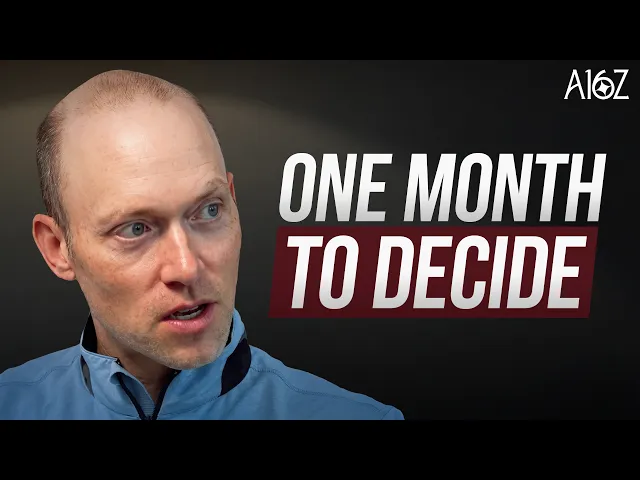
Why a $1M Startup Wasn’t Worth Building in the Age of AI: transcript
- a16z
- Published
- Added
- 1:01:59
- English
- auto-generated captions
AI summary
AI-generated from the transcript below. Check anything that matters against the video.
In this a16z conversation, Alex Rampell interviews Jean-Denis Greze, former CTO of Plaid, about shutting down a profitable AI tax product for small businesses and pivoting to Town, an AI assistant that works from email and calendar. Greze's tax startup made just under $1M in its first year and projected $2.5M to $3M in year two, but he concluded it could never be venture scale: incumbents could automate tax prep for existing customers faster than a startup could win share, tax is sold once a year, and word-of-mouth is weak. He and his co-founder used a roughly one-month window around October 15 to decide before the tax season closed the door. They explored about four ideas before landing on Town, which found product-market fit quickly, aided by more agentic models. Ben Horowitz praised Town to Rampell without knowing whose company it was. The discussion covers product-led growth versus enterprise sales, horizontal versus vertical strategy, competing with OpenAI and Anthropic while buying their tokens, model neutrality, data ownership, and how agents may reshape distribution and advertising.
Key points
- Greze's AI tax startup made just under $1M in year one and projected $2.5M to $3M in year two, but he shut it down as not venture scale.
- Incumbents could automate tax prep for existing customers faster than a startup could gain market share.
- Tax is sold once a year with little word-of-mouth, leaving roughly a one-month window around October 15 to pivot.
- After exploring about four ideas, the team built Town, an AI assistant working from email and calendar, and found product-market fit quickly.
- Ben Horowitz told Alex Rampell that Town 'changed my life' without knowing whose company it was.
- Town bets on product-led growth and horizontal reach first, then verticalizing based on what power users actually automate.
- Town positions itself as model-neutral, routing to whichever AI supplier is best for the user at the moment.
- Greze argues supply aggregation becomes less valuable as agents automate human attention.
Chat with AI
Ask about this video. Answers come from its transcript, with links to the moments they use.
Free with a Google, Telegram or email account.
Sign in to chatTranscript
- 0:00
I get pinged by Ben Horowitz about like I found this amazing tool. It's called town. It like changed my life. I was like wait, that's John and Annie's company. But he does SMB tax. That doesn't make any sense. >> This was not going to be a venture scale company. [music] No one had built great AI around these very common knowledge worker workflows. Like meetings, meeting prep, getting people to be prepared [music] for their day. We're trying to build a product that works with people to find more and more opportunities for them to deploy AI to be better at their job.
- 0:29
>> It's going to cost you like a dollar a month to run that thing. >> thing is the one month out of a year where it finds something, it's going to find like hundreds if not thousands of dollars for you. >> The product experience can't just be a text box. You have to just show the value prop to someone [music] and do it for them. We will use whatever supplier we think is the best for you in the moment. >> Humans are slow routers. That's right. >> And I think the future looks like a lot less human in the loop than we see today. And I think our job is to >> Hi everyone, I'm Alex Rampell, partner here at Andreessen Horowitz, and I'm here with Jean Denis, the CEO and founder of Town.
- 1:03
>> Thanks for having me. >> So what I find cool is that we worked together when you were the CTO of Plaid and I had led our investment in Plaid here. >> Yes. >> And I heard you were leaving and going to start a company. And then I remember you told me you're working on an SMB tax tool. >> Yes, we had coffee. We had coffee here in in Menlo or Palo Alto. >> And uh I got a little uh not happy about. I was like like I was so excited and it's like SMB tax tool. Ooh, that's >> That's rough. >> Uh now now you know all cards on the table, right?
- 1:33
>> You didn't tell >> I know. I yeah I I I I >> You didn't tell me that at the moment, you know. >> I know. I know. But I I want to you know I have to I have to maintain a very happy face at all times. Um you never know. Um And then uh this is what I find so funny about about this is that I think you know this whole story. I get pinged by Ben Horowitz about like I found this amazing tool. It's called town. It like changed my life. It's so great. And I'm like like, good, right? It It's like an app, so therefore it falls under under my fund. And um I was like, wait, that's John Donahue's company. But he does SMB tax. That doesn't make any sense. I'm so confused.
- 2:08
And that's what I texted you. And then next thing you know, a week later we we became partners, which I'm extremely excited about. But maybe tell us what Town does, and I think it's going to be incredibly interesting for everybody how you got to this point from the origination story. It's like you left Plaid, you started doing SMB tax. Like kind of walk us through the founder's journey from there to here. >> I left Plaid. I took a few months off with family cuz I knew that if I was going to be a founder I was going to have no more time off for a while.
- 2:37
Um yeah, and then um started exploring in the very like B2B way, what would be interesting markets where AI could really change the product experience. And for a variety of reasons tax made a lot of sense. Uh there's a lot of text in tax, and LLMs are very good at text. Uh you deal with a lot of structured formats as inputs, like uh uh financials and lease documents, and it just felt like a medium where we could take this process of putting together a business tax return, which is pretty different from a personal tax return, and automate it. And I did what engineers do, which is we did technical due diligence to prove to ourselves that it could be done. And the feeling was like, yes, within the next 2 years the process for a small to medium-size business of going from, you know, your financials and and a bunch of documents about your business and a finished tax return, that could be automated with AI. And we spent a year
- 3:36
building that. And I think uh there's a nice day in it, but it worked from a product perspective, but not from a go-to-market perspective. Meaning even though I have no doubt that tax prep will be automated, how do you reach millions of businesses efficiently and sell that product? That That had a lot more question marks than we anticipated. And And basically after 1 year, we had what I would describe as a a good business pre-AI. That is, if I showed you the revenue number and the revenue growth in our first year, like a little little bit below a million, and if I showed you what I thought we could do in year two, which is we we thought we could get to like two and a half to three million in in revenue, I think pre-AI you would have been like, "That makes a ton of sense."
- 4:21
But post-AI, it just it just this was not going to be a venture scale company. And And also, I think even more importantly, we realized that the incumbents were going to be able to use the technology to automate tax prep for their existing customers faster than we could grab market share. And that's like a key thing if you're a founder you have to think about. It's It's your advantage if you're a new entrant is you're faster moving, you can build a different product, you can use different go-to-market approaches, but there's a ticking clock on the wall, which is how quickly can you get real word-of-mouth network effects and market penetration before the incumbents who have other advantages. They have distribution advantages, right? For example, before they can catch up and and and and copy what you're doing effectively enough. And it felt for tax like we wouldn't be able to get to hundreds of millions of revenue before our competitors, the incumbents, could because you can only sell tax once a year. Yeah. And that's like a, you know, >> And not only they sell it once a year,
- 5:21
it's like the interaction. It's not like a It just fundamentally cannot be a DAU tool. >> That's right. And And it also doesn't have a ton of word-of-mouth because it is a rare It's rare for people to brag about their tax prep situation. And when they do, again, they can only do it once a year. After they've done the tax return, and so when you when you brag about how good your tax prep experience is, usually it is also not the time when people are purchasing, like are looking for a new tax preparer or accountant. And so >> They're going to forget in the next year. >> That's right. Those discontinuity make it really difficult to to hyper scale.
- 5:54
And so, that's that's why it was, you know, it was not a great idea as a business. And it's funny, one of my best friends has built like a successful EdTech company. And one of the things he always complained about with EdTech, it's the same thing. You can only sell on that tech twice a year. You can sell in the summer for the fall, and then you have a short window where you can sell the end of the fall and winter season before before the new year. Those are the only two times where you can really sell software to schools and to school districts. And he was like, you know, that really limited my ability to hyper hyper hyper scale. And I chose to forget that when we were doing tax. Um So, yeah, so we built Tax.
- 6:30
And after 1 year, after the first tax season, we basically my my co-founder and I, we, you know, went for a a lot of walks, with a lot of coffee, for a week, and really pondered the meaning of life and entrepreneurship and capitalism, and decided Um we should do something else. Like we we need to find a a better a more fruitful market to play if we want to impact millions of people. There there there better ways to get at that goal. And we started >> a pretty brave thing to do. Most people probably wouldn't do that, especially because it wasn't not working.
- 7:02
>> In the moment, it felt like failure, like we were failing. But I think you What are your core motivations for building a business, right? You have to As a founder, there are these moments, they happen more often than you wish they did, where you really ask yourself the question like, "Why am I doing this?" And, you know, for us it was like impacting the world was really, really important. We really wanted to build something that mattered and help people. Um so, we stopped believing that we could have as much impact in the world as we ought to have because we didn't feel like we could scale the business quickly enough. And the second reason why I think you you build a company for us was really enjoy working with our team. and but everyone on our team has an opportunity cost. They could be working at town or they could be working at you know, a lot of other great companies in the valley. And so if you stop believing that you can have a great outcome, then it's really hard to come into the office every day and look at people in the eye when when they when they tell you like
- 8:01
hey, I'm having a hard time with this or we're trying to convince a candidate to come join your company and you you know, you know, they have an offer from someone else that's liquid and you know, you're like oh well, who am I as a human being like you know, I have to I have to believe in myself. I know your pain. I I was there. So you know, you there's a few things that we looked at that and we were like well we got to make we got to make the decision. You know, the counter on the other side is maybe we would have figured a way and there's always this thing you never know for sure, right? You and we're very resourceful humans. So you can always try something else, but it just felt we we didn't have the idea in our brain to make it a really breakthrough business.
- 8:37
Um and you know, the the hard part of it is admitting to other people that you failed and to some of your employees maybe like our tax team wasn't going to have a future if you at the company for we're not going to do tax. And you face that and you're like first of all, who cares what other people think of you? You know, my friends will still be my friends regardless of whether I I succeed or fail. For employees, we'll help them. We can help them find their next gig. We can treat them really well in terms of severance and other things and make it okay. And then you realize it's not as hard a decision as you might have emotionally reacted to initially and it's the right decision. You start to get that conviction and then you just do it. One last little bit is because tax is annual I think making the decision at that point in time it it was the only time we could make the decision. We couldn't you can't pivot like April 16th after you've told a bunch of people that you're going to do their tax return. You can't pivot in January after you've signed half of your partners, right? There was we had a
- 9:35
window between let's say like right around October 15th of probably a month where we could live in both universes. The universe where we kept doing tax and the universe where we could. And after that, the door was closing. And so, I think that time pressure helped us make the decision more efficiently than than otherwise. I think if you're in a continuous if you're not in a cyclical business, I think you can always tell yourself, "Well, let me try the next idea for a month. Let me try the the next thing for the next 3 weeks. Maybe that'll work. Maybe this'll work." We had a short window, right? Where we could like change the direction potentially. And once the window was gone, it was like, "Hey, we have to decide right now. This is Otherwise, we're going to be here a year from now.
- 10:14
And a year from now, we won't have the capital to make the change." >> Um so, from there to obviously the name didn't change. It's still Town. It's a good domain. Town.com. It's a very good domain. Uh but how did you get from there to where you are right now? >> We basically explored about four ideas seri- pretty seriously. And um it's not worth going all four. What led us to what became Town was um this question, which is why has no one built a great AI that works out of email and calendar. And we started asking that question one because when we're building the tax product, a lot of customers were telling us like, "Hey, it's amazing that you're automating tax, but I also spend a lot of time setting up set them up meetings with my customers.
- 11:02
When I go into the meetings, I'm trying to my clients When I go into the meetings, I forget what the meeting was about. Clients always ask me the same tax questions. Wouldn't it be awesome if you could pre-draft answers for for for me?" And so, we realized from these needs that like these weren't very complicated things to do, but no one had built great AI around these very common knowledge worker workflows like meetings, meeting prep, meeting outcome, answering pretty pretty simple emails that happen all the time, getting people to be prepared for their day. So, we just started exploring that idea and it we did it at the time that Opus 45 was happening and agents, at least for coding, were able to do more and more autonomous work. And I would say that very simple insight plus the models suddenly being able to be more agentic meant that we got product market fit very quickly.
- 11:49
And you know, project market fit is a it's a magical thing. Once you once you have it, you kind of want to hang on for dear life and keep pulling at at the string forever and ever. And so, we didn't sit we didn't actually sit back and ask ourselves like, how big could the TAM be? Or like, will everyone want to do this? Or you know, like, what does it mean to win? We were just like, hey, we're getting a ton of pull from users. Let's go after this for a few months really hard and learn about the market and see what the opportunity could look like. And you know, as we did it, we started you know, we started to realize well, most businesses run out of email and their calendar, right? Especially any any role at a business that's external, that's like sales or business development or recruiting, you know, the way companies work together is is through email, mostly. So, we're like, oh, the TAM's got to be big. And it's not just in the US, it's like everywhere in the world.
- 12:45
And then we start like when our customers start telling us what they liked about the product, we realize, oh, there's a depth to what they're asking us to solve for them. It's not this isn't as simple as just hooking up an LLM to your email. There's a lot more that goes into making this experience better and better. So, we started feeling like on the product end, I'm not saying necessarily we had a line of sight to a moat, but there was enough complexity that we thought, hey, we could really dig into this and build a great product experience.
- 13:13
And basically we did that from December of last year until April and we just kept going every day. Like every day the product grew by a percent or a percent and a half. And and our customers kept asking us for more and the road map was very clear and you know, we got pulled onto the point where we were like, "Hey, enough with this closed beta. Like we're ready to to launch the product out into the world." >> And one of the things that I thought was very bold about what you did as well. Um so you have product market fit, but you're also, we talked about this a lot of do you go PLG, right? Or do you go like you have big companies that say, "Hey, give me your product. I want it." But you kind of realized that if the customer is not the user, the customer is the person that writes the check, the user is the person that has to deal with the product. If the customer is not the user, you might end up building a bad product because you're making the CISO happy, you're making the you're not actually making the user happy, you're making the customer happy.
- 14:10
>> Yeah, we my co-founder and I worked at Dropbox and I think one of the big learnings for us from Dropbox is you you can always take a world-class product experience and and figure out how it works for the enterprise. It's really easy to go in that direction. I mean, let me rephrase that. It's tough to go in that direction, but it is possible. It is almost impossible to go from an experience that starts from the compliance IT enterprise requirements and then figures out how to make the product experience incredible if you take that as the baseline. So, we we we felt and I think until now, until maybe a couple months ago, we felt like there was so much alpha in just making the product better, that should be our focus.
- 14:51
Growth was just happening naturally. We're like, "If we figure out the product experience and if our foundation from an enterprise perspective, from a data security and privacy perspective is good, we can figure out later how we shape the admin side of the product to be perfect for an enterprise." And I think that was the right call for us. Like I think, you know, um especially as consumers' expectations around what AI can do, it like those are going to be consumer grade experiences. And so, our thesis is that CIOs, CEOs of companies are going to tell themselves, "Hey, this amazing personal assistant experience that I get on the personal side of the world, I want that for my company." And so, whoever has an enterprise experience that feels like a consumer experience, like they're going to be set up to win. And And we were like, "That's where we want to be as a as a business." And I think I think we've mostly actually succeeded in getting there. And now it's Now the question is, "Okay, like, you know, we
- 15:49
we first we have like large companies that are using the product. So, you know, it's like, "How do we go from just like one enterprise deal to like being able to do dozens effectively? How do we take the data privacy, security requirements of not just like a couple of customers, but, you know, how do we satisfy those for every enterprise company?" That feels like a much more knowable problem now, and and we can go after that with our heart out, because the core product experience is good. >> Yeah. You know, I agreed. And I I know you and I've talked about this a bit where I remember having a BlackBerry.
- 16:21
>> Yes. >> And call it 2007, the iPhone launches, and then Steve Ballmer's like, "Nobody's going to buy an $800 phone. This is going to be a flop. It's such a joke. Blah, blah, blah." You know, eventually Microsoft buys Nokia. But, uh, the BlackBerry died pretty quickly because, uh, my theory on this, at least, is that every CEO got an iPhone for Christmas that year or something, was taking pictures of their kids, and like, "Holy crap, this is really good. This thing's not that good. Hey, I'm the boss. You go figure out how to make this thing work here."
- 16:52
>> Yep. >> Right? And we're probably I I talked to a lot of enterprise leaders, and it's funny, the ones that have seen the future are like, "I need this." There's some that are like, "Oh, yeah, like, AI doesn't work that well. I use Watson" or something. Like, there are there are still plenty of those where there are skeptics. But, like, it feels like the iPhone has emerged in terms of like people have been exposed to the wonders of AI in a personalized setting, but not in a work setting, and it's kind of an open question as to why. And part of it is the permissioning, part of it, but I I'd love for your thoughts on kind of if if you agree with that framing, and kind of what what the next few years of like AI for work look like.
- 17:31
>> one I agree with the framing. I think a little side note, there was this company, I believe it was called Good. >> Yeah, Good Technologies. >> Yeah, which was uh it was an enterprise-ready email client for the iPhone. >> was an app. It was like the ugliest thing in the history of the world. Yes, I used to use it. >> And I I I the reason cuz I think it's not just a BlackBerry story, like I don't want to be good, right? Because Good eventually is not a good business because people are like, "Yeah, sure, you're enterprise on the iPhone, but you're not at the level of quality of every other iPhone app, right?" And so I think that's the that's the risk for us. It's not just being the BlackBerry, it's also like being good as opposed to hey, people just using like Gmail uh the Gmail app, right? On on on their iPhone because it's both the convenience and the enterprise features that that a business is going to is going to care about. Um Yeah, so I often think about this things that happen at the speed of a
- 18:30
human, right? And first of all, assistance as a category is used by a few million folks, right? Worldwide today. It's still very early in the adoption curve. So I don't I don't even think all of the CEOs have gone there. And just like the iPhone, it will probably take 6, 12, 18 months for most people to experience this magic even in their personal life. Once they do, then there's the question is how do you adopt that within the company? And I think it is more complicated than just the iPhone because the way agents work is they're more and more effective if they have access to the data and the APIs that run your business. If they have access to those things in a secure, privacy-preserving way, then they can do lots of things for you. But, if they don't, right? They're They're only really as smart as the data they have the access to. So, you know, I think the the way we think about the journey is first uh
- 19:29
be able to go to any company and and get a few people at that business simply by connecting their email and their calendar. So, not the core systems of record yet, to feel enough magic that they're like, "Oh, this is going to bring a lot of mal- value in my work." And as I said, for external-facing roles, the calendar and email are real sources of insight about how you can automate part of someone's work. And so, then you can show up with the assistant, you can be like, "I can help prepare you for these meetings. I can tweak the decks for that meeting to use the design language better and to be updated with the latest numbers that are in this in this PDF that was sent to you." And just from that, people will start to feel the magic. And then you ask yourself, "Well, have I earned the right to ask you to connect your CRM? Have I earned the right for you to go to your IT team and ask all these other tools to be connected?" And I think that journey will happen more at the speed of humans.
- 20:23
And you have to have you have to have the other side of the coin. You have to have the audit logs, you have to have the posture that allows, you know, privileged information not to be shared with the agent. You You need all these You need the cost control for the CFO so that they understand that if their whole team operates on town, they're understanding where money is being spent and that tokens are being used efficiently so that Right, it's all that side of things that will take more human time to adapt cuz you're still selling into, you know, a Fortune 100 company that has to be run with a certain level of diligence.
- 20:57
As you move down market, right? As you move towards SMBs and mid-market firms, I think you have fewer of those requirements, right? And the adoption will be much faster. And so, our current bet right now is we are really focusing on from a product experience and self-serve growth, the SMB market, the mid-market, and then from a what security, compliance, finance features do we need, focusing on the enterprise. And we think we can knock out that whole part of of the space.
- 21:26
>> Yeah, I mean, I think there's also a Jevons paradox to this whole assistant space, if you think about it, right? So, I have an executive assistant in here. Um but still, I don't I mean, I trust her, I like her. I don't want her reading all of my email. Um and actually, this just came up. I was in London. I thought I had a dinner to go to. So, I could have sworn like I got an email about it. I texted Snap, my townie, and I was like, "Don't I have a dinner to go to?" And it like it's like, "Yes, you do."
- 21:57
Um you do. >> And it wasn't on your calendar. >> It was not on my calendar. It was my fault, not my assistant's fault. It was my fault because I didn't respond to an email. Um they didn't CC her, that's not their fault, that's my fault. And it caught it, but but now I have it automatically going through like it it reads my email all the time. >> Mhm. >> And that's something where so, I can or my firm is nice enough to give me an executive assistant, there are plenty of people that don't have one. And it turns out, you might just say, "Well, the market for executive assistants is rather small because most people don't have them." Um but it turns out if you could actually produce it via silicon, the market's quite large, and then you find things to do. Like, I'm going to have somebody read my email all the time, which I would never do, both from a privacy It's actually it's it's like a twofold Jevons It's like a Jevons paradox of pri- of of privacy that obviously like for those that don't know, Jevons paradox is about how when the steam engine became more efficient, you know, the original J- like James Watt made a more efficient steam engine,
- 22:56
and then the assumption is that the demand for coal would go go because what used to take like a pound of coal now took like an ounce of coal, but actually it turned out that it went up like a thousandfold because now you had something that could do it very efficiently. So, it feels like that probably exists for the, you know, assistant market, but I'm wondering how do you how do you how do you define your market? Is it like assistant? Because that seems like it casts too too narrow of a brush on it. >> I think of the market as we're trying to build a product that works with people to find more and more opportunities for them to deploy AI to be better at their job.
- 23:35
And I think in some case so I think of our of our product as a token allocation machine. We're trying to give options to the human about where they could apply tokens, and then we choose the human can choose whether they want the outcome of that. And I think as the tokens get cheaper, there are more and more places where you would apply tokens where you would never have done it with today's expensive tokens, and you definitely would not have done it with humans before. So, like the very very basic example is writing prep notes for every meeting that you walk into.
- 24:10
Even if you have an EA, your EA is not spending for every meeting, every 30 minute that you go into writing perfect prep notes. It's just not a good use of time. But an LLM can do that for, I don't know, a penny, right? And so then suddenly for anybody feeling like you have prep notes for every meeting that does some research on who else is in that meeting, have they said anything in X in the last week that might be relevant for the meeting? Like all this long-tail research is now worth it because it's so much cheaper. So, our job is to find things that look like that more and more and to tell you as the user, "Hey, do you want us to do that for you?" So, I'll give you like an another example that I'm recently pretty infatuated with. It's like if you are a small business owner and you run a restaurant in America, your wholesalers, that is the people that you buy uh the produce and other things that go into making food at your restaurant, uh they email you
- 25:09
probably once a month, maybe once a quarter, with an Excel spreadsheet or a PDF of the prices for all their inventory. So, like thousands, if not tens of thousands, of items. And the prices are always changing. And if you're a restaurant owner and you have a finance person part-time, what that person should do for you is once a quarter look at how the prices have changed to see if you could order some things from different wholesalers, to see if you're uh maybe getting ripped off or paying too much because the price of something has gone up 20 or 30%.
- 25:41
Mostly you don't do it. Because it's like a rare thing, and even though it could save you money, it's a pain in the ass, it's not part of your operations, you don't have a full-time person to do it. With a town, having a thing run once a month and do the analysis, like literally you can prompt your way to having that exist for you in 5 minutes. And if it finds nothing 11 out of 12 months that's worth doing, it's going to cost you like a dollar a month to run that thing. But the interesting thing is the one month out of a year where it finds something, it's going to find like hundreds, if not thousands, of dollars for you, right?
- 26:16
And so now this thing that may or may not have been worth it, you should do it at least once a month. You should do it whenever there's a change to the You maybe you should do it daily if you have a wholesaler that changed prices daily, that doesn't happen. But, you know, our job though is to show that opportunity to this to the restaurant owner because they won't It's not that they aren't very smart or don't understand their business very well, they do. They're not going to think that that's valuable. So, we you kind of all tell them like, "Hey, listen. You want me to always make sure that your wholesalers aren't changing prices in a way that's negative for your business?" Sure, do that. You don't really care actually after how often it runs. What you care about is once in a while you get an email that tells you like, hey, you you should probably move all these things to this other wholesaler. They have a discount or like this one is really raising prices on these things and it's getting a little too expensive.
- 27:01
Maybe you should remove those menu items. Like it's not rocket science to do this, right? Um but you have to have a product that tells you that this thing is possible that makes it, you know, >> Well, the issue the interesting point around that example is if you went to a restaurant owner and said, "Do you want an executive assistant?" >> They would have no idea. Yeah, yeah. >> Whereas if you said, "Do you want to save" it's it's like Geico, right? It's like, "Do you want to save 15% on your current Like do you want to save money on iceberg lettuce? And I can save you $500 a year and charge you $52 a year."
- 27:33
The answer is yes. But how do you know, I mean this is kind of the product marketing question or challenge because I remember the two things that we talked about when we first talked about this the new direction of the future direction of the business, post-tax, where PLG versus sales-led growth. Um where what you said really stuck with me where it's like if you want to build a product that is designed for the user, you have to build it for the user not for this you know, the the corporate overlords, all the lawyers at the company. And eventually you can work your way backwards into into enterprise sales and sales-led growth. But the other thing is this kind of horizontal versus vertical.
- 28:06
And this is a this is a question that a lot of companies struggle with a lot. And this kind of actually will bring us to a different point on like what do you think about the big guys, right? Like obviously like Anthropic or OpenAI OpenAI and everybody else who's kind of building things both for enterprise and for consumer. But how do you How did you kind of think about horizontal versus vertical? Because what you said, hopefully I'm going to capture it correctly, was we're going to start off as horizontal as possible because we don't want to be like, you know, we don't want to be siloed into like something that might be very We don't want to be siloed and branded as like the save you money on iceberg lettuce company. We want to do that and we're going to learn. This is my sales pitch to your candidates, by the way, now. So hopefully I'm getting this right. We're going to learn from hopefully thousands, tens of thousands of businesses and people that use our product and then eventually we can verticalize from there because we're going to let the market define that and we're not going to we're not going to presume that we know about the iceberg lettuce problem. We wouldn't know that until somebody actually downloads town uses town they learn from their townie and then we can we can
- 29:04
actually recognize that that can be a vertical but I guess how do you think about vertical versus horizontal? >> So the way I think about most AI products today is that the capabilities will be very similar. Meaning most harnesses in the work context will be able to do the same things and so the differentiator like I think what has been the main differentiator in Silicon Valley for a long time which is you have different product features that are ahead of market it's going to be more and more difficult to sustain that kind of an advantage. Um and we can we'll put a pin in this one we can have an interesting conversation about I think the unit of value in software has changed from the app to the computer but what that really means it's gone from an app to anything that a human can do and a human can do almost anything with a computer so we're abstracting away the app layer totally and I think the value will drop in the app layer. Um so so if the capabilities aren't different
- 30:03
then how do you build a successful company and I think our take on that is we're betting that as AI gets better it can better customize the product for each user like very specifically to their need. Meaning if you're an electrician that signs up for town in your onboarding the things we recommend to you that we can automate are very specific to electricians and if you're a venture capitalist they're very specific to a venture capitalist and if you're an EA it's specific to an EA in that industry and so on and so forth and so how do you do that? Well the models aren't yet good enough where when you just ask the model, "Hey, recommend for Alex, who's a VC, things that he could automate with Town." I think you get pretty good surface level suggestions, but not really deep ones. So, what we do, and cuz we don't look at user data, right? Like a part of being enterprise ready is you you can't look at user
- 31:01
data. So, what we do is we look at aggregate metrics of which who are our power users on the platform today. And then we go talk to them. And when we talk to them, they tell us the kinds of things they've automated. And so, we might talk to 10 power users that run restaurants. And what we'll see when we talk to that, there's five things in common that they all do. And then we'll sit internally and we'll build prototype automations, we call routines, for restaurant owners that we think are really good, like the one about wholesalers.
- 31:32
And we'll use that as the seed, right? And so, when someone joins, we look at your email and inbox and we're like, "You seem to be a restaurant owner." And then we have templates of what we think really good problems and potential solutions are for restaurant owners that we've kind of hand-carved from those interviews. And we put those in front of you. And you sign up and you start using the product. And then AI's getting better, and we're talking to more restaurant owners, and now we don't have just five, we have like 15 things that we can do for restaurant owners. Still a bit manual, but you can speed it up. You can schedule interviews automatically. You can ask the restaurant owners, you give them an Amazon you give them a free Amazon card, and you're doing an AI recorded interview of them and what they do with your piece of software. So, you're no longer operating at the speed of humans, you're operating at the speed of AI. And this library is getting better, and then the models get better, and so now the recommendations use the library less because and what we think is over time, through this through this approach, we'll be offer able to
- 32:31
offer 80/20 very customized software for for people. And and people aren't just one role in the in the future. Right? Like, yes, you're a restaurant owner, but also you run finance for your restaurant, too, cuz you don't have a separate person doing that. And also you have a vacation rental that you rent. And so really, you want your Townie to be good at those three things. >> Right. >> And also you have two kids at school, and it can help you like schedule their activities for the summer. So it's it's custom software all the way through, and we you know, our belief is that you can use AI to build that. I think the other strategy that you see in the market, which is what I think what the labs do, is a FDE approach. And this is very different. FDE is like, I have a human go into your business, understand how your business runs, then they'll build custom software with AI that uses my labs AI in order to serve you better. I think the FDE approach, you know, if you're a enterprise that's willing to spend like 5 million a year paying OpenAI for FDEs, like, it looks really good right now, but I think over
- 33:30
time, as the models get better, the FDE approach actually gets much worse, and our approach, which is much more around automation and using AI to to build the custom software, will scale much better. And so the bet we're making is we start with PLG, SMB, mid-market, enterprises that are very tech-forward, because there our approach scales really, really well. We'll let other people fight in the enterprise for this much more like hand-crafted software, and the bet that we're making is the things that we learn in the flywheel that we can get will make us more successful in the long term than these more custom approaches.
- 34:03
>> But maybe But maybe also define why is Town better than OpenAI and Anthropic, that now also have connectors? Like, you can hook up your Slack, you can hook up your LinkedIn. I mean, obviously I believe I'm both an investor and a power user of Town. So I I have my answer, but I'd love to have you expand on why use Town. And also just like I mean, so many people that are probably listening to this that might be entrepreneurs are also wondering like, uh-oh, are those guys going to eat my Not you, Town. Like, you have this weird situation where you have the infrastructure layer and you have the application layer. And that's always been the case. Like you know, Cisco and Akamai were infrastructure companies in the '90s and then Amazon and eBay were application companies. But never in a million years did Cisco say, you know what, we're going to build a bookseller. We're going to build an auction website. We're going to build a directory like Yahoo that competes with No, they were just happy selling their switches and load balancers and everything. So, I'd be curious like, you know, maybe define how you think about town versus the people that you often buy the tokens from.
- 35:01
Um and then how should others maybe think about this this kind of weird time that we're living in where it's like infrastructure is becoming application. >> I mean, it It is not It is risky always to be competing with your suppliers, right? >> And we are competing against their cheaper cogs, right? >> competing against your suppliers. So, you got to you got to ask yourself, is that naturally the right state of the world? So, the small answer, which is not the good one, is we believe very different things about the the experience of the user initially around email and a calendar that for whatever reason none of the other players have really focused on. And there's a lot of complexity to email and calendar, which makes our product much, much better there. But that's a small answer because obviously someone at OpenAI, Anthropic, at Google could wake up and decide to do that. So, the better answer actually I is to think about our customers and what they want. And when we when we talk to like a
- 36:00
mid-market firm, so that's a firm with like 500 to 1,000 employees about town, what what we tell them is like, "Hey, listen, do you know which model provider is going to be the mess model provider over the next 3 to 5 years? Like, what's your opinion on that?" And they don't know. And they they don't know. And you're like, "Well, you know, if you buy the OpenAI product, well then you'll always have OpenAI models in that product. And what if Open AI is not the best model provider, doesn't have the best intelligence for you for the next 3 to 5 years? Then, as AI does more and more for you, you may be at a competitive disadvantage.
- 36:37
>> hike the rent? >> Yeah, all of that. And so, the first thing is we're just like, "Look, we're neutral app. We will use whatever supplier we think is the best for you in the moment." And that's like a big part of it. It's also not just general intelligence, like which supplier is better at voice, is better at video, is better at slides at that time. Like, we feel like it is our job to determine from all the AI capabilities, frontier model, open weight, what is the right thing for you as a business. And I think you can save money there, but also you can de-risk ever having made the wrong partner. And there are companies that picked Open AI like 2 years ago.
- 37:17
And then Anthropic was better at coding for a 12-month period. And those companies had to use both because they realized to be competitive, they needed Claude, right? And they they needed those those models. And I don't think I think if you're a smart business, you really think about the neutrality of the who's providing intelligence for you and who's routing. So, that's like one reason. I think the second reason, which is like very important, is our stance is that you own and like truly own as a business the data and memories and contacts that's being that's being created on town. And so, you know, in the old world, pre-computing, if you're a business, you had different assets. You had physical assets.
- 38:02
And you had maybe like human assets, right? Uh and increasingly now, maybe people call it context, but there's the set of assets which is all the things that AI knows about your business to help you run your business effectively. And I think you should own that entire bucket. And I think you should own it so much that if there was ever a better solution than town, switching to that other solution would take you know, a day. And that that, you know, that's what I'm selling. I'm selling like you want to own that asset.
- 38:35
And I think if if you look at anyone who's deploying FDEs to build software for you, they actually what they're trying to do is they're trying to make it more difficult for you to switch at any point to someone else. So, I think that's the second So, first you want neutral intelligence, but I think you also want the app layer on top of the intelligence to be one that you feel comfortable you could move to something else. And then the new world, that's really like, you know, um it's owning this context layer and having someone who makes it available to you. Now, that means town, the risk that I'm taking is that I'm my it's the switching cost for my customers is easier, right? But that's that's my selling point. And look, if I can't have the best product in the market, then that's okay. Then I just means I'll lose. But that's like my competitive stance against um against the labs. And you know, the third part for me is just on training. And I think you like if you're a large enough company that labs won't train on you, but it's the way you operate your business, if that ever makes it into the weight of someone that's reselling to someone
- 39:34
else, that physically you're selling what makes your business successful to someone else. And you really don't want to do that. So, I think, you know, we are on on the training layer, we are like, you know, we we don't we don't train. Like that's just not part of our philosophy uh as a business. And then the final one on competition is we believe different things about the world and about I think the relationship between a human and AI where we are probably more forward-thinking than even the labs are.
- 40:03
So, you know, the the Teams product for town has um a mode around um basically building an internal CRM where we're trusting agents to decide what information at the company that would is available to other employees at the company. Let me just give you an example like you're in town and you say "Does anyone know someone in the finance team at this potential customer?" And Town's able to look at talk to the agents of other employees at your current company to find someone who's connected to that lead that you want.
- 40:42
That's like a really powerful product, but from a privacy perspective you really have to design it really really well to work. And the way I think about that is we are really thinking about how do you get AI to operate humans to operate at the speed of AI and not at the speed of humans. So, the speed of humans version of that question that I just asked is you would go in Slack or Microsoft Teams and be like, "Does anyone know someone at that team?" And then everyone your company would have to read that message and think about it and you get an answer like a day later. >> like a day later. Yeah, exactly. >> And with us >> Humans are slow routers.
- 41:11
>> That's right. And for us you're going to get an answer immediately cuz we've decided that for that kind of a question, we will trust AI to mediate the security and privacy of that request within a company. And you know, we believe things like that that can really speed up a company that I'm not seeing anyone else do. And you know, it's like when you're building a startup, you always have to think about like what does the future look like? And I think the future looks like a lot less human in the loop than we see today. And I think our job is to get companies to be comfortable with that universe because the economic benefit for them far outstrips any risks that they would see in that experience today.
- 41:48
So, those those are the differentiators. I think that like data ownership and neutrality are are like so important. And you know, if you're you know, look at what's what's happening to Rogo, what's happening to Harvey, right? If you look in OpenAI, they're building vertical companies that are competing with that. And from a competitive standpoint like you're like, "Oh man, those labs are really unstoppable." But what's If If a neutral business choosing who to work with, that you got to think about like, well, how far up the stack are they going to go, right? So, I I I just think strategically it shouldn't make sense for most large companies to really be beholden to to anyone app.
- 42:24
>> It seems like it's also like there's the Goldilocks zone of of relevance here, which is if you had $1 trillion in revenue, I would obviously be very happy as a shareholder, you'd be very happy as a CEO and co-founder, but you'd probably be the number one target for OpenAI and Anthropic. If you have $0 in revenue and nobody uses your product, they just wouldn't care. But if you're This is kind of like coding fell on the wrong side of the Goldilocks zone, arguably. Like the way that you Like if you were a coding agent right now, like what is Who's adding $10 billion a week or what Who knows what it is for Like Anthropic's adding so much It's so relevant for them. They cannot, to use a double negative, they cannot not ignore it.
- 43:07
And um or the sorry, they cannot ignore it. Just single negative. Whereas for what, you know, you're doing where Again, this this sounds like an insult. It's not, right? It's just like this is probably not the biggest thing. I think it actually is the biggest thing longer term, but short term, it's not coding. Right? It's not like, oh my god, I have to do this or else it's game over for me. Because like OpenAI, it seems like they learned that lesson from Anthropic, where OpenAI had like 50 bets, and then Anthropic went all in on code, and that did really, really well. So, you know, there's also this element of just kind of like focus and and relevance, which it seems like they're not going to [ __ ] Like, you know, healthcare, really big.
- 43:47
Like law, really big. Uh coding, really big. These big bets they almost have to make. Whereas these kind of horizontal ones that are spread out, it seems a little bit harder for them to to commit to. >> I think for the SMB and mid-market, I would say I would agree with you. But the market is Look, the the the market for AI doing more for a business and helping the business be more successful is bigger than the coding market. >> Oh, for sure. >> And so you know, for me it's a question of like when not if, right? I think in the in the current environment, it's not going to move the needle at those companies, but I think in 12 months it will. And so it's going to move very, very quickly.
- 44:27
>> right now you cannot not be This is the one that I was looking for. You cannot not be in the coding market. >> Correct. >> Right? Whereas this is something where it is like the iPhone BlackBerry. There's a diffusion point here. And actually I get This is another question I'd love to ask you. Um like I have a theory I'd love to see see if you agree with it. So uh Silicon Valley almost overhypes AI if that's even possible. I don't think it is possible to overhype overhype AI because every week it's better. The rest of the world I think is almost underhyped AI. And I'm kind of curious, how do you think about, you know, this guy People talk about crossing the chasm.
- 45:00
But this is not a great example where it's not like this is a technology that only exists here. It's nowhere else in the rest of the world. No, people are using it throughout the world, just not It's not evenly distributed. But I guess how do you think about like where where are we kind of short AI or what pockets of the economy either geographically or by profession or like there's certain areas where like cuz I'm This is the cool thing about having a very horizontal product and having a very horizontal PLG product where people are finding Town from all over the world. Like I remember you told me it's like, "Wow, we're big in Japan." Like that wasn't Intentful. It wasn't like let's go get big in Japan. It just became big in Japan. So you're finding this everywhere. Like are there pockets that have surprised you? And there are pockets where you're like, "Wow, there's actually a lot more opportunity here than people have thought of."
- 45:46
>> So I'm thinking I'm thinking about individual anecdotes. Like I'm thinking about this like this business that rents like surfboards on an island to people and then uses Town to inspect like surfboards and and uh little like beach buggies, whether they've been damaged to decide whether afterwards a person should get their deposit back. >> That's pretty cool. >> Yeah, but it's like it's like I'm like that is not on my bingo card. It's not on my 128 by 128 board bingo card. It's like just nowhere on there. Really what's happening is there is a tinkerer at that at that small business who there was something that was annoying to them and then they figured out with town how they could automate comparing these pictures and deciding whether to release people's deposits and and what makes it work there is the tinkerer.
- 46:36
And so my answer to you is actually we're seeing use in all the weird spots of the economy and the the unlock is is there someone over there that gets AI enough to want to tinker a solution to their problem. And the problem with that it is that there aren't enough tinkerers in the world or there aren't enough people that have the time to be tinkerers to help their business. And I think that's why AI is not diffusing.
- 47:05
The reason why it's not diffusing is because even though in Claude or in ChatGPT there has existed for the last 12 months features that at a lot of small businesses you could use to save you so much more time. But instead what you're doing is you're using them as a replacement as a like a better Google search and you're like what's happening. And it's because the product experience can't just be a text box. And what we have to do is we have to you can't teach someone. You have to just show the value prop to someone and do it for them. I think that's like the real unlock. And so whenever you know for our product like the what makes someone stick with town? Like it's this.
- 47:46
They've connected their email, their calendar and ideally one really important system of record for their business. And then they've built one custom integration. That means they've built one thing that didn't come out of the box that was magical. And I'm trying to just get rid of the custom integration. I'm going to get each person, which is as soon as you connect your system of record, can I deliver value to you in a way that feels very you, that really helps you. And that that's the opportunity and that's why you don't see it spread evenly. It's because in Silicon Valley there's we're all working at companies next to engineers.
- 48:21
And so we're we're much closer to this innate problem-solving and tinker. Like we have tinkers everywhere in our firms. So yeah, our firms are using AI effectively. And most of the world just doesn't have that. And so that's the real problem. And if you can fix that, if you can make a non-tinker into getting the same value as a tinker in the AI in the world of AI, like you could be a ginormous business today cuz AI can solve so many business problems. Like you don't need more intelligence. The intelligence is there. It's just how do you deploy it effectively at scale? >> Yeah, and it feels like it's an integration problem. It's a product marketing problem.
- 48:55
>> Yes. >> Because everybody and it's also I think this is really interesting to me as well. I met a professor at Harvard. Very very smart woman. She's like the number two person there and I'm talking to her about AI. She's like, "Yeah, yeah, I tried this a few years ago. It it was okay, not great." And I was like, "No, no, no, it's it's really good now." So I had a I had ChatGPT rewrite her dissertation. Um that she wrote 20-something years ago, but everything is now current. Like take everything today like and she was like, "This is amazing. What AI is this?" And I'm like, "It's ChatGPT."
- 49:32
She's like, "No, it's not." She's like, "How is that possible?" It's like because this is moving so quickly. And you know, a lot of people they judge things on the present. I think that's the other thing is like Silicon Valley tends to judge like where it could be. And that's where sometimes you oversell reality and reality distortion field this that and the other, but you see where this could go and a lot of other people it's like they see it as it is today and it's like the slope of this stuff is also such where it's like if you follow this curve I mean yes where it is today it feels like people aren't taking advantage of it partially because they were almost ironically early adopters. They tried something two years ago they're like yeah this hallucinated this kid that it didn't really work that well and then they they're they're they they've kind of ossified that version of of the reality and like if they tried again now it's just I've done this experiment like 10 times like where did you get that AI? Like that's not the AI that I have is like yes it is you just have to try it again.
- 50:28
>> I mean because the product space is moving so fast this is going to keep happening right? So I think the winning platform is the one that continues to adapt the business to the best AI. Like that's the problem because the AI will just keep improving and improving and improving and improving forever and people's mental model of what's possible and not possible what's difficult and not difficult will will be updated. I mean just with computer use and browser use today like in the last two and a half months the assistants can do things that were near impossible six months ago right?
- 51:02
And they can do them 90% of the time whereas before they were doing it like 30% of the time. Most people don't they've not experienced that and that's why when you do a demo with town of it's shopping for something for you or it's like using your software to to to do something that you're like wait don't you need a UI to do that? People are like wow I had no idea it could do this. >> Yeah. >> Um but I don't think I don't know how you market that to people because I think if you told people like oh town now has computer use you know that doesn't mean anything. It needs to be much more concrete like hey like I can make posters for this event that like look just like the ones that you've been making in Canva. Hey I can do it using your Canva subscription right? Because you're already paying for it and like do you want me to just do that and the person will be like let's like do a pass at that." And then 5 minutes later when first $0.25 it's shown you something that's super valuable, then it needs to go like, "Hey, do you want me to do that before every event like this that I notice in your calendar?"
- 51:58
And then what happens is you separately change the design of your small business or your mid-market firm, and then it should be like it you shouldn't even have to ask, but the next time it makes flyers, the flyers should look like the new design. And it cuz it it should have noticed that for you. And you know, next when it can do video effectively, it should be like, "Hey, do you want me to me to make video assets so you can advertise this on Instagram?" It just needs to suggest this increasing like things that are feel increasingly impossible in today's technology, but really it's just following the curve of what the models will be able to do for you.
- 52:33
>> Well, you've probably seen it agent traffic, and this is largely not assistant agent, but just kind of agent traffic writ large has vastly surpassed human traffic. So, that's kind of point one. And then the other thing that's been in the news a lot is about this kind of adversarial versus call it maybe synergistic approach to agents. Kind of this new generation of agents, not agents as in like, you know, chat GPT is you know, just searching something on the internet, but actually doing proactively things on your behalf. So, like Amazon has obviously adopted a somewhat adversarial approach, which makes sense because they're an advertising company, and like there is this covenant that existed on the internet for a long time. I go to Yahoo Finance to look up a stock quote. Yahoo pays money to go get a feed of stock quotes from the Nasdaq or something, but my eyeballs then hit an E*TRADE ad. And the covenant is like, "I Yahoo give you Alex free stock quote if you give me your eyeball."
- 53:24
>> Yep. >> And that covenant has been broken. So, that's So, like people that have kind of hit that broken covenant are adversarial, but it feels like there was a big opportunity to be synergistic. It's like, "Wow, like it's like the new SEO." If if I can be on the receiving end of agent traffic and not block it, not to out how do I stop this, but like how do I welcome it? It seems like a massive opportunity on the other side there, too. >> Yeah, I mean, you know, Amazon's loss should be Walmart's gain, right? I mean, Walmart, you know, the the they don't have the advertising business, and so, you know, their incentives are going to be different. And I think some I mean, to your point, distribution has changed. I think the the part that's interesting about the agent, by the way, is how does distribution change if you no longer trust your agent themselves not being interested in things is like a like a little bit of an interesting question mark, right? So, say you use uh the meta agent, and meta has lured advertisers, and then
- 54:22
you ask it and say like United Airlines advertises a lot more on meta than uh than, you know, nobody Airlines, and then you ask it to do a flight. You know, what happens if you feel like it's no longer giving you the neutral thing? Cuz this is the thing is there's always a there's what is there's still human incentives to promote products and and marketing. And so, what does that look like in the world where you the humans' eyeballs are no longer looking at things is a very open question. I'm a firm believer in the like you want a neutral agent that is yours, that you have no you like the only source of money for the agent is your wallet as the user. And then, whoever's creating that agent, their incentive is to give you the best information for you as a human with no distortion in terms of uh the great forces of marketing. And then, you as a human, you have taste, and you express your taste as you make the choices that you do.
- 55:18
And you can ask your agent like, "Hey, what are people talking about on Instagram?" Or like, "What's being advertised on it?" You can ask that question, because there you want to be flavored by the world of advertising and marketing. But, again, you want your agent to be neutral vis-a-vis that. The other you talk about adversary versus not, I think the other thing that is interesting to me conceptually are like experiences like friction that you enjoy as a human with that friction that you don't. So, me walking around SoHo in New York City shopping, it's friction that I enjoy. I like that I have to walk between stores.
- 55:53
I like that there are other humans waiting in line because I can copy their styles. I like the friction. It's an it's a part of that shopping that is enjoyable. I like doing it. Uh then there's friction that I don't enjoy. I want to like order toilet paper at home. I don't I'm not You know what I mean? I just want the same toilet paper that I've been ordering for a while. Like just get it in there as quickly as possible. Like and as cheaply as possible. And so, I think sometimes when we think about agents too much, we think too much about um reducing friction and toil and making thing as efficient as possible, but humans don't always optimize, you know, for efficiency. And so, you know, the the Amazon example for me on the ad is like actually I think there's times when I'm on Amazon like when I'm buying LEGOs for my kids, where I do want ads of other construction uh uh like toys for my son. Because I may realize one I It's not LEGO-branded that I don't know about it and it's interesting and then I want to ask my agent for some reviews of it and I might be like, "That's an interesting. Is it popular with the kids?" and maybe I want
- 56:52
to buy it. And in that experience, I think Amazon can make a ton of money and there will still be value for places that are aggregates of supply with advertising and marketing. But I think there's a lot of times where you're optimizing for friction where you don't want that stuff. So, the If I were Amazon and I had the 80 billion or whatever 70 billion-dollar-a-year like advertising business, the question that I would ask is like, "Hey, I should I don't think you want to block agents because I think that is I think there may be a a bigger-than-Amazon company like a headless Amazon could be a huge huge business, right? But I think it puts more pressure on them to create a separate experience where you do want the ads and that's really good. And making that worthwhile to go on for on its own. And I think I would still go to Amazon for those things, you know, at the end of the day. But, you know, the AI is moving so fast that it's going to change distribution and human habits at a rate where I don't think anyone can predict what the winning platforms will be in those spaces. And there's going to be huge losers, right?
- 57:52
And Amazon might lose a huge chunk of their advertising business trying to fight the future. Be But, because they can't predict what it would look like without like the The other one I was just thinking is Muse for me. I don't know if you've seen the discussion around Muse. It's like free quotes free personal agent. Cool. People like, "Well, one day they're going to have to put ads in Muse." But, actually, if you maybe they never have to put ads in Muse. Maybe Muse just gives them data that allows it to target you better on Instagram. And when you go to Instagram, you're on Instagram cuz you don't want efficiency if you're on Instagram. You want to be entertained, right? And if they can target better on Instagram because of the information from Muse, and Muse is still free.
- 58:32
And And on Instagram now, when you see the good that you like, they can also get you to pay for it using a wallet that they've accumulated on you from Muse. Or Muse can look online for different variants of the thing. It's like a really nice flywheel. And what it What it means is that you've divorced the monetization from the agent experience for this personal use case. And that's like a you know, it it's it it's And that's where a property like Amazon is at a disadvantage, I think, is it might be with agents like you you can't having just been the aggregator of supply just may not be a good business model in the world of agents.
- 59:10
It just may no longer be. And so, there's really not much they can do about it. They're going to lose. And probably the countermove for them, honestly, is they should have a personal agent. >> Yeah. >> They should have a Muse compa- Like, that's actually the countermove for them. It's not to block Muse. It's to have a Muse. >> Have a better Muse. >> A >> a Muse, and have the exclusive on shopping for that and and hope that's enough of an incentive and put it part of prime. But, you know, I I don't know if they're able to do that. >> Well, the funny thing is like with Amazon, so they have there's a website called CamelCamelCamel.
- 59:38
It's a price engine for Amazon. So, you basically say, "I want to know when Dr. Pepper is right now it's $8. Tell me when it's $6." >> And then buy it basically. >> The second it's $6. No, it doesn't do the buying. It just emails you and then you have to do the buying. >> Yep. >> 20 million people use this website. >> 20 million people? >> Yeah. 20 million people in America. >> And this is just a >> And it's it's an affiliate website and this has been around for 18 years. So, and like my So, Justin and I wrote a post about this where it the best way to predict the future is to observe the present. Again, going back to like it's not evenly distributed and like this thing is the future because like the other way I think about agents is there are people that have more time than money.
- 1:00:19
>> Yeah, that's right. >> And then there are people that have more money than time. >> Yep. >> And people that have more money than time, they're not going to use CamelCamelCamel. People that have more time than money, they are. Um but wait a minute, what if you now can give everybody who has more money than time, give them all of the tools and the agent does it? Like, of course they're going to use that. It's an IQ test. So, these things are are definitely going to be a lot more pervasive and again, sometimes you don't even have to like picture what might happen. You just have to look at like, you know, coupons.
- 1:00:49
>> Yeah. >> Coupons like you shouldn't use a coupon if you're wealthy because it takes too much time. You're going to spend like 2 hours like hunting for the right coupon, but guess what? Like so, and that's another covenant that's being broken because it was a very neat way of dividing the world. >> Yeah. I mean, Amex premium membership, it's the same way. Now, it'll just optimize >> Yeah. >> all of your all of your premium benefits. >> The >> all going to abuse all of our Chase and Amex benefits and >> And they're going to have to change it. >> It's not cost-effective for me. >> Because then it's going to be adversarial. This is kind of the adversarial versus synergistic thing. So, >> And by the way, the the through line all of those it is I just think supply aggregation is a lot less valuable than it it used to be very valuable because human attention was limited and now supply aggregation is a lot less valuable because human attention can be automated away.
- 1:01:36
>> Yeah. This has been an awesome conversation. Thank you again for coming in today and go town. >> Yeah, thanks so much Alex. It's always good to chat. >> Thank you.
Questions
AI-generated, and answered only from the transcript.
Why did Jean-Denis Greze shut down his AI tax startup despite its revenue?
He concluded it would never be venture scale. Incumbents could use the same AI to automate tax prep for existing customers faster than a startup could win market share, and tax is sold only once a year.
How much revenue did the tax product generate in its first year?
It made a little bit below $1 million in its first year. Greze projected $2.5 million to $3 million in year two.
Why was timing so important in the decision to pivot?
Because tax is annual, there was only about a one-month window around October 15 to change direction. After that, the door closed until the next year.
What is Town and how did it get product-market fit?
Town is an AI assistant that works from your email and calendar. Greze says a simple insight plus models becoming more agentic let the team get product-market fit very quickly.
How does Town compete with OpenAI and Anthropic while buying their tokens?
Greze says Town is model-neutral and routes to whichever supplier is best for the user at the moment. He argues customers also want to own their data and memories rather than depend on one model provider.
What does Greze say about horizontal versus vertical strategy?
Town starts as horizontal as possible and learns from many users, then verticalizes based on what the market shows. He says the team interviews power users to build templates for specific roles like restaurant owners.
Latest transcripts
+ Agua + Carbono Una mirada a través del CIHH
El video del canal UTPPanama presenta el trabajo del Centro de Investigación Hidráulica e Hidrotécnica (CIHH) de la Universidad Tecnológica…
The Work of the Co Creator: Visualization II - Hugh McCague
In this RosicrucianTV presentation, Hugh McCague continues a series on mental creation or visualization as a central Rosicrucian exercise…
The Work of the Co-Creator - Visualization - Hugh McCague
This RosicrucianTV presentation by Hugh McCague explores visualization, or mental creation, as one of the central Rosicrucian exercises for…
Rosicrucian Exercises: A Foundation for Daily Living VI - Hugh McCague
In this sixth installment of the Rosicrucian Exercises series, Hugh McCague of the Rosicrucian Order, AMORC, guides viewers through an…
Rosicrucian Exercises: A Foundation for Daily Living V - Hugh McCague
This video is the fifth installment in a Rosicrucian Order AMORC series on Rosicrucian exercises as a foundation for daily living, presented…
Rosicrucian Exercises: A Foundation for Daily Living IV - Hugh McCague
In this RosicrucianTV session, Hugh McCague guides viewers through a series of Rosicrucian exercises as a foundation for daily living. He…