How to Stop Being Overlooked & Start Getting What You Want: transcript
- Mel Robbins
- 58:29
- English
- auto-generated captions
AI summary
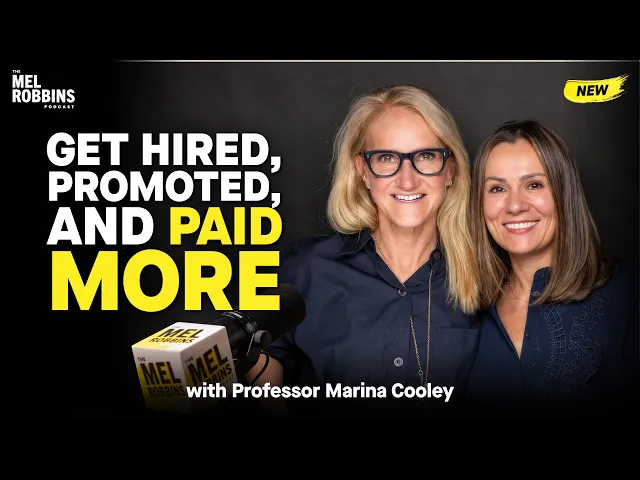
In this episode of the Mel Robbins podcast, Mel interviews Professor Marina Cooley, an award-winning marketing professor at Emory University’s Goizueta Business School. Professor Cooley teaches the attention economy and how to break through the noise to get noticed. She shares her personal journey from management consultant to failed peanut butter entrepreneur to Coca-Cola marketer to professor, highlighting how her unique story made her memorable. The conversation covers the importance of knowing what you want and asking for it, overcoming the fear of self-promotion, and practical strategies like making ideas sticky, communicating achievements, and building a portable reputation. Research from Catalyst shows that for women, communicating achievements is key to higher compensation, while for men, it’s about external opportunities and willingness to work long hours. Professor Cooley also emphasizes the value of critical thinking, preparation, and having a hobby to develop a third identity and become more interesting.
AI-generated from the transcript below. Check anything that matters against the video.
Key points
- Knowing what you want and being willing to ask for it are both essential to getting ahead.
- Fear of rejection and social cringe are hardwired but can be overcome by pushing through.
- Sticky ideas are memorable and help you stand out in the attention economy.
- Research shows women advance by communicating achievements, while men benefit from external offers and signaling long hours.
- Build a portable reputation with a clear personal brand, especially on LinkedIn.
- Preparation and asking what success looks like can boost confidence and performance.
- Critical thinking and controlling your attention span will be rare and valuable skills in an AI-driven world.
- Having a hobby provides a third identity, reduces pressure, and makes you more interesting.
Transcript
- 0:04
Professor Marina Kohley, welcome to the Mel Robbins podcast. >> Thank you for having me. I'm a delighted to be here. >> Could you share what might be different about my life if I take everything to heart that you are about to teach me today and I apply it as soon as I'm done listening to you. If you take everything we talk about today, you'll be able to amplify anything that you want in your life. So whether you want to be a chef or an author or you want to change careers or you want that VP title or you want to be an entrepreneur, all of that is available to you if you are willing to put yourself out there and get over your cringe and build those dreams out loud. And there has never been an easier and more accessible time to do that. So do not for a moment think that it is too late. And what does dream out loud mean?
- 0:59
>> It means that you're willing to know what you want and to ask for it. >> Oh, which part of it do you think stops most people? Knowing what you want or being willing to ask for it? >> Both. We are so busy and there's so much information coming at us that it can be really hard to discern what you want. >> Yeah. And then if you are lucky enough to find out what you want, you are then scared about putting yourself out there and not getting it and rejection feels really bad. So both of those things.
- 1:27
Yes. It's so true. Can you explain your background? You teach this wildly popular class and I feel like I am in day one and I was lucky enough to get one of the seats in your class. So tell us a little bit about your background and what you teach. Okay, I'm going to start with the background because if you've ever heard the expression, um, a cat has nine lives. >> I'm like the woman with nine careers. I started as a management consultant, >> traveled, um, every single week for 4 years, 46 weeks, packed my little suitcase, traveled to a client, and learned that is a very challenging job.
- 2:05
Um, and it can feel very shallow. And so after four years, I realized I had this really fancy degree, four years of consulting, and I was empty inside. And I had hit a dead end. And I thought, well, I actually do know what I want. I want to be a marketer for a food and beverage company. And guess how many food and beverage companies wanted to hire me? >> How many? >> None. You know why? >> I don't know why. >> Well, I had zero experience doing marketing. >> You sound like every 20-year-old I know [laughter] right now. >> Right.
- 2:35
>> Yes. So, I did the only thing I could really think of was that I I started my own food company. >> What kind of food and beverage company did you make? >> Peanut butter. >> You made peanut butter. >> Yeah. I had this really great idea. I I mean, I love nut butter. I probably consume half of my calories from nut butter. And I thought, this is like such a calorically dense thing. What if we could blend it with something? So, like a pumpkin peanut butter, a honey nut banana peanut butter. And um I did it. I got FDA approval for a recipe. I got a commercial space and I probably knew without within 18 months that it was going to fail. Maybe maybe earlier. Now I'm like a failed management consultant.
- 3:14
I'm a failed entrepreneur. And so I >> How old are you at this point? >> Um I'm 28. >> Okay. >> And h Mel, I'm feeling very behind. >> Yes. >> Okay. Very behind because meanwhile everyone I was consulting with has gotten promoted again. They've already gone to business school. I'm behind. I'm late. This is such a universal feeling. And that nagging sense that you're behind late and late >> and late. It's too late. I screwed it up. Okay. So, what did you do next?
- 3:47
>> I tucked my tail and went back to school, went to get my MBA. >> Okay. >> This time, laser focused, right? Cuz I'm lucky. I know what I want. I want to do marketing and I want to do it for a food and beverage company. No distractions. >> Okay. >> Okay. Uh and not only that, I wanted to work at Coca-Cola. >> Oh. >> It was the only job I wanted. Um so >> now, why did you want to work for Coca-Cola? >> I I just think if you're going to learn to do marketing, >> like learn to do marketing.
- 4:20
>> And so, um Seattle at Nike fell just a little too far. I'm an East Coast gal. >> Y >> um and my family was from Atlanta. >> Okay. Oh, and there you go. >> And there you go. Right. I mean, Coca-Cola is based. >> That's where Coca-Cola is based. So, one track focus. Iworked like crazy. I don't think there was a person on the interview team that hadn't met me before I came to that interview and they were all like, "Oh, it's the peanut butter girl." And when they called me and made me an offer for this job, they said, "We hired you because you have Moxy." So, this failure, this being behind ended up serving me. Well, one of the other things I want to say about it is that because you had something unique.
- 5:04
>> Mhm. >> It made you stand out. >> Yes. And I would imagine that the fact that there was something unique about you that you were willing to talk about, that you were willing to use your word, amplify, >> also helped to have you rise above the noise of everybody else that was just who was that? Where did they work for? Oh, the peanut butter. The peanut butter girl. >> Interesting. Okay. I have a feeling we're going to circle back to that. So, what what happened next?
- 5:36
>> So, I start working at Coca-Cola. Okay, >> I work on, you know, the biggest brands with the biggest budgets. >> So, I continued to progress. I had all of these grand visions of becoming a CMO one day, >> a chief marketing officer. In case you don't know what a CMO is, >> okay, I was going to be a big deal. >> Um, and then I had a baby and then I had another baby really quickly after that. Okay. >> Um, and then I thought, wait, I'm sorry. How am I supposed to do how am I supposed to uh work this many hours and have children? And and again, I have to say it felt like a dead end. And I know that millions, probably hundreds of millions of women face the same question of am I at a dead end because how how can I prove myself here and prove myself at home? And then one day I get an email and it's from my favorite um professor from business school and he says, "We are going to be hiring a full-time marketing faculty member. you've never mentioned wanting to teach, but would you be interested in
- 6:36
applying? I saw that email and within 5 seconds I knew I was going to find a way to get that job. And it took 9 months to get the job. I had to be an adjunct and they gave me a class to teach to show that I could do it. And the class was scheduled for Thursdays at 6:30 p.m. >> Okay, can we just stop? That is the worst time. and they're like, "Obviously, we can't find a real faculty to teach at this time, so we'll put you in here, and you prove to us that you can be good at this job. Clearly, the Thursday night uh class was very popular."
- 7:14
>> Mhm. >> And now you teach one of the most popular classes there, and you are an expert in marketing. But I'd love to talk a little bit before we jump into some of the big takeaways from your course. How does this apply to your life? what you're about to teach us about dreaming out loud and amplifying yourself and putting yourself out there. How does this apply to somebody who doesn't have a business or doesn't think they have some product to market? When you know what you want, yes, you are able to verbalize that to anyone that you meet with. So, let's say that you are thinking about transitioning roles or you feel like you're in an industry that AI might take away. You're gonna have to communicate your narrative and you're gonna have to do it in a way that you feel good about that you can sleep with at night and learning the skills of how to tell your own story are valuable to anyone at any time.
- 8:10
>> I would love to talk about what are the courses that you teach at Emory Business School and what are some of the biggest takeaways from this wildly popular course. >> Okay. Well, I teach advanced marketing strategy, which really takes someone that wants to go into the marketing profession all the way through to how do I create a brand, launch a brand, maintain a brand. But my um I would say my calling card is this content marketing class, which I would argue is one of the most unique marketing classes in the country because we study the attention economy.
- 8:44
>> Okay. What is the attention economy for somebody who doesn't know what that is? >> Yeah. Right now there are 1.3 billion things posted on Instagram every day. >> 1.3 billion. >> That's right. Our bottleneck, our limiting factor is the amount of time that we have available to us. That that is the attention economy. Okay. >> There's there's just there's too much information out there. I can't process all of it. And there's there's different elements to it. One is just how do I make sure that my attention is being put into the right things.
- 9:15
>> Yeah. Then the other part of it is well how do I use that to my advantage? So if I want to build a business or progress or if there's a message I need to put out, how do I grab someone's very limited attention? So you teach the core principles about how somebody can break through >> and get their message across and amplify their business or amplify their message. But every single thing we're going to talk about is also applicable if you want to effectively ask for raise, if you want to communicate your boundaries, if you want to basically do anything.
- 9:56
Because a one-way ticket to a life that's not working is sitting silent and hoping somebody can read your mind or actually guess what it is that you need and want. And so this is going to be more and more important because everybody is so distracted. Is that right? >> That is that is so well said. Yes. >> And I would love to have you put us right in the classroom with you and you are now in front of the class. The person who's with us is sitting next to me in class and class is now in session.
- 10:32
What is the assignment that you give to everybody? Okay. Well, the assignment is called go viral, get an A. But I have to tell you that as as fun as this story will be, it goes to a very important ethos. Okay? And I myself have been the student in a classroom for many years. I think most listeners have spent time in a classroom. My philosophy is tell me and I forget. Okay? Teach me and I remember. Involve me and I will learn.
- 11:02
>> And I want my students to learn. If we want academia to continue on if you don't want all of your learning to come from YouTube, >> yeah, >> we we have to make the classroom experience something special. >> Yes. >> Um and I racked my brain on how to do this, right? How to make my students get over putting themselves out there, how to take the principles of sticky ideas, which is what I teach, >> okay? >> And pour it out, right? Prove to me that you have gotten the learnings from this class. If you go viral, I'll give you an A because you've done it. You've understood the science of sticky ideas.
- 11:40
>> Now, what is a sticky idea? >> So, something memorable. So, in this, you know, in this noise, so um let's scale down to size a little bit, right? So, if there's 1.3 billion messages a day just on Instagram, 34 million on Tik Tok, you and I are each seeing about 6 to 10,000. So, as we're walking, as we're opening our phones, on the way to the elevator, maybe even in the bathroom, 6 to 10,000 messages a day. God, how many will you remember? >> Zero. Especially now that I'm in menopause. [laughter] >> I mean, m, if we're lucky, maybe three.
- 12:16
>> And so, you want to figure out how to make your idea sticky. >> And that is what will help the local real estate agent have someone remember him or her when they're looking for a home. True. >> And that's the principle I'm trying to teach. >> Okay. So, even understanding >> that if you want somebody to remember you or you want somebody to remember what you just told them, it needs to be sticky. Otherwise, it's not going to break through.
- 12:44
>> Yeah. Yeah. It's almost like a Velcro hook, right? >> Yeah. >> I bet if you take an interruption right now and you're like, "Hey, what did what was that woman talking about?" the thing that you're gonna come back and say peanut butter girl. Like yes, that's a that's a sticky idea. I mean, in in a few ways, pun intended. >> Yes. >> Um well played. >> That that is why they remembered me. >> Yes. >> That's why I got that job. So what are you doing to make your conversation different than everyone else's conversation? That's how you demonstrate a sticky idea.
- 13:15
>> You know where I think this is super relevant. you mentioned AI is I think it's super relevant if you are either applying to school whether it's a graduate school or college or whatever >> whether you are trying to get a job >> whether you are out and interested in meeting new friends or meeting you know somebody that you connect with in a romantic way >> cuz if you're not memorable then you are forgettable and that is kind of a painful thing to think about.
- 13:50
>> So when you present this, first of all, what does it mean to get to go viral in your class? The person that's listening, you're sitting right next to me and I'm like, what does she mean go viral? What does it mean go viral? >> So the assignment is for 30 days. >> Yeah. >> We will post once a day. So >> like as in every single student has to post on their own account. >> Every So we break up into 30 groups. Okay. >> And every group gets assigned one day. Group one posts the first day, right? They're sharing something about their college experience. They're running around on campus with little mics.
- 14:19
They're making dance videos. They're doing man on the street interviews. >> And they post and then group two sees what they post. We discussed it in class. What could be better? And then group two builds. And then group three watches group one and group two and they're like, "That was too long." Right? Or, "Hey, I loved how they did that. We could do that a little bit better." So in 2022 when I started this experiment, the algorithm rewarded consistent daily posting. That's what it wanted. It was like feed the beast. >> Okay.
- 14:47
>> And we fed the beast. We hit our first 1 million mark on day 15. >> Wow. >> And by day 30 cumulatively we had hit 10 million impressions, over 1 million likes. 30 days baby account. And you know we did it. So tell me what what have you learned teaching this? Because as you listen to it, you go, "Yeah, that makes a lot of sense." You're going to iterate on an idea and you're working on a group project and if you do silly things, it's going to go viral on the internet. But listening to the idea and thinking about the idea is very, very easy. Just like it's easy to think about asking for the raise. It's easy to think about applying for the job. It's easy to think about starting the YouTube channel. It's easy to think about writing the song, but there is something that you discovered that really is the breakthrough that keeps people from dreaming out loud and from amplifying
- 15:47
themselves. And so, what stands in most of our way that you're actually the deeper thing that you're teaching here? >> Fear. I mean, when you put something out there and it and put something out there, yes, in this case is a post, but put something out there could also be asking for the raise, asking for the meeting. >> Yep. >> Um, >> two things can happen that you're not going to like. One of them, um, is that you don't get it, right? >> Yeah.
- 16:16
>> Uh, and the other one is that you get ignored. >> And both of those things feel awful. I mean, our our brain is programmed to save us from those feelings. I mean, social rejection feels awful. >> Yes. >> It's literally the same part of your brain that tells you you're in physical pain. And so, we're we're wired to not experience that. And when you think about it like that, like, how does anyone ever post anything or ask for anything? It's because we're finding a way to move past that and to be able to give students and and you who is listening uh a reminder that you can you can put it out there and you actually won't die. Well, one of the things that I think we all know and we talk about is that fear that people are going to criticize you. That fear that
- 17:15
that that people are going to, you know, judge you. But what I've never considered is the other fear that you mentioned, which is that no one is going to even look at it. Like we talk a lot about being scared about people judging us, >> but I haven't had a conversation yet with somebody, Professor Culie, about this deeper fear of what if it sucks?
- 17:44
What if no one comes and watches? Mhm. >> What if nobody listens to the song? >> Mhm. >> Can we talk a little bit about that part of social rejection? >> It's so deep within us to to be scared that nobody will care about us. >> Yeah. >> And the only way forward is to use the rational part of your brain and tell yourself that nothing will happen if you get ignored. I mean, you might you might learn a lot that you're not asking in an impactful way that you're forgettable instead of memorable.
- 18:23
>> Um, if it's about content creation and no one sees it, >> and the truth is a few people will see it. They're going to be your friends and family that see it and they're going to be sorry for you on your behalf, right? They're you're you're going to be thinking about how they're thinking like, "She's so pathetic. She just keeps sharing stuff that nobody sees." Uh-huh. >> And this is where that rational brain has to use the tools that you've given a smell, which is to say, "Let them, right? Let them think that I'm being ignored, but I am going to figure out a way to communicate effectively because I want to amplify the life that I'm living." You know, I really I I I I'm really stopping to think about this concept though that so you just said so deep within us is this fear that no one cares about us.
- 19:18
And as you said that, I realized that I did not do events. Like I I would go and speak at other people's events, >> but over the past I don't know, six or seven years, people be like, "Why don't you do your own events?" Lots of people, you know, that write books, do their own events. And do you want to know why I didn't do my own events? >> Because I I it's not that I thought people would judge me if I did my own events. It's because I truly believed people wouldn't come. You know, when we went we went on tour and when we started planning this thing last minute, of course, and people are going, "Oh, we should go to all these cities." I'm like, "Are you kidding? Can we Why don't we just go to a couple and see if anybody comes?"
- 20:06
Like, who's going to come to a podcast? Like, I was still in that mode. And I think it's important to say it because >> this fear that you have, whether you're afraid no one's going to show up and buy your granola, >> or you're afraid that lots of people will be there, but they're going to be rolling their eyes and laughing at you, >> lots of people are going to see your post and no one's going to like it. Like, >> it is so hardwired in you >> that feeling that cringe and that, "Oh my god, am I really doing this?" that that it is part of what you have to go through. Can you talk about the social wiring and the cringe factor and just like that it's just part of the deal and that if you if you feel it are you normal like is that just part of this? I mean cringe is kind of a new word. Okay.
- 21:00
>> But really cringe is that social rejection. >> Yes. >> It's I am going to do something that in a way you know society has told me not to do. Maybe maybe you interpret that as bragging or self-promotion and you've seen it done in really bad ways, which we all have. >> Yes. >> And so you think cringe, but I think if that's how it feels, you're doing it wrong. >> Wait a minute. If you feel cringey, you're doing it wrong.
- 21:28
>> I I think that there are ways to a get over it, right? Which is the push through. We're going to push through. We know we're going to make it on the other side. And then I think once you've done that, there are ways to show up authentically for the interview, for the business, for the email that you're writing that aren't going to keep you up at night feeling like you're about to jump out of an airplane. >> Wow. You also teach some unbelievable research in your class when it comes to making sure that you aren't sitting back hoping people notice. Like if you're somebody right now that's listening and you're annoyed because you feel like you keep getting passed over or if you can't seem to get the promotion you want or you can't seem to get the type of salary that you want, there is something that you need to know based in research that's really important. So could you talk to us about that, Professor Kulie? The research that Mel is referring to from Catalyst took a
- 22:28
look at 3,000 respondents that were um labeled high potential. So you might want to know >> what is high potential, >> what high potential meant. And you know studies like this have to have a very specific definition. And we um called high potential that you have an MBA and that you are progressing up a career field in a traditional corporate job. Okay. >> So I know these people. >> You used to be one of these people. be one of these people and my MBAs are these people. So 3,000 people and the researchers then took nine attributes that people used to have career progression and specifically to get higher compensation. Okay.
- 23:09
>> And so some of the tactics were finding a mentor, taking additional training, looking for external opportunities and bringing those internally. Um communicating that you'll work long hours, working long hours. and then communicating your achievements. And then they were able to over time establish which of these work. And there's a very surprising finding which is that what works for men is different than what works for women. So for men it is taking opportunities externally and showing them off internally like look what I'm worth. And surprisingly it's the communicating that I'm willing to work long hours. So for guys if you communicate which means amplifying.
- 23:53
>> Yes. >> And even hearing like that you are talking about working long hours feels like ghik but but as you say it but so as a dude the research shows if you're willing to communicate that you'll work the big hours. Yes. >> And if you're also willing to go out and get other jobs >> and then come back and say these guys are going to pay me X. that those are two attributes in terms of amplifying yourself that lead to an increase in salary and an increase in your your like you get a raise. >> Yes.
- 24:22
>> Okay. What what about for women? >> So for women there's one attribute that moves the needle and that is communicating your achievements and I find this to be so exciting. >> Exciting. >> I do. >> Okay. tell us >> because I think and and I'll speak for myself and also many of the women that I have taught, we believe that often we're going to have to get pushed out of the workforce because we can't communicate, we're going to work the long hours because for stages of our life we can't.
- 24:53
>> Mhm. So to know that we're not we're not going to be punished for not doing that and instead all we have to do is the work and then communicate what results that work led to. That's what it's going to take to get paid more. I think that's really good news. >> I think that's really good news. And what do you think the big mistake is that women make based on this research? I think we believe that if we do great work that that is enough and it's >> that somebody's going to notice.
- 25:23
>> Someone's going to notice. >> And what are the things based on this research and based on all the the work that you're doing around amplification? What is it that women are supposed to do that they don't know that they need to do? Like how do you promote the things that you're doing? Taking this back to the attention economy that we live in. Yes. >> I want to feel what it feels like to be that manager for a minute. Okay. So, you have 10 direct reports. >> Yep.
- 25:53
>> Um you have your own boss. >> Y >> maybe you have three kids at home. Maybe your mom is going through cancer or your dad. You are also seeing 6 to 10,000 messages a day. M >> and so if one of your 10 direct reports is always demonstrating this is what our team has accomplished like if they are the ones that are making you the boss look good I think it's not surprising that that person would advance. So if you're one of the other nine and you're crossing your fingers thinking that your boss is thinking about you they're not. And again I I don't think a lot of the times it's malicious. It's that our attention is the most scarce resource and so you have to do the work and then help illustrate what you have done and not every statement is about bragging >> right >> and there are many ways to do it in a
- 26:53
way that you are sharing what contributions you have made to progress the goals of the organization forward. >> Yes. And when you do it like that, I I think a lot of the the cringe is removed. >> What are small examples of how do I make these things known? And how do I also be sure that I even know what are the things that I'm supposed to be advancing? >> I mean, there's so much to unpack there.
- 27:23
And before we jump into tactics, >> because I think that's so tempting, right? And and I love action and I I love imperfect action. It's worth >> taking, you know, 2 hours a quarter. >> And I know that and that might sound crazy, right? Like two, you want me to spend two hours thinking about my career, but I'm going to remind everyone that you for sure spend two hours on social media every single day. So spending two hours solely dedicated to thinking about your career is not too much to ask for. And in that time, you're going to really consider what the organization's priorities are and you're going to consider a few models that you have at that organization, right? So, who is being rewarded for doing great work? Okay.
- 28:09
>> And what are the important projects and if you cannot ladder up to those important projects and show your contribution? >> Yep. And if you cannot display the attributes that are important to that organization, you're going to struggle to advance. >> Yes. So that's the strategy, right? Who's doing great work and what are those characteristics that are being rewarded and what are the projects that move the organization forward and how do I be a part of them? Once once you've got that template, then I think you can start doing tactical things. So um the time to share your achievements is way before the review, >> okay? you know, you need to be you're in that quarter, you're going to decide, okay, what have I done and what are some of the visuals that help demonstrate that I've done that. So, if there is a quarterly business review and people are coming together, h how do I be the one that is sharing results because we're going to remember the person that that
- 29:09
shared them even if they're not directly responsible for them. So the person that volunteers to talk out loud deals with the pain, but they also receive the fruit. >> That's true. You do also a lot of teaching about designing a reputation. >> Mhm. >> And how can you think about just even at the basic level Monday through Friday, whether you're working at a retail store >> or you're working, you know, at a small business or you're you're in a career at a big hospital, like how do you want us to think about this? Maybe it's the brand marketer in me, right? Like that's my background. And so I've grown up really comfortable with the idea that brands have attributes associated with them. I don't want to keep giving um Coke all this free advertising to Coca-Cola, but you know, when I say Coke, it's open happiness. It's refreshment.
- 30:02
>> Um those are the attributes associated with Coke. >> That's true. If you think about Ford pickup trucks versus GMC, one feels one way, another feels another way. If you think about Nike versus Reebok or Duncan versus Starbucks, like there's attributes to every single brand out there. And how does that relate to your reputation as a person? >> So, I guess because I've always lived in this brand building world, it comes really naturally to me. But the more students I meet, the more I realize like, oh, it's not that natural. and who I think it's least natural to are people that are older.
- 30:37
>> So dealing in demographics is a is a tricky thing, right? I don't want to just say, you know, if you're if you're older, this isn't natural to you, but for a long time, we worked at companies for many years, >> right? >> Right. So I I'm I'm somewhere for 20 years, 30 years. >> And now the average job tenure is hovering around 3 to four years. Wow. >> If you're a young person just starting out, it might be closer to two. And so you can't count on being at a company and being this, you know, known entity for 20 years. You're going to be moving around a lot. And so you need a portable reputation. And that's really where the idea of personal brand comes from if you have to go from one company to the next, you know, what what can you bring with you? And that's why I do think having an online presence is helpful. every meeting you go to, every potential customer, um every interview, I promise
- 31:34
you they are looking you up. Uh in fact, the data suggests that 98% of the time somebody is going to look you up before they have a meeting with you that so what what's going to be there [laughter] when they look you up? you and you you have a chance to create a quick little calling card on LinkedIn that explains here's who I am. Here are the kind of problems that I have solved in the past. Y >> and here's my brand, here's my reputation. So, is it that you're an innovative thinker? Is it that you're techsavvy? Is it that you're resourceful? Is it that you're great at startups? I want to land there and I want you to tell me what you know how to do in three seconds.
- 32:19
How do I do that based on the photos and the titles and >> Yes. Okay. >> A good test is so if you want someone to know that you're an amazing film editor. Yeah. >> And that you help small brands, I should know that within 3 seconds, ask somebody to take a look at that and say, "Hey, in 3 seconds, what's your takeaway?" >> And if they're not there yet, you haven't done it. And again, I want to highlight that this is not about you bragging.
- 32:50
This is about you showing what kind of problems you solve >> and what kind of person people can expect you to be? >> That's right. >> Yeah. So, that's a portable reputation. Are there other ways you want us to think about just building a reputation or having a type of brand or attributes that you like are creating? >> Um, okay. I am thinking about two students that have stuck with me.
- 33:20
>> Okay. >> And something that they did at least once a semester. So, this is more like a category. I will have a student come up to me after the first day of class and they will look at me in the eyes and they will say, "What do I have to do to be successful in this class?" In the past, when you have had students excel and get one of the A's, what have they done to get them? Just tell me what success looks like and I will do that for you. And I promise you, Mel, those are the students that always get one of the A's.
- 33:53
That is so genius. Like just stop and ask yourself honestly on the first day of any job that you've ever had, have you ever asked the person that hired you, please tell me exactly what I need to do and how I need to behave in order to be wildly successful working for you and wildly successful within that company.
- 34:20
and that person will tell you exactly what to do. That is the best advice I've ever heard. >> Okay. So, >> coming from a 20-year-old student, >> so I Yeah. So, it happens once a semester, one student. Okay. I teach about 250. Okay. One of one of them will do this. And I will tell them, nobody asks. >> And then you sit around and guess. And then you're mad at your boss. And then you're mad that you're not noticed. >> Yeah. >> And you can just ask. >> Okay. Okay, the other one that's blown me away, I had a student um who wanted to be a teaching assistant for me and I always have more people that want to be TAs than there are spots. So, I have a student reach out and she writes, "I was in this class, this section, right?"
- 35:03
Because again, she knows I'm teaching 250 students a semester. And she said, "These are the grades that I received in your class and I wrote the case that you shared as the example." And when we did this class, I was the one that shared that example and I am now in the top 5% of this. And then this is the part that got me. And she said,"I understand that the job is grading papers and I still want that job. I'm hoping I have access to your research, but I understand that the way to be helpful to you is by grading papers."
- 35:39
Fired, please. Because everybody else, they come and they tell me, "I want to do the sexy projects. I want to do the sexy research." And here was the person that actually said, "Here's the part of your job that's really hard. I'm going to help you with it." Wow. I'm just thinking about even how this relates to families, how it relates to friendship. You're dating somebody and you're just getting to know the family, like asking the person Tell me how to be successful with your family.
- 36:15
>> Yes. Just ask the right question and people will be helpful. >> That's fantastic. If you think about all of us as wanting to get ahead, wanting to be respected, wanting to be treated well, wanting to be compensated for the contributions we're making. >> How do you want us to think about like how we conduct ourselves? >> Number one, you have to show up. Tell me. Okay. You do a lot of speaking. Yep. >> Um I'm guessing sometimes it happens virtually. Is that right?
- 36:45
>> Uh yeah, I do don't do a lot in person these days because I just don't have time. >> Okay. So you talk to big audiences virtually. How many cameras are on? >> Oh, that I see. >> Yeah. >> Maybe the person interviewing me. >> So I would I would guess that of the 300 people that are on this big call, y >> four have their cameras on. >> Have your camera on and look professional. I wouldn't even like It wouldn't even occur to me not to.
- 37:12
>> I know, but I very rarely attend a call where people have their cameras on and then the same people are wondering why they don't have visibility in an organization and how can they make their presence known when they're working virtually. Well, number one, turn your camera on. >> Okay. Number two, now what do I do? >> Um, number two, the greatest mistake we do in having this meeting culture, right? meeting and then I run to the next meeting and then I'm 5 minutes late and then the other meeting. >> Yes.
- 37:41
>> And we never take this this assessment of what is my day and what meetings will I be at and who will be there that could potentially be interested in the achievements that I have made to my company lately, right? What are the projects I'm working on that again are high visibility? What are the characteristics I have that the company values? So, this idea of coming to a meeting with a good understanding of who will be there and what is that one or two nuggets that you're going to slip in, Mel, nobody does that. Everyone just bumbles around. They they come in, what are we doing here? What's the goal? If you're the person that knows the goal and also has thought through what are the one or two things that I am going to get into this meeting, you will be ahead of 98% of people. This is one of those pieces of gold that is right under your nose. And I'm going to I'm going to give you an example. So, if you were to go to
- 38:40
a meeting with a person where you're doing an interview for your dream job, of course you would prepare. Of course, you would think about what you wanted to say. If you were pitching a client, of course you would think about what you wanted. If you were going to a meeting with a brand who wanted to potentially pay you money to make videos, of course you would think about it >> and what you're saying is if you want to get ahead at work, take 10 minutes in the morning and look at the meeting schedule >> and say to yourself, is there anybody important in this meeting? Do I want to plant a seed that could start to grow?
- 39:21
and do I need to put the ring light on and maybe do my hair so I don't have my dog running around in the back and I'm sitting here in my pajamas. And another I think piece of gold right underneath our nose that if you're running a meeting, I recently started working with this person who starts every meeting by pulling up a slide and going, "Let me remind everybody why we're here >> and here's the two things we're going to be talking about." And every time they do it, I just exhale and go, "Oh my god, you're the most organized person I've ever >> is." So, is it that complicated?
- 39:56
>> No. >> That's what I mean. You show up and you are the one that is composed and you have it together. >> Yes. >> And that is that that's unique. Um, okay. Two more. One is to actually come to a meeting early. >> So, if you're if you're a younger person. >> Okay. And what I've realized is that the people at the top, the people that and and that sounds very crass, but people that could eventually be your mentors or stakeholders that help you actually have a little more control of your schedule than people at mid level and and entry level.
- 40:30
>> Okay. >> And they tend to come to meetings early. >> Really? >> Yes. Usually they even have a handler, right, that is moving them along and making sure that they get to the place that they need to get to. And if you're the one that is also there a little bit early, it is it's a one-on-one for three minutes, right? And you've got your little nugget prepared. >> Yes. >> And you know, hey, I just started here two months ago and I love that one of our corporate initiatives is this and I'm and I'm already I'm already getting a chance to touch that, right? So that's something small. And then I think you can go to the office more than prescribed. So let's assume you are in a hybrid situation. Uh, again, it's it's generational. So, there's going to be a midlife generation, mid-level manager who's not going to the office of law because they're in the, you know, thick of it with having children and caretaking, you know, the sandwich responsibilities that we have. Yep.
- 41:26
>> And then there's the entry level person and then there's senior leaders. I think senior leaders are still very much going to the office. And so, okay, fine. They tell you you only have to show up on Wednesdays, but what if you're the one that shows up Tuesdays, Wednesdays, and Thursdays? You get so much facetime and that that's how you stand out. >> Well, it's also how you get all kinds of responsibilities because you're sitting right there. >> You're sitting right there. Yes. >> Yes. >> And when you're sitting there, you're going to dress for the job that you want to have. And that is like that's the oldest advice in the book. One of the things that I that I think a lot about is the fact that there's a ton of people entering the workforce. Whether it is people in their 20s who did college kind of remote because of the pandemic or they're entering a job market that's hybrid or maybe you've got somebody who's going back to work after raising
- 42:24
kids. And when you go through these periods where you've not been in person or you have been working retail or a bartending job and then all of a sudden you get, you know, like a more corporate professional job, there is this just kind of confidence that you lack and you feel behind because you're not used to sharing your ideas in a meeting. you're not used to kind of self-starting and and just taking control. There's this behavior that I see in a lot of people of sitting around waiting to be sure or waiting to be told what to do versus taking the initiative and pushing through, to use your word, that cringy or uncomfortable feeling that uh what if I get it wrong? What if I look stupid?
- 43:16
What if this? What if that? Can you talk a little bit about that and talk to the person that feels like they just are very uncomfortable putting themselves out there in a work environment? Preparedness will do wonders. Knowing what is the agenda, who is there, what are we there for? I have one or two things that I've already thought of. Just that will give you so much confidence. So invest the morning 10 minutes. reap the benefits all day. And I as an introvert relate deeply and for a long time and and I still do to a certain extent live under you don't need to talk if you don't have something relevant or new to say and and I h and I have to stand by that. I cannot talk just to have myself heard. And so what helped me so much was doing some advanced notes, >> okay, >> just so that that I could pull out. So
- 44:16
if we were talking about, you know, launching a new brand deal, having a little bit of research about, well, what are other brand deals? You know, maybe with like a nice statistic like that increased results by 32%. That's a great idea. If you are introverted or you have a lot of self-doubt and fear about having the attention on you or having to speak in public and not setting yourself up so that you have to both have words come out of your mouth and manage fear at the same time >> is a massive tip. And so the preparation ahead of time takes care of the words.
- 44:56
And one thing I would add to it is that in life there are no extra points if you recite the words. In life it is wonderful when I see somebody pull out an index card and when they want to say something they say, "I have something I want to share and I I I brought some notes because I want to make sure I got it right." Mhm. When you hold up the index card and you say, "I brought some notes and I want to read you some of the things that I, you know, wanted to share." I go, "That person's prepared.
- 45:30
That person did some research and this person wants to get it right." And I want to pick up on something else that you said because I realize that there's a couple people that work for me that do this and I didn't realize that they were doing this and it works like a charm and you just recommended it. So, I want to be sure for those of you that are introverted or starting out in a new company or new career, this is a fabulous way to come up with something to research or contribute. Anytime you research what the competition is doing.
- 46:00
>> Mhm. >> Anytime you look into the industry that you're in and you say, "Hey, I don't know if you guys probably saw the article in the New York Times or did you know, I just read this, you know, in Consumer Reports that buying is down 15% with this demographic." I think it's an important thing to consider when you come in and say, "I looked at what the realer down the road was doing. I heard what the hospital down the street is doing. You could be on your third day of work and if I'm the manager, I spin around >> and I'm like, where have you been all this time? Thank god you're here. What else can you do? Like, amazing. Find out more.
- 46:39
>> And so that piece of advice works for everybody. And it's something that you can do in situations where you either feel too junior or you don't quite understand the culture yet because we all want to know what the competition is doing. We all want to know what's being written about the things that we're talking about. So that's a fantastic piece of advice. One of the things I would love to have you talk about is just the fact that the job market is so brutal right now and learning how to amplify yourself and learning how to be a sticky candidate and to break through is absolutely essential. And so, Professor Kulie, what do you believe the skills are that actually matter? And what are some things you want anyone that is looking for a job or thinking about changing jobs, what do they need to know in order to stand out and get hired?
- 47:36
>> I want to start by saying I know that the job market is brutal because that's what every headline says and that's what our job numbers indicate. But I also want to say that this is certainly not the first time that we've had a bad job market. And I believe that if you can be resourceful, if you can network effectively and take help from anywhere that you can get it, if you can demonstrate that you are techsavvy and then I saved the best for last. I think the thing that is lacking and we know it is critical reasoning.
- 48:12
And if you can be someone that demonstrates, I think, I foresee the problems we're going to face and I solve them before they happen. I do not immediately ask a question. I try to answer it myself. I am a critical thinker. You will rise to the top. >> I agree. I agree. The other thing I wanted to say as somebody that is, you know, running a company and hiring people, I once read a statistic and I believe that this is true. 80% of jobs that people are going to hire aren't even listed somewhere because the people that are working are too busy to write the job description. We probably have 10 to 12 jobs that we need filled >> and we have not had time Mhm.
- 49:05
>> to just stop and figure out the job description. >> Mhm. >> And so the reason why I'm telling you that is because part of it is yes, apply, apply, apply, apply, be sticky, follow the stuff that Professor Kulie is talking about. Manage your portable reputation, but you will find a job by talking to people. >> Mhm. >> Because there are more jobs out there than you realize. And a lot of them are not listed yet. A lot of them are inside companies where they don't know they need the person yet. And you might know a person who knows a person that can get you there. And so it's not about sitting home and mindlessly hitting submit. It's about getting your rear end out of the house >> and talking to people.
- 49:53
>> Mhm. Best advice. Wholeheartedly agree. And I think it's because we like sure things, right? like I want to see job online. I want to submit something and then I want to tell myself I just completed an action, right? It's like check >> check check. Like that's that's the template >> of applying for a job when really it's the I'm going to dream out loud. I'm going to amplify because I know what I want. So like you said, you're growing like crazy. You have so many needs. Mhm.
- 50:33
>> What if I were a person that wanted to break into this space? I believed in your mission and I wrote to you, right? And I wrote to everyone on your team and I said, "These these are my skill sets." Like yes, I'm 50, but like a lot of your audiences, too. And I know that audience and I know how to show up and I know how to have energy. These are the 10 books I've read. These are the next 10 guests I think you should have. Like how blown away would you be?
- 51:03
>> And another thing you can do is you could actually do the work and say, "I pulled this together. I think I could do and I've edited this or I've done that or I've written this. Check it out." And demonstrate what you can do. >> Demonstrate. You know, as a business school professor, I'd also love to hear your take on the skills that you think are going to become more valuable as AI is rapidly changing the workforce. It's changing the way people work. What do you think the most important and valuable skills are going to become?
- 51:39
>> Well, I I think you're hitting on a really important note, which is that you can't ignore it. And so, the best way is to get comfortable. So all of the different tasks that you are currently doing, I think each of them deserves an experiment to see whether AI can be a tool to save time and the more tools that you can play with, the less that you will be scared and the more competent that you will sound. Okay. But the flip side of that for sure is that critical thinking will be the most rare skill set. It is so easy, right? And we love easy, right? I want I want abs in a week. Um I want to be able to run a marathon, you know, after training for 20 days. Like I want it easy. And now there's this tool, right? Write my emails for me. Schedule my vacation for me. Um create the strategy deck for me.
- 52:34
Create my content social calendar for me. Will you know how to think? More importantly, if that's the only thing you can do, within six months, AI can do that without you. >> Yes. >> So, not actually understanding what you're talking about is a one-way ticket to no job. >> How do you develop critical thinking skills? >> I mean, it's hard. It's I I'm trying to solve a problem and I'm going to stop inputs from coming in and I'm going to think about how I could solve that problem. So no aids, quiet time, turn off, right? And that that has to do I think critical reasoning and attention span are very very closely intertwined.
- 53:23
>> And so the person that can control their attention span >> will unlock critical reasoning. You have given us so many incredibly specific things to do and to think about and I have so many people in my life I want to send this to. And Professor Kulie, if you have just one thing that you think is the most important thing for the person listening to do of everything that you're talking about, what do you think the one action that is critical to take?
- 54:00
>> You need to know what you want before you can ask for what you want. >> We often say time is your greatest resource. >> And I think the modern day version of that is that your attention is your greatest resource and everybody wants your attention so much that often you don't place it on the right things because you're so distracted.
- 54:27
>> So I know that um I am a content marketing professor who you know wants you on your phone but actually a lot of the magic happens off your phone. M >> so the first thing to do is to put it down and take a really good look at what kind of life you want. If there are things you want to do like open a jewelry store or switch careers or get that VP title, if there are things that you want, you're going to have to take the time and attention to make a plan.
- 55:06
>> What are your parting words? I think they'll be slightly unrelated to this topic, but I wholeheartedly mean them. And that is to get a hobby. >> Really? >> Yes. Um, in this modern overwhelming world, we have so many obligations and it's right. It's either the work or the finding ways to accelerate at work. It's the family like whether it's young or old. There is so much duty in our lives. One way to go off duty, it is to to do a hobby. So fall in love with something and give yourself a third identity, >> which takes a lot of the pressure off all of those other things. So create a self that is outside of duty. Um, and as a bonus, I think you'll realize that when you try a new hobby, you will without a doubt make an idiot of yourself. And that practice of looking
- 56:04
stupid in front of people will go on to serve you when we talk about all of these other ways of putting yourself out there. It is like it is the practice. You know what else I love about that is the second that you said duty. I I kind of felt like my shoulders drop a little bit. And when you said hobby, all of a sudden you invited play in. >> Yes. >> You shifted our focus away from all these things that we feel like we have to do. and self-promotion is hard and hobby is for play. But what I also love about it, and this is very sneaky of you, is that it tracks back to sticky ideas because hobbies make you interesting.
- 56:43
>> Absolutely, they do. >> And it gives you something to talk about. It gives you something that brings you joy. It gives you something that helps you connect to other people. It helps make you memorable. And when you're doing something interesting that's interesting to you, now all of a sudden you've got something that's kind of cool that might be interesting to other people, too. Professor Marina Kulie, I just want to thank you. Thank you. Thank you for hopping on a plane and coming here to our Boston studios. I know that this advice is going to make such a big difference in so many people's lives.
- 57:20
>> Thank you for having me. >> And I also want to thank you. Thank you for taking the time to listen to something that is going to help you get promoted, get hired, get paid more, and help you amplify yourself, dream out loud, and push yourself through all the things that are holding you back so you can actually get what you want. And in case no one else tells you today, I wanted to be sure to tell you today as your friend that I love you and I believe in you and I believe in your ability to create a better life and learning how to define what you want and how [music] to ask for it. There's no doubt it's going to help you do exactly that. Thank you so much for being here with me and watching all the way to the end here on YouTube. If you're not already subscribed, [music] it's the best way that you can support me because I'm always showing up here with my team supporting you. Thanks for sharing this with people in your life who are looking to get promoted, to get hired, to get ahead at life. This information is going to help them do exactly that. And I know you're looking for the next video that is going to help you get ahead. I think
- 58:20
you're going to love this one. I'll welcome you in the moment you hit play.
Questions
AI-generated, and answered only from the transcript.
What is the attention economy?
The attention economy refers to the limited resource of human attention in a world with 1.3 billion Instagram posts daily. It’s about how to capture and keep someone’s focus amid overwhelming information.
What does it mean to 'dream out loud'?
Dreaming out loud means knowing what you want and being willing to ask for it. It involves putting yourself out there and building your dreams publicly despite fear of rejection.
What did the Catalyst research find about how men and women get ahead?
The research found that for men, taking external opportunities and communicating willingness to work long hours leads to higher compensation. For women, the key is communicating their achievements.
How can I make my ideas sticky?
Make them memorable by being unique and different from everyone else’s message. For example, Professor Cooley’s peanut butter venture made her 'the peanut butter girl,' which stuck with interviewers.
What is a portable reputation?
A portable reputation is a personal brand that you can take with you from job to job. It includes a clear online presence, like a LinkedIn profile that shows who you are and what problems you solve.
Why is having a hobby important for career success?
A hobby gives you a third identity outside of work and family, reducing pressure and inviting play. It also makes you more interesting and memorable, which helps in networking and self-promotion.
Related transcripts
This Crash Course Astronomy marathon, hosted by Phil Plait, is a full-series tour of the universe. It begins by defining science and…
This Crash Course episode examines why U.S. politics has become so divisive, tracing the roots of polarization over decades. Host Kousha…
This Crash Course Geology episode explains what glaciers are, how they form, and how they shape landscapes. Glaciers are huge masses of ice…
In this episode, Shaan Puri shares three embarrassing personal stories and the lessons they taught him. First, after selling a company, a…
In this episode, Robert Greene discusses his book on the sublime, a project he delayed for years after reading about the concept in 2000. He…
This Crash Course episode examines why the United States remains a two-party system even though, as of 2025, more voters identified as…