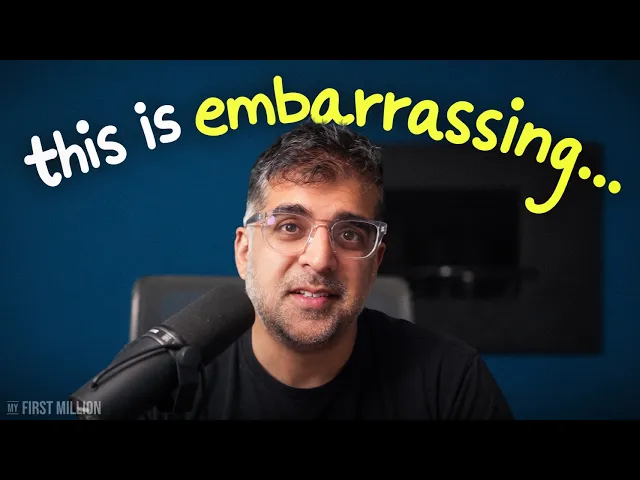
3 times life put me in my place: transcript
- My First Million
- 21:58
- English
- auto-generated captions
AI summary
In this episode, Shaan Puri shares three embarrassing personal stories and the lessons they taught him. First, after selling a company, a personality test revealed he scored 110 on narcissism, leading him to realize that seeking external validation can turn heaven into hell, and that he must get clear on what makes him special. Second, at 21, he and friends pitched a 250-page business plan for a sushi chain to the founder of Noodles & Company, who told them it was nothing and that starting a restaurant requires action, not planning. This taught him to worship at the church of action. Third, as a shy teenager, he wrote a love note to a girl but lied about its recipient, then later reinvented himself when moving to China, learning that the decision is upstream of all action. He concludes that embarrassment can be a door to growth if you ask what you gained.
AI-generated from the transcript below. Check anything that matters against the video.
Key points
- Shaan scored 110 on a narcissism scale, which he initially took as a win but later saw as a mirror.
- Narcissism involves feeling special without knowing specifics, leading to seeking external validation.
- You can make hell out of heaven if you're in your own head and not filling your own cup.
- At 21, Shaan and friends pitched a 250-page business plan for a sushi chain to a Noodles & Company founder.
- The founder told them the plan was nothing; starting a restaurant requires action, not planning.
- Inspired by Seinfeld, Shaan adopted a 'do the opposite' approach and became a man of action.
- As a shy teen, Shaan wrote a love note but lied about its recipient, digging a deep hole.
- Moving to China, his sister suggested he could reinvent himself, leading to the insight that decision precedes action.
Transcript
- 0:00
All right, today I'm going to talk about some embarrassing stories that happened to me. These are three moments where I felt that sting of embarrassment, but something changed in me because it was it was so painful. As they say, sometimes the wound becomes the door. I think in every social situation, I am fundamentally, at some level, just actively trying to avoid embarrassment. Probably even more than trying to avoid like pain and death, because I don't even want to think about those, but I definitely think about ways I could be embarrassed. And yet, embarrassment seems to find me, and it finds me, you know, somewhat often. And and you know, there there is an upside to the embarrassment. After the the sting wears off and the pain is gone, there is usually some sort of learning, some sort of growth, some sort of benefit. But even knowing that, I don't go look for embarrassment. I still actively try to avoid it. So, the first story, I recently sold a company and made more money than I've ever made in my life.
- 0:59
And with that gain comes the obnoxious problems that nobody wants to hear about, where you're just sort of like, I don't know what to do anymore. And so, I hired this coach, this sort of like life direction coach. And he has me take a personality test at the beginning. And he tells me this personality test is going to be kind of weird. It's not like a normal one. But he's like, don't worry, just answer all the questions. So, I'm answering all these questions. Some are about work, some are about personal life, some are about relationships. I answer all these questions. I thought it was pretty straightforward, pretty easy. And I tried to answer them as honestly as possible. A few weeks later, he says, "You want to see the results of that test?" Yeah, absolutely. And he pulls up this slide. Like, there's like all these categories, and I have low scores in all these categories. And there's one score where I'm off the charts, and I squint and I lean in to zoom to see what it is.
- 1:42
And it just says, "Narcissism." >> [laughter] >> I had, no joke, 110 on the scale. It was over 100 [laughter] on the narcissistic personality tendency score. And as a narcissist, I was like, "That's right. >> [laughter] >> I win." And so, I'm like, "What is this?" And he's like, "Yeah, so um you scored very high on this thing." Is this guy calling me an and like arrogant and narcissistic? And am I?
- 2:16
Wait, I kind of am. What does that mean? And so, my head is swirling. I'm not even listening to him for the next 5 minutes. I'm just again, thinking about myself. And proving his point. And I actually learned something pretty valuable about myself. And I'll share with you the the lesson. Probably most of you won't score 110 or 115 on the narcissism scale, but maybe some of this might apply to you. So, the thing about this trait is it's not a judgment or an insult, but it is something to be aware of. >> [laughter] >> I was like, "Okay." So, he was like, "People who have this trait, what it means is that they feel like they are special and their life and their life is going to be special. And that the norms of the world, the averages, the rules of the world don't fully apply to them. Sound familiar?"
- 3:00
>> [laughter] >> Yes. Actually, I remember feeling that in on the test. Absolutely. And I've always taken great pride in that of not wanting to be ordinary, of wanting to be extraordinary, of wanting to have a special life, of feeling like, you know, great. You can tell me all the averages. Those don't apply to me. I'm the outlier. And he goes, "That's served you, hasn't it?" I say, "Yeah." "Well, what's served you can also screw you. The dose makes the poison. If you believe that to be true, then you're not going to accept you know, that you shouldn't go start a business. 90% of businesses fail."
- 3:32
Well, I'm special. I'll be different. And you'll take it'll get you to go take action. But the thing about it, why it's called narcissism instead of just self-confidence or self-belief, is you don't know what it is that's special about you. There's a vague sense that there's something special, that something is going to happen here, but but you don't have any specificity on it. And because you don't really know it and really understand it and really understand the specifics of it, it's fuzzy. And when it's fuzzy, you go searching for validation in other places. Meaning, you want others to see you as special cuz it validates that that thing inside you that you felt was special about you. So, you might be more active on social media, creating content, or public speaking. I'm like, well, yep, yep, check, check, check. You know, definitely have have oriented my entire life around that. Uh that sounds sounds correct. There's a danger in that in seeking that validation of your specialness because you'll get a high high when you get it, but you'll get the a lower than normal low when you just lack it. Not even somebody says something bad about you, but they just
- 4:29
don't you don't feel seen as special. Does that sound familiar? And I thought about I host this event with 30 of the most unbelievable people on earth. You know, founders of the biggest companies in the world. But every so often in this event, I feel this pang of insecurity. And I want them to know how how awesome I am and how special I how great I am. I don't say this out loud, but deep down that's what bothers me, right? Like that's that's the part I'm feeling feeling bad about cuz everything is going great at the event, but I am feeling bad. I've gone to heaven and I I'm feeling hell. And a man could do that. You can you can make hell out of heaven if you don't if you're not careful, if you're in your own head.
- 5:06
And I said, well, is there something I could do about this? He said, well, yeah, you can you you know, first step is just being aware of it, noticing when that might be happening, catch yourself before you fall down a a trap. But the second part is get clear. Get clear about what it is that is special about you so you don't need it from others. When you filled your own water cup, you're not waiting you're not sitting around waiting for the waiter to come back. I think that's a very powerful idea. Many many of you probably like me where you seek some external validation, some external praise, some external awards, some external whether it's grades or money or praise or whatever as a substitute for just filling the cup up yourself. And when you fill the cup up yourself because you understand what makes you great, you could just kind of be comfortable in your own skin, which I think is one of the greatest feelings on earth is when you feel totally comfortable in your own skin.
- 5:54
You don't feel like you need to be anything more than you are. And I don't think I've achieved that yet, but I've definitely taken the wound of seeing the 100 and 110 or whatever on the narcissism scale and saying, "Mhm, okay. That's a somebody held up a bit of a mirror and I can maybe I don't love what I see, but at least I see I see what it is. And now I can you know, I can adjust accordingly. The truth is such a rare gift. One time I got a call from Scott Harrison of Charity: Water and I know Scott, but I we're not friends like we don't call each other. It's the first call I've had in 10 years from him. You got a minute? Yeah, yeah, I got a minute Scott, what's up? Hey man, I was listening to your podcast. You know, you do a good job.
- 6:32
But you want to be great at podcasting, right? This is like your thing? You really care about podcasting? I was like, yeah man, it's my thing. You got to stop saying like. You say like all the time. Huh? >> [clears throat] >> Dude, you're saying like all the time. You say like 500 times in an episode. Oh, yeah, yeah. Yeah, that's true man, I should I should work on that. Yeah, yeah, you really should. You could do it. You could fix it. It's not that hard. Just pay attention to it and do it and you you'll be so much better at it. You're doing so many other great things, but this like thing is crazy and I I just wanted to tell you that man cuz I know that this is important to you and I wanted to to make sure you're aware of it. You might not know.
- 7:06
And you know, at first you know, I'm simultaneously having two two reactions. The embarrassment of getting called literally called out on saying the word like too much as a podcaster. On the other hand, I really appreciated it. I was I was thinking man, who how many people in my life could I count on to tell me the truth in a way that is completely uncomfortable for them and not self-serving in any way, but they just literally he came by and just dropped something off at my door that would be helpful. And so Scott, thank you for that. I'm I'm still working on it. All right, I'm going to give you the second one. I'm 21 years old and me and my two buddies have had this brilliant idea to start a new restaurant concept. We think we're going to be the next Chipotle, the next Subway, the next Five Guys, and we're going to do it in the world of sushi. Now, you might be wondering, how does somebody who looks like me start a sushi chain? Many people wondered this. Many of the investors we pitched wondered this. And there really was not a good answer. I was not a
- 8:06
foodie, I was not a sushi chef, I had not grown up eating sushi. In fact, before I had this idea, before this moment of embarrassment, I had really tried sushi like 3 months prior or 5 months prior, something like that. But I had the confidence that a beginner has. You know, when you're young, you do have one great asset. You you lack experience, you lack knowledge, you lack skills, but you do have the beginner's mind and the beginner's confidence, where you don't know what you don't know. So, I think at this stage, I think I know what I'm doing. And why do I think that? Because I had won a business plan competition. I had written a business plan, and we won this competition. So, we cold emailed the founder of Chipotle, we cold emailed the founder of Quiznos, we cold emailed the founders of all these different companies, and one replies to us, the guy from Noodles and Company, if you've ever been to Noodles and Company. And so, he invites us out to lunch, and we get to go and and show him our plan. And we're hoping for some great advice. So, for the last 3 months before this, I had been working on bringing this business to life. And in my mind, what that meant
- 9:05
was take that business plan that had won the competition, really flesh it out, leave no stone unturned. I really subscribe to this kind of hard work grind set mindset mentality, but my version of hard work was what it is for many people, where you avoid the actual work, and you instead do the the flavor of hard work that you feel more comfortable with, that you you feel safe in. And for me, that was planning. And so, we were writing our plan, we were creating forecasts, financial models. We were planning everything from like what our employees would wear, and how our managerial system would work, where somebody would get promoted and what would that would take. And we thought that was a symbol of um preparedness.
- 9:43
And so we walked in ready to impress this guy. We printed out this binder. It was like this thick. And uh you know, it's I think it's like a 250-page business plan, which is if you know anything about business, you already know where the story's going. The last thing you want to do as a founder is build something that nobody wants. You might dedicate years of your life just building, building, building only to find out at the end that nobody even wanted the thing in the first place. The better way is to validate your idea as you go. Earlier the better. So, the team over at Starter Story, which is part of HubSpot, has made a guide for validating business ideas.
- 10:13
It's templates and case studies to learn how to validate an idea and how to start uh doing that before you build too much. And it shows you how the best founders test their ideas before wasting months building the wrong thing. You can get the guide for free. You can scan the QR code on the screen or click the link in the description below. All right, back to the episode. And so we go, we sit down, and he says, "So, tell me, what are you guys doing?" I said, "Well, I could tell you. Or I could show you." And I thump this business plan on the table dramatically. And uh I said, "Take a look at this.
- 10:43
This is a business plan that we've been writing up, and um I think you're going to like it." >> [laughter] >> And so he starts flipping through, and I notice he's not really reading it. He's flipping through and I and pretty quickly he's just trying to grock like what the hell could possibly be in this 300-page binder. And I'll never forget because I've I've already realized at this point that it's not going well, and I'm bracing myself for rejection. But, you know, I as a entrepreneur, I was prepared for rejection. I had actually experienced a little bit of rejection through trying to sell, trying to pitch investors. So, I was hardened to that. I was ready for that. I braced myself for that. But it was like I thought someone was going to hit me in the face, and then they just punched me in the gut cuz he did not reject us or say anything mean. Instead, I could see on his face he was trying to work out how to be nice to us cuz we were so hopeless that it was not rejection it was pity.
- 11:36
And he didn't even really know what to say so he started trying to just be like, um, look guys you know you put a lot of thought into this. And he goes down that road and you know, halfway through I'm like hey man, you could just tell it to us straight and he goes, okay, um, I'll give it to you straight. This is nothing. What I don't know what you're doing. I don't know why you were doing this but this is not how you start a restaurant. You start a restaurant by going around finding a location, paying the lease, you know, you're putting down a deposit and you know, saying we're going to open the doors in the next 90 days and getting going and start serving customers and start figuring out how to make them happy. That's what it means to start a restaurant, not this. So we kind of go home with our tail between our legs and I just remember we didn't even get in the we like got in the car but we didn't drive. We just like had a moment of silence the three of us friends who were co-founders of this company. And we didn't even really talk. We didn't know what to say. It was very It was It was just embarrassing. It was like, okay, we didn't lose anything except for our
- 12:35
dignity. Like that guy didn't He wasn't a part of our life the day before. He's not going to be a part of our life the day after but like, wow. We really thought we were doing something right and we just got smacked. So we go home and we procrastinate. We turn on just a great episode of Seinfeld where George walks in and George sits down and he goes, Jerry, I don't know what I've been doing with my life with my life. You know, he's like, I don't know where I went wrong. I was a promising young man. He's like, and here I am and he describes the state of his life. You know, he's like, I'm single, I'm balding, I'm blah blah blah and he just starts to describe how his life his life did not go the way he wanted.
- 13:12
That's how I felt in that moment too. Life was not going the way I wanted. We're living in Trevor's Aunt Patty's basement. We're no closer to the restaurant than we were 5 months ago. We've just been wasting our time with this plan. The guy who's done this before told us this is nothing. Don't even do this." And so, like George, we were I we we realized we had gone far wrong. And in that episode, the waitress comes up and she's like, "Can I take your order? You know, the usual, George?" Yeah, yeah, I'll take the chicken salad. And then right before she walks away, he goes, "No, no, no. Wait. Every day I eat chicken salad. And chicken salad has got me here. Today, I'm doing the opposite."
- 13:47
What's the opposite of chicken salad? Tuna on toast. I'll have the tuna on toast. And um and so he changes his order right there. And she's like, "Okay." She leaves, and then he sees this beautiful girl at the at the counter sitting there. She kind of was looking at him there. And you know, Elaine's like, "You know, George, she's looking at you. Go talk to her." He goes, "Well, talk to her? Why would Why would she talk to me? I'm a I'm a loser who's blah blah." And then she goes, "That's what the old George would say. So, what's uh what's the opposite?" He goes, "The opposite I would I would approach her.
- 14:18
And I would tell her." And so he goes up to her and he says, "I'm George. I'm single. I live with my mother." You know, he's he's introducing himself as a loser instead of uh playing himself up, and she loves it. And so, that day I was like, "Okay. Same as George. From now on, I'm doing the opposite." So, I went from a I said, "Well, what were we doing so far? So far, we were planning everything. We were trying to be buttoned up to impress people like this guy from Noodles & Company. Forget it. We're not going to be It's not going to be about planning. It's going to be about action. It's not going to be about impressing others. It's going to be about doing the thing. Actually doing it. So that, you know, I don't Who cares? We don't need their approval.
- 14:54
We're we're no longer in school. This is the real This is the real world now. We're We're actually graduated. We're in the real world now, and I got to change my approach." And so from then on, I decided to become a man of action. And I became religious. And I worshipped at the church of action. And I everything just became about action. And so if there was ever a choice between action and inaction, I had to be tuna on toast, baby. I had to take action. And that really served me. A year later, we met this mentor. He gave us some advice.
- 15:22
And like 48 hours later, we came back to him and we're like, "Cool. So, um we did those three things and this is this is what we learned and here's where we're at now. Um you know, here's what we're thinking next. Let us know if you have any ideas." And he was pretty blown away. And we just did that like three times with him and then he wrote this blog post for the world to see and he said, "I met these founders recently and I don't know if their idea is any good or not, but they have the highest bias for action of any founders I've ever met." And it was sort of a validation of the the you know, going from chicken salad to tuna on toast. So, the embarrassment once it wore off, it had a had some some powerful effects on me. Let me give you the third story. You may not know this cuz now I'm a talker for a living, but I was very shy growing up. I remember once my sister pointed this out. She you know, I have an older sister. She likes to make fun of me and she called me the laugh track because you know, like in a sitcom, you have all the characters. You have the the main character, then you have his love interest, then you have the the the buddy, the sidekick.
- 16:17
At school, I was none of those characters. I was literally the laugh track. The background of the background. Uh not even a background character. I had a few friends, but I I was basically just this kind of NPC that was walking around school. And um I really liked this girl and you know, it's pretty scary as a teenage boy to to go tell a girl you like her. So, I thought, "Okay, I'm going to write this note." So, I wrote this note. I'm calling it a note. It's probably a poem, but that's even more embarrassing. So, I'm just going to call it a note for now. And it was basically like describing this girl and how much I liked her.
- 16:46
But it was like describing her in abstract terms. Like I didn't say her name, but I just felt this girl, she's so great, you know, blah blah blah. And then so I the New Testament, the Old Testament, and I wrote the cringe testament. So, I have it and um I kind of like planned for her to see it at her locker right next to mine. And so, I'm like at the locker and I like have the note and I like drop the note and whatever. She picks it up. She's like, "What's this?" And I was like, "Oh, it's this note I wrote for this girl." And she opens it up. She's like, "Oh." And she reads it. And I'm I'm totally friend zoned at this stage. So, she's just amused. Like, what is Shawn doing? So, she reads this note and she realizes it's this like very like this love letter basically.
- 17:23
And 14 15 year old me is is sitting there. I'm waiting for the reaction. I'm waiting for her to to to love it. I was so far in the friend zone that her reaction was who's this for? Like she couldn't even imagine that this was for her. Certainly this must be for somebody else cuz like the the feeling I had and the feeling she had was so far apart. And so in this moment she asked who's this for? And I immediately you know embarrassed and I'm like I should just say it's for you and just see what happens and just face the music.
- 17:55
But I'm a coward and I don't do that and I say um it's this girl I met. And I make up this fictitious girl that I met at some you know some competition that weekend from oh and she goes to another school. I literally did the girl from girlfriend at another school. And then not even girlfriend just a girl I like at another school. And she's like that's so sweet. And then six months I basically had to keep up the appearance how it's going with this girl cuz she would ask me for updates and I dug the the lie so deep.
- 18:24
In fact if she's listening to this today she probably now just now is realizing that that note was about her cuz I never came out of the hole. I just dug dug dug dug dug until my family literally said we're moving to China and I moved from Houston Texas to China in in the in 10th grade. And so as I now I'm moving to China and I've I've you know basically decided I guess I'm just sell a bit and like you know it's just not it's not for me. My sister who called me the laugh track and knows that I was not particularly popular or successful at school definitely not successful with girls.
- 18:54
She has this conversation with me on the plane and she says um you know the school you're going to nobody here knows you. You're going to go in and they're all going to know each other they're not going to know you. And I was like wow like thanks for you know piling it on older sister. And she but she was actually going from a good place. She goes so you know what that means, right?" And I go, "What?" And she goes, "You could be anybody." I go, "Well, what does that mean?" She's like, "They don't know you're laugh track. They don't know who you are. So you can just be a different guy." And she's like, "Who is Who is the coolest guy at your school? Like the guy if you were him, you would want to be him." And I was like, "Oh, it's this guy, Casey Breusman." And I was like, "Yeah, it was Casey Breusman. He was He was the class clown. He was athletic. He was nice guy. He was nice to everybody." And I just loved this guy. I was like, "Yeah, he was He was a great guy."
- 19:39
She was like, "Well, when you get off this plane, you could be him. You could just go to that school and you could be him. They don't know that you're not him." And I realized that life really is that simple. You actually don't have to move to China for this, but you can reinvent yourself like that. You can literally reinvent yourself today. You can say, you know, that Yeah, that's who I was. Well, now I'm this other guy. Now I just do this other thing. And it's literally a It starts with a decision. The decision is upstream of all action. And when I went to this new school, I just decided, "What would he do?" And I would just do that thing in that situation. And you know, at first it felt a little uncomfortable or odd or like I was acting, but pretty soon I just realized like, "Well, I can just do those things.
- 20:18
That can be me." And so I realized the power of reinventing yourself. And I've since reinvented myself several times. And I've taken stripped off labels off off me and put new labels on. You know, before I started this podcast, I was an entrepreneur. I was a tech entrepreneur. That's what I did. And I got my value and my worth from that. And my friends that And that's how I introduced myself. And that's what I thought I would do every day. And then one day I decided, "You know what? I think I want to be Tim Ferriss. I think I can say things that will entertain people and will contain enough insight that they'll walk away being like, 'I kind of want to listen to that guy again.'" And I just decided that.
- 20:52
I wasn't that yet, but I believed it and I decided it. And so the next day I just thought, "Well, what would Tim Ferriss do today?" He probably wouldn't go to meetings. I don't think he does that. And so I created a show and I booked a studio and I got my friend to be my first guest. And that became episode one of My First Million. And that's how this podcast started, just by literally reinventing myself at the drop of a hat. So, those are three stories of embarrassment where the wound became a bit of a door. And uh wanted to share those with you today. I hope you enjoyed them. Hope you took something from them. If nothing nothing else, a nice laugh at me. Uh but maybe there's something from your own and maybe there's maybe there's a moment uh either upcoming where you could remember, "Hey, yeah, I might have lost something here.
- 21:30
I might have lost a little dignity, but what did I gain?" Um there is a gain. The question is of what? And when you start to answer that question, you know, you start to grow from it. All right, that's it. I'm out.
Questions
AI-generated, and answered only from the transcript.
What did Shaan learn from scoring high on narcissism?
He learned that narcissism means feeling special without knowing specifics, which leads to seeking external validation. He realized he needs to get clear on what makes him special so he doesn't need it from others.
What was the embarrassing business story Shaan shared?
At 21, he and friends pitched a 250-page business plan for a sushi chain to the founder of Noodles & Company. The founder told them it was nothing and that starting a restaurant requires taking action, not just planning.
How did Shaan change his approach after the business embarrassment?
Inspired by a Seinfeld episode where George does the opposite, Shaan decided to become a man of action. He stopped over-planning and started taking action, which later impressed a mentor.
What happened when Shaan gave a love note to a girl in school?
The girl asked who the note was for, and Shaan lied, saying it was for a fictitious girl from another school. He then had to keep up the lie for months until he moved to China.
What lesson did Shaan learn from his sister on the plane to China?
His sister told him that since no one at the new school knew him, he could reinvent himself and be anyone he wanted. This taught him that the decision is upstream of all action.
How did Shaan apply the reinvention lesson to start his podcast?
He decided to become like Tim Ferriss, asked what Tim Ferriss would do, and then created a show, booked a studio, and got a friend as the first guest. That became episode one of My First Million.
Related transcripts
In this episode, Robert Greene discusses his late career breakthrough, revealing he felt like a loser until he wrote The 48 Laws of Power at…
In this episode of the Mel Robbins podcast, Mel interviews Professor Marina Cooley, an award-winning marketing professor at Emory…
This Crash Course Astronomy marathon, hosted by Phil Plait, is a full-series tour of the universe. It begins by defining science and…
This Crash Course episode examines why U.S. politics has become so divisive, tracing the roots of polarization over decades. Host Kousha…
This Crash Course Geology episode explains what glaciers are, how they form, and how they shape landscapes. Glaciers are huge masses of ice…
In this episode, Robert Greene discusses his book on the sublime, a project he delayed for years after reading about the concept in 2000. He…