An Update on My Next Book: transcript
- Tim Ferriss
- 10:53
- English
- auto-generated captions
AI summary
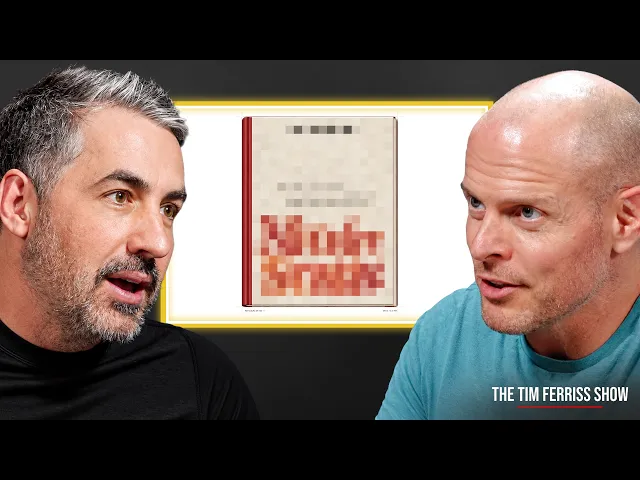
Tim Ferriss discusses his upcoming book, which he aims to finish in eight weeks. He reflects on his third book, which sold 120,000 copies in its first week but failed to connect with new readers because it tried to do too much. He emphasizes the importance of a simple, differentiated premise, like 50 Shades of Grey, and the 'crowded bar test' for explaining a book or product in two sentences. His new book is about saying no and focusing in a world of noise, but he is concerned that the title and description may not resonate with a broad audience. He is leaning toward publishing with Authors Equity, a company where James Clear is a major investor, and is considering formats, including print, to encourage single-tasking. He cut the book from 870 pages to 350, ensuring every remaining part is rated highly by test readers.
AI-generated from the transcript below. Check anything that matters against the video.
Key points
- Tim's third book sold 120,000 copies in its first week but failed to attract unfamiliar readers because it tried to do too much.
- He advises that presentations and books fail from too much information, not too little.
- The 'crowded bar test' requires explaining your idea in two sentences so someone says, 'I'll check that out.'
- His new book is about saying no and focusing in a world of noise, but he worries the title may sound negative.
- He aims to finish the book in eight weeks and is leaning toward publishing with Authors Equity.
- He cut the book from 870 pages to 350, keeping only content rated 8-10 by test readers.
- He prefers print to encourage single-tasking, calling the book a giftable workbook that saves time if used.
Transcript
- 0:00
My third book for our chef, that's where it failed. It tried to do too much. It was like three books in one. It was not a simple premise. It was very >> cuz I felt like it was well received? >> well received. I mean, it sold hundred hundreds of thousands of copies. It sold like 120,000 copies the first week. But, that was a function of my die hard audience who would take me at my word that it's worth reading. But, if you if you went blind, unfamiliar with me at all to the say Amazon page, it tried to do too much.
- 0:34
And I think this is true with presentations. Like if I'm talking to someone who's going for instance, I was just coaching someone who's going on a 60 Minutes, right? And they wanted to talk about messaging. >> Mhm. >> And or if I'm talking to somebody who's got a TED Talk coming up and they're they're asking for advice. You know, my advice is is always the same. I didn't come up with this. Somebody else gave it to me, which is like a presentations fail from too much information, not too little information. And I think that's true with books, too.
- 1:03
It's like does this conjure a simple image in someone's head like immediately? And that is not easy to do while being differentiated, right? So, 50 Shades of Grey nailed it. Completely nailed it. And that has turned this thing into a global phenomenon, right? Whereas this third book, which I'm still very proud of. I think it's a great book, but it it's really three or four books combined into one. And to try to convey that to anyone in a paragraph is next to impossible.
- 1:32
>> Yeah. I mean, the same applies to so much in life though. I mean, even on the product side of all the products that I've built over the years, it is you know, I don't know. Watch entrepreneurs going to launch new consumer products or whatever may be, the ones that boil the ocean and throw in every single feature. And they're like, "Oh, but wouldn't it be great if it had this?" And I'm like, "Yeah, maybe someday." Yeah. But, can you really distill down this idea to that one concept so that when you're in that, I used to call it the crowded bar conversation. Not the elevator pitch, but the crowded bar. Like, if you want to say in two sentences what your thing does.
- 2:06
>> Yep. >> Can you get it out to there where they say, "Oh, yeah, I'll go check that out." >> Mhm. >> You know, and oftentimes you can't do it. So, the battle is cutting features out. This is what Steve Jobs was so good at. >> It's like he could have added App Store on day one for the iPhone, but it was like he didn't. He was like, "It's going to do these 10 things really well." And then slowly build on on that base, you know. >> Yeah, I mean, if if the V1 iPhone could get away with no copy paste, remember that? >> Oh, yeah. >> That's right. >> Sucked. Bro, talk about >> [laughter] >> minimalist.
- 2:37
>> Yeah. >> So true. >> And this is also part of the reason why, frankly, the the [clears throat] book that I'm working on right now is has taken so long, cuz I'm like, "It's not ready just yet." Because the way that I try to explain it in like the crowded bar test, >> [snorts] >> and there are ways I could probably do market analysis to get more comfortable or to confirm or disconfirm this a concern, maybe, but if I talk to, say, some of our friends who are super busy, right? And I tell them it's a book on saying no.
- 3:09
>> Mhm. >> And focusing in a world of noise, right? How do you create systems for that? They're like, "Fuck, I need that right now." >> I would please send it send me the draft today. I don't care if it's right. >> But for nine out of 10 people who are not like one of our friends or one of the podcast guests who have been on. When I tell them that, I do not see like the slight eye opening and lean in. I don't see it. They're like, "Oh, interesting." And I'm like, "Hm." >> Is it because most people are looking for more things to say yes to because they don't have the opportunity?
- 3:40
>> Well, this is what I'm working on to do saying, like, is it the title? Maybe it's the title, right? So, I was just playing around with that yesterday. >> Mhm. >> Is it the description where the promise is unclear. >> Mhm. >> Is it the fact that it sounds perhaps negative instead of affirming? >> Mhm. >> Right? Saying no versus something else. Because a third of the book actually is like how to pick the one or two things that change everything to say yes to.
- 4:11
>> Right? So, it's like, "Hmm, maybe the book positioning should be more focused on that." >> Mhm. >> It would require a very heavy lift on like revamping a bunch of the positioning in the book or explanatory stuff in the book. Uh but I am trying to learn from past mistakes, right? I don't think this book tries to do too much. I don't think that's probably an everybody who actually reads it and test reads it and they're like, "I was never bored. Like, I would gift this book to my friends more than any of your other books." So, it's like it's working.
- 4:41
But if people go to the Amazon page and the title and the description don't work, it doesn't matter. You're dead. >> Right? >> Mhm. >> So, that like 50 Shades of Grey genius >> Mhm. >> I want to get that right, which is part of the reason why I'm like, "I don't need to publish a book." I didn't take an advance, right? Which I mean has its own drawbacks. I don't have a gun to the head. I don't have accountability to a publisher, which is actually can be a bad thing. Because like we have 20 different things we're doing at any given time. It's very easy to be like, "Yeah, I'll just push it off another 6 months. It's fine." And that's actually not a great thing when it comes to writing books.
- 5:17
>> [snorts] >> So, TBD. But that'll get figured out. I feel pretty confident in that. You know, the my aim is to have the book done in the next 8 weeks. >> Oh, wow. >> Yeah. >> And so, when you go from that to no publisher, like how do you think about printing? How do you think about distribution? Are you going to do like Author's Equity or >> Yeah, I'm leaning I'm leaning towards Author's Equity. I'm a small investor in that company. I mean, not enough to >> People should know that it's James Clear's like from >> Clear is one of the largest investors. I mean, talk about a phenomenon, man. Holy [ __ ] What is it? 25, 30 million copies sold?
- 5:51
Nobody does that. In prescriptive non-fiction, nobody does that. I mean, James is a non-recurring phenomenon. Very nice guy, very smart guy. And he's he's one of the largest investors in Authors Equity. Great team at Authors Equity. So, I'm leaning towards doing something with them. I don't know what the exact form it'll take, right? Do I do all formats? Do I do some formats? I'm not overly worried about that. I was just chatting with them the other day just to figure out like, what are the actual lead times if we're going to do the dead tree format in addition to other things? I thought about only doing Kindle and Audible, but I feel like this book Here's a hot take. It's like a giftable book. It's a giftable book.
- 6:33
Here's the other hot take. It's like the more this become I'm holding up my iPhone. The more these become a digital leash that is feeding you 24/7 distraction, the more I want to have a format that forces people to single task. And the only option for that right now, I suppose you could do it on a Kindle if people are using an actual Kindle device that is not internet connected for distraction. But, print is a great way to single task.
- 7:04
And this is also this is a workbook. This is not a passive spectator book. If you put in the work, like if you put 4 hours [snorts] of work into this book, it should save you Yeah. If you put four, let's call it five. If you put five hours of work, inflation. If you put five hours of work into this book, it's like it should save you 100 hours in the next year if you're a busy person. Like without question.
- 7:30
And it it just goes up from there. So, So, we'll see. But, the goal is to be done in the next eight weeks. >> What is the lead time just out of curiosity for someone looking to make a actual physical book? Like is it 3 months, 5 months? like what >> It depends a lot on who you're talking to. >> Yeah. How big the first run is, right? >> Yeah, and what Yeah, the the size doesn't matter as much as you might think. If it's a simple page layout, black and white, or two color, >> [snorts] >> I would say it's still pretty slow, right?
- 8:01
But, there's a lot that goes into it, right? Like, if you're going to get a polished book and you're not just self-pubbing whatever comes off your laptop, if you're going to have copy editors and professional layout and so on, like there are things that make that easier. I'm sure AI could do a lot of page layout at this point. I'm sure people are developing harnesses that'll help with that specifically. But, if if you're looking to have And I'm not sure how relevant this is to me at this point, honestly, in terms of like retail distribution. I don't know how much it matters in terms of market share at this point. Things are changing so quickly and have been changing so quickly.
- 8:36
But, if you really want like the full traditional experience, I would say from what you consider a finished book, but there's still people who are going to do copy editing and everything else, probably a year. >> Wow. >> Yeah, maybe more. >> slow. >> Now, there are cases where you can do a crash book where it's like, okay, let's just say I mean, this is maybe not a lovely example, but it's like Princess Diana dies. Publisher wants to be first out of the gate. Can they get a book printed out the door in 3 months? Yeah, they can. If they make it the top priority and everything else goes to the back of the line, >> Mhm.
- 9:11
>> Yeah. If in most cases, if their primary distribution is in the US and they have printers in the US, a lot of publishers print overseas. Um so, those are all factors that go into it. And like, part of me is like, "Ah, man, once I'm done with this, I want it out ASAP. I don't want to like wait for a year." So, like, what does that mean? Do I not do print? Right? Right? Do I I some small print run? >> It might be interesting to just do one print run ever.
- 9:40
>> Yeah, do I do do I do publish on demand? Right? Like that you can get out the door quickly with with with POD and the quality has gone up a lot. But the collectibility of a single run of like 10,000 could be really interesting. >> [laughter] >> I mean, yeah. I could do that. >> I mean, who knows? Maybe I do that and then I'm like, "Hey, if you want the book like you can either get a hard copy now and there are 10,000 copies >> Right. >> or you can get it in a year. Or you can get it in a format. >> Yeah, right. I mean >> That's cool. >> So I get I get excited about it.
- 10:10
It's a strong book. Like I I feel very, very good about it. I wouldn't I mean, I wouldn't put it out otherwise. I cut it from I think it was 870 pages down to like 350. That is a lot of cutting. >> Holy [ __ ] >> a lot of cutting. So everything that is in the book right now has been rated by proof like test readers and proof readers, multiple test readers as an eight, nine, or eight, nine, or 10 out of 10 in quality. Like everything that remains is kind of cream of the crop.
Questions
AI-generated, and answered only from the transcript.
Why did Tim's third book fail to reach a wider audience?
It tried to do too much and was like three books in one, so it was not a simple premise that could be easily conveyed.
What is the crowded bar test?
It is the ability to explain what your thing does in two sentences so that someone in a crowded bar would say, 'Oh, yeah, I'll go check that out.'
What is Tim's upcoming book about?
It is about saying no and focusing in a world of noise, and how to create systems for that.
How long does it take to publish a traditional print book?
From a finished book, it can take about a year or more, depending on factors like copy editing, layout, and distribution.
Why is Tim considering a print edition?
He wants a format that forces people to single-task, and print is a great way to do that, especially as phones become digital leashes.
How much did Tim cut from his book?
He cut it from 870 pages down to about 350 pages, keeping only content rated 8-10 by test readers.
Related transcripts
In this episode of My First Million, Shaan Puri and Sam Parr discuss the diamond industry as a marketing masterclass. They trace how De…
In this episode of the Mel Robbins podcast, Mel interviews Professor Marina Cooley, an award-winning marketing professor at Emory…
This Crash Course Astronomy marathon, hosted by Phil Plait, is a full-series tour of the universe. It begins by defining science and…
This Crash Course episode examines why U.S. politics has become so divisive, tracing the roots of polarization over decades. Host Kousha…
This Crash Course Geology episode explains what glaciers are, how they form, and how they shape landscapes. Glaciers are huge masses of ice…
In this episode, Shaan Puri shares three embarrassing personal stories and the lessons they taught him. First, after selling a company, a…