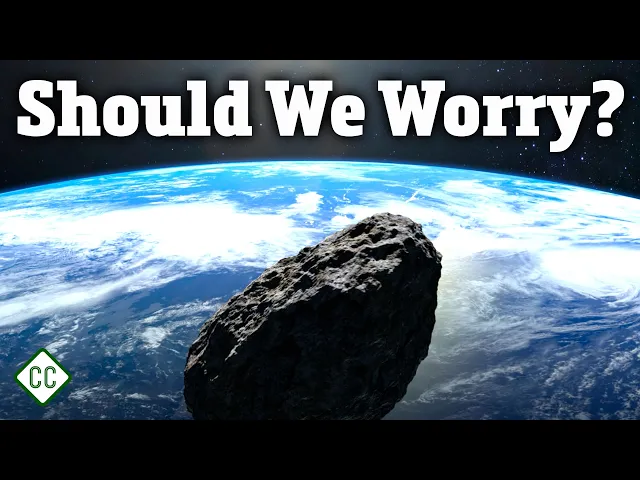
How Often do Asteroids Hit the Earth?: Crash Course Geology #20: transcript
- CrashCourse
- 10:33
- American English
AI summary
This Crash Course Geology episode explains the differences between asteroids, meteoroids, meteors, and meteorites, and how often space rocks hit Earth. About 48.5 tons of space debris strikes the planet daily, but most burns up harmlessly in the atmosphere. An asteroid is a rock orbiting the sun that is more than one meter across; smaller pieces are meteoroids, which become meteors when they burn up in the atmosphere, and meteorites if they reach the ground. Only one recorded meteorite strike on a person exists, in Alabama in 1954. Larger impacts are rarer: a 140-meter asteroid hits roughly every 20,000 years, while globally devastating impacts occur every 100 million years at most. The episode recounts the Chicxulub impact 66 million years ago, which killed about 75 percent of life, and notes that NASA now tracks asteroids and, in 2022, successfully redirected one with the DART mission.
AI-generated from the transcript below. Check anything that matters against the video.
Key points
- Earth receives about 48.5 tons of space rocks daily, but most burn up in the atmosphere.
- An asteroid is a rock orbiting the sun that is more than one meter across; smaller ones are meteoroids.
- Meteors are shooting stars that vaporize in the atmosphere; meteorites are pieces that reach the ground.
- Only one recorded meteorite strike on a person occurred, in Alabama in 1954.
- A 140-meter asteroid hits Earth roughly every 20,000 years; global killers every 100 million years at most.
- The Chicxulub asteroid 66 million years ago killed about 75 percent of life, including the dinosaurs.
- NASA tracks asteroids and in 2022 the DART mission successfully redirected a 160-meter asteroid.
- No known asteroids large enough to be damaging are on track to hit Earth in the foreseeable future.
Transcript
- 0:00
The sky is falling! ...Sort of? Our planet gets pummeled by about 48.5 tons of space rocks every day. That’s the weight of seven and a half elephants falling from the heavens, 24/7. Most of that cosmic debris is harmless— it’s so tiny it burns up in the atmosphere before it rains down on Earth. But what about the really big rocks? The asteroids that could wipe out life as we know it? The truth is, they’re out there, and they’ve collided with Earth before. Today, let’s talk straight about rocks from space. They’re at the top of my Things to Worry About List.
- 0:30
Hi, I’m Sage, and this is Crash Course Geology. [THEME MUSIC] You’ve seen the movies. “An asteroid is headed straight for Earth! Everyone panic! Run for your liiiiiiives!” Thanks, Dwayne. I really should go on more movie auditions. But despite all that drama and disaster, space rocks are sort of… run of the mill here on Earth, hitting its surface daily like a light drizzle. Most of the time. So… what exactly are they? Most space rocks are leftovers from the moment our solar system formed, some 4.6 billion years ago.
- 1:00
And we differentiate them in a few ways. An asteroid is a rock that orbits the sun and is more than one meter across. Basically, anything with a diameter longer than a baseball bat, but not big enough to be a planet with its own gravitational pull. That’s why asteroids are sometimes called a minor planet. Oooh, burn. Most asteroids hail from the asteroid belt— an area between Mars and Jupiter that’s chock-full of space rocks, some of them hundreds of miles across. A trip to the asteroid belt would be like… what am I thinking of? That video game where you dodge barrels that a gorilla throws at you? Oh. Dwayne has just informed me that there’s a video game literally called Asteroids, and apparently it’s very famous.
- 1:34
My bad. Now, when a space rock’s diameter is less than a meter across, it’s a meteoroid. Usually, a meteoroid is a chunk of asteroid that got blasted off during a collision with another asteroid. You’d think that wouldn’t happen, with all that, y’know, space. But it does. So, big space rock: asteroid. Small space rock: meteoroid. And if a meteoroid leaves space and enters a planet’s atmosphere, it becomes a meteor. These are the flashes of light we spot in the sky and call “shooting stars.” Meteors are little space rocks that burn up and vaporize into dust as they hurtle through the atmosphere.
- 2:06
If a piece of a meteor doesn’t completely obliterate before reaching the ground, it becomes something else: a meteorite. As for asteroids that enter Earth’s atmosphere or hit the surface? They’re still called asteroids. But here’s some good news. While our planet gets pelted by tons of space rocks every day, there’s only one recorded instance of a meteorite actually striking a person. In Alabama in 1954, a meteorite broke through Anne Hodges’s roof, interrupted her nap, and left a mean shiner on her thigh.
- 2:38
And most of the space rocks that hit Earth aren’t big enough to completely wreck it. If an asteroid less than 25 meters wide enters Earth’s atmosphere, it’s likely to burn up and disintegrate. In fact, an asteroid the size of a car enters the atmosphere and explodes before reaching the surface almost every year. That’s what happened above Chelyabinsk, Russia, in 2013, with an asteroid about two-and-a-half times as long as a London bus. It entered Earth’s atmosphere and burned up 30 kilometers above the city, releasing 30 times more energy than the atomic bomb dropped on Hiroshima.
- 3:09
And the soundwave that followed was so powerful, it shattered windows across six cities, injuring 1500 people. So even asteroids that burn up can have an impact—especially if they’re big. An asteroid 140 meters wide hits the Earth roughly every 20,000 years. That’s big enough to wipe out a metro area or even whole U.S. states. An asteroid with the potential to cause global devastation and kill most living things is extremely rare, reaching us every 100 million years at most. But it does happen.
- 3:39
And we know that because it’s happened before. Let’s dig a little deeper… Sixty-six million years ago, an asteroid wider than Mount Everest is tall hurtled through Earth’s atmosphere— and it didn’t burst in mid-air. It directly collided with our planet, off the coast of what’s now Mexico. And the world changed. In the first minute of impact, what’s now known as the Chicxulub asteroid carved a crater over 20 kilometers deep into the ocean floor, vaporizing some of the rocks and water around it.
- 4:10
Within three minutes, its sheer force caused the ground in the center of the crater to liquefy and rebound up into a giant peak. Then, it collapsed again, sending out shockwaves out in every direction. That collapse dumped chunks of rock at the edges of the crater, forming a ring around the molten gap at the center. And that’s just the first thirty minutes. Within an hour, the ocean surged over the molten crater, where the water began churning and spitting up steam. For a whole day, the ocean sloshed back and forth as rocks from the crater’s rim toppled and stirred up water, waves spitting them back onto the crater’s rim.
- 4:48
Also, everything within 1400 kilometers of the impact was on fire. Twenty-five trillion tons of debris had been hurled up into the sky, some of which landed far from the crater, setting fires ablaze all over the planet. And there was a massive tsunami, with waves 1.5 kilometers high. The shockwave then triggered more tsunamis, earthquakes, and volcanic eruptions across the globe. If that wasn’t enough, the rocks vaporized by the asteroid’s impact unleashed up to 325 gigatons of sulfur into the air, creating toxic sulfuric acid.
- 5:26
This might’ve blocked the sun and chilled the climate for years, or tainted the rivers and oceans with showers of acid rain. All told, these effects were eventually enough to kill roughly 75 percent of all plants and animals on Earth, including the dinosaurs, except for the few that evolved into today’s birds. Those guys are resilient! Can we just appreciate, for a moment, that human brainpower can reconstruct a thing that happened millions of years ago?
- 5:57
But I can’t remember where I left my keys. Has anyone seen my keys? To be fair, it took decades of shared brainpower to get to this level of detail. In 1977, an American father and son team— Luis and Walter Alvarez— made a discovery. In Italy, they found a very thin layer of clay sandwiched between rocks with tons of marine fossils, and rocks with barely any. It turns out, you can find this thin, clay layer in rocks from the same time period all over the world. The Alvarezes and their collaborators discovered that this layer is full of soot and iridium, an extremely rare metal on Earth, most often found in asteroids.
- 6:36
This was the first clue— all that iridium must’ve been ejected from a space rock. A really big space rock. Today, that thin layer is called the Cretaceous-Paleogene boundary, or the K-Pg Boundary for short. It marks the moment, about 66 million years ago, when a 12-kilometer asteroid rammed into the planet, and left a geological stamp. The other big piece of evidence was the Chicxulub Impact Crater, which marks the spot where the asteroid hit, just off the coast of what’s now Mexico. It’s a whopping 180 kilometers wide and 900 meters deep— but it’s also buried a kilometer below the surface, partially under the ocean.
- 7:14
So it wasn’t even discovered until the 1990s. Chicxulub: you can’t see me. It’s pretty much impossible to find evidence of asteroid impacts from that long ago. Erosion and plate tectonics are constantly exfoliating Earth in slo-mo, erasing the evidence. Like, the Vredefort Impact structure in what’s now South Africa marks the spot where an asteroid up to 25 kilometers wide slammed into the Earth, a little over 2 billion years ago. But the main clue left behind isn’t even a crater anymore— it’s a dome, an area where the ground lifted after an asteroid obliterated the ground surrounding it.
- 7:47
Hm, yeah. Dwayne doesn’t like that I used the word “obliterated.” If you’re wondering how worried we should be about an asteroid doing the same thing to us, you’re not alone. But I have more good news! We’ve got one thing the dinosaurs didn’t have, and that’s— what’s that Dwayne? Chappell Roan, well yes, definitely. Thumbs? Well, I think you could argue iguanadons did have thumbs. But we’re getting off track here. We’ve got one thing the dinosaurs didn’t have. And that’s human brainpower! Remember how I said that before? That’s foreshadowing, baby. Over the years, we’ve developed different ways of tracking asteroids, like they’re pizzas we never want delivered.
- 8:20
Today, NASA uses powerful space telescopes to take pictures of asteroids’ movements and calculate their orbits. And none of the asteroids big enough to be damaging— let me repeat: none of them— are on track to hit the Earth any time in the foreseeable future. If an asteroid does someday pose a threat, we’ll know. And there’s an organized effort to prepare for these risks if they ever arise. Every two years, NASA’s Planetary Defense team leads a hypothetical tabletop exercise, where key leaders and experts run through the “what-ifs” of a potential asteroid impact.
- 8:52
Somebody should tell ‘em to play that Asteroids game I just learned about. There’s also ongoing research into redirecting an asteroid’s path by crashing a spacecraft into it. And get this: we’ve done it. Like, not in a movie. In real life. In 2022, NASA sent a spacecraft on a one-way trip to smack an asteroid. And it worked. The craft, called the Double Asteroid Redirection Test, or DART, had to travel for more than 10 months to reach the asteroid. But it successfully headbutted the 160-meter rock onto a slightly different path. That’s one small smack on an asteroid. One giant leap for humanity.
- 9:23
So, the sky is falling. But it’s far more likely to be a shower of Cosmic Brownie sprinkles than a massive dino-killer. At the time we’re filming this, there are almost 1.5 million asteroids in our solar system that we know of. But altogether, their total mass is less than that of our moon. And there’s even more good news. The last time a large asteroid had a major impact, some life managed to survive, adapt, and evolve into new life forms. Including a weird, complicated ape that’s invented marvels like novelty socks, pizza with cheese in the crust, and ways of tracking asteroids before they become a threat.
- 10:01
Alright, can we strike “asteroid impact” off my “Things to Worry About” list? Presently, it is directly above “The server being mad at me because I corrected my order.” You’re not mad at me, are you, Katie? Next time, we’ll learn how geology fuels our world. I’ll see you then. Thanks for watching this episode of Crash Course Geology which was filmed at our studio in Indianapolis, Indiana, and was made with the help of these stellar people. If you want to help keep Crash Course free for everyone, forever, you can join our community on Patreon.
Questions
AI-generated, and answered only from the transcript.
What is the difference between an asteroid and a meteoroid?
An asteroid is a rock orbiting the sun that is more than one meter across. A meteoroid is a space rock less than a meter across, usually a chunk blasted off an asteroid during a collision.
How often does a large asteroid hit Earth?
An asteroid 140 meters wide hits Earth roughly every 20,000 years, which is big enough to wipe out a metro area or whole states. An asteroid capable of global devastation reaches us every 100 million years at most.
Has a meteorite ever hit a person?
Yes, there is only one recorded instance. In 1954 in Alabama, a meteorite broke through Anne Hodges's roof and left a bruise on her thigh.
What happened during the Chicxulub impact?
Sixty-six million years ago, a 12-kilometer asteroid hit off the coast of what is now Mexico. It carved a deep crater, caused fires, tsunamis, and climate effects that killed roughly 75 percent of all plants and animals, including the dinosaurs.
Are any asteroids currently on track to hit Earth?
No. NASA uses space telescopes to track asteroids, and none of the asteroids big enough to be damaging are on track to hit Earth in the foreseeable future.
Has NASA ever tried to redirect an asteroid?
Yes. In 2022, NASA's Double Asteroid Redirection Test (DART) spacecraft successfully crashed into a 160-meter asteroid and changed its path slightly.
Related transcripts
This Crash Course Astronomy marathon, hosted by Phil Plait, is a full-series tour of the universe. It begins by defining science and…
This Crash Course Geology episode explains what glaciers are, how they form, and how they shape landscapes. Glaciers are huge masses of ice…
In this episode of the Mel Robbins podcast, Mel interviews Professor Marina Cooley, an award-winning marketing professor at Emory…
This Crash Course episode examines why U.S. politics has become so divisive, tracing the roots of polarization over decades. Host Kousha…
In this episode, Shaan Puri shares three embarrassing personal stories and the lessons they taught him. First, after selling a company, a…
In this episode, Robert Greene discusses his book on the sublime, a project he delayed for years after reading about the concept in 2000. He…