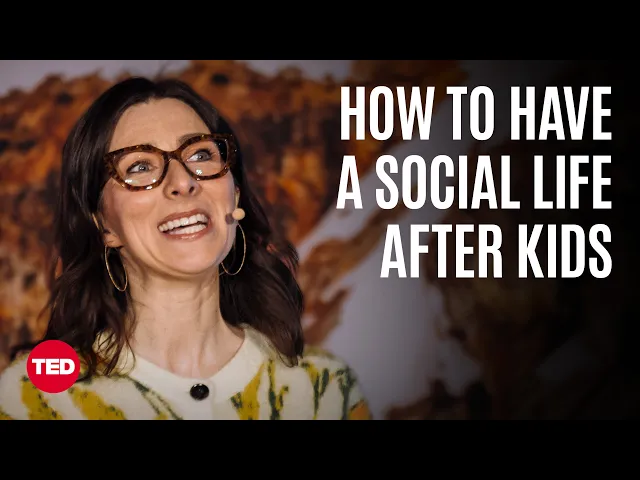
How to Make Parenting Less Lonely | Stacey McLachlan | TED: transcript
- TED
- Published
- Added
- 17:53
- English
AI summary
AI-generated from the transcript below. Check anything that matters against the video.
In this TEDxVancouver talk, writer Stacey McLachlan addresses the social isolation many parents experience after having children. She cites a study by Action for Children finding that 68 percent of parents felt isolated from friends after having kids, and another UK study showing half of mothers under 30 felt lonely often or always. Drawing on her free-range 1980s childhood in a townhouse complex with a communal courtyard, she argues that third spaces where adults and children mix are vital. Rather than abandoning her social life when her daughter Coco was born, she brought her along to bars, trivia nights and wrestling shows. That led her to organize "Witching Hour," a family-friendly event at a Vancouver cocktail lounge that sold out in a day and was later held more than 30 times at various bars. She urges businesses to host family-friendly nights, parents to ask venues, and designers and planners to create multigenerational spaces.
Key points
- A study by Action for Children of 2,000 people found 68 percent of parents felt isolated from friends after having kids.
- A UK study found half of mothers under 30 felt lonely often or always.
- An 80-year Harvard study found close relationships, not wealth or status, are the biggest indicator of happiness and longevity.
- McLachlan brought her daughter Coco to adult activities like wine bars, trivia nights and a pro wrestling show.
- She created "Witching Hour," a family-friendly bar event in Vancouver that sold out in a day and ran more than 30 times.
- One attendee took three buses over 90 minutes with two children because she wanted to be around people who get it.
- She calls for businesses to host one family-friendly night a month and for planners to design multigenerational spaces.
Chat with AI
Ask about this video. Answers come from its transcript, with links to the moments they use.
Free with a Google, Telegram or email account.
Sign in to chatTranscript
- 0:00
My cousin Beth has a 10-year-old daughter named Birdie, and she might be the most interesting child alive. She does karate, she gardens, she makes stop-motion animation films. She's a Renaissance woman. I think we can all agree. But even though she is obviously amazing company, and while Beth is obviously pretty fond of her, Beth still had a pretty socially isolating experience as a parent. Or as she put it, "I've just had the loneliest decade of my life."
- 0:32
Beth isn't alone in her aloneness. A study by Action for Children of 2,000 people found that 68 percent of parents felt isolated from their friends after having kids. 68 percent. Let me do some quick math for you. Break it down, because I'm basically a woman in STEM, as you can tell from the glasses. That's more than half, almost 75 percent. Almost three-quarters. It's a lot, it's a lot. Another 40 percent felt unsupported in their parenthood.
- 1:04
A different study in the UK found that half of mothers under 30 felt lonely often or always. That sucks. Needless to say, I was a little bit nervous about that isolation when I got pregnant myself four years ago. That's right, I'm a teen mom. (Laughter) It wasn't just Beth's dire warning, it wasn't just the statistics. It was that I had seen so many of my friends, during [the] childless phase of my life, disappear once they became parents themselves.
- 1:41
Disappear into a black hole of parenthood. It wasn't that our friendships fell apart because I was jealous of the attention the babies were getting, although, obviously, that's a small part of it. (Laughter) It was that once somebody has kids and you don't, you just fall out of sync. You can't do the same sort of things together that you always used to. You can't bring your baby along to the pottery studio where you're failing miserably. You can't take them along with you to your improv class. You can't bring them out for drinks with the gals.
- 2:13
When you do, you're either stressed out that you’re ruining everyone else’s fun [or] you’re going on Reddit afterwards and learning that some people think of children at restaurants as crotch goblins. (Laughter) It's not encouraging. It's absolutely easy for parents to shrink away from their usual activities and environments, even after the tough newborn days are over. It’s not just inconvenient to lose those friendships -- it’s unhealthy. An 80-year Harvard study found that the biggest indicator of success, longevity, happiness, isn't wealth, it isn't status, it isn't how many abs you have, it is relationships.
- 2:58
Not how popular you are, but how many close relationships you have in your life. How many people care about you, follow up with you, are invested in your life. Who's laughing with you and fighting with you and reminding you that an eight-pack is not realistic, Stacey. (Laughter) This isn't just a personal problem. It's a collective one. So that's right, whether you have kids or not, this is your issue, too. Deal with it. Bad news. Because parenthood and loneliness, it's an epidemic that affects us all.
- 3:31
Close relationships, close adult relationships, are the social glue that holds all of this together. It's how care is shared, how information travels, how we all are prevented from falling through the cracks. So when we quietly push parents out of social situations or social spaces, we're actually damaging the social web that holds this all together. This is high stakes. OK? OK. (Laughter) So when I got pregnant, I wasn't thinking about that big picture though.
- 4:03
I was mostly thinking, how many cups of coffee can I drink without giving my child an extra set of arms? (Laughter) And then when I wasn't worried about that, I was like, oh no, do I still get to go do the things that I love to do? Who cares about the crumbling web of society? I just don't want to be relegated to mom-only activities. Yes, I’m amazing at singing “[The] Wheels on the Bus,” but I don't want to do it all the time. Luckily, I was stubborn enough to wonder, what if I didn't have to? After all, the way I'd been raised, I viewed parenthood as a social endeavor.
- 4:38
I grew up in the '80s, so pretty free-range. I lived in a townhouse complex where we had a big communal backyard, a playground. All the kids roamed around, a feral pack of Capri Sun-fueled little animals. (Laughter) There was always an adult watching us from one of the balconies up top, but more often than not, the parents were down there in the yard with us, making margaritas for each other, sharing gossip, taking turns yelling at us to stop playing Power Rangers in the garden bed.
- 5:10
A communal experience. That courtyard was an important third space. A third space is what sociologists call that gathering place that isn't home and isn't work. In our third-space courtyard, we experienced multigenerational fun. Parents could enjoy being parents, responsibly -- [a] responsible amount of margaritas, while simultaneously embracing the joys of adulthood. A cold drink, an inappropriate joke, commiseration and community.
- 5:43
And call me delusional, but I thought that was possible. I thought it was still possible to have that community, to have friendship, to be a parent, and not abandon the friends I had before I entered that stage in my life. I didn't want the loneliest decade of my life. I didn't want to have to choose between my kid activities and my parent activities. In cities, though, that's tricky. There isn't always that big communal courtyard waiting for you, or a safe cul-de-sac for everyone to gather in. Living here in Vancouver, I realized I'd have to be intentional about creating that experience myself.
- 6:17
So flashing back -- time travel -- to four years ago. [My] daughter is born, her name is Coco. That'll probably come up later. I’m with Coco, [adn] we’re not just going to the mom-and-me sing-along classes, although I'm crushing it when I do. I'm bringing her along to all my adult social activities, whether she is welcome or not. I'm taking her to the cool wine bar. I'm taking her to trivia nights. I'm bringing her to a pro wrestling show.
- 6:48
She's got headphones, it's responsible. (Laughter) I just refused to be left out. She is my plus-one to everything. And that works pretty well when she's portable and strapped to me. But when she starts to crawl and then walk and then run and then climb, things get a little more awkward. Which is how I find myself at a sports bar, trying to have a happy-hour drink with a friend. I find myself sprinting away from the IPA and the gossip, both juicy -- (Laughter) to make sure Coco isn't falling off a bar stool, to make sure she's not stealing French fries from another table, or bonking her head on a corner, or trying to work a shift behind the bar.
- 7:31
(Laughter) I’m trying so hard to squeeze my parent self into the adult identity that I've left behind. But I spend most of happy hour apologizing to the bartender that my 18-month-old has tried to tap her keg. (Laughter) It's on the fifth rescue mission, though, that I realize I'm not inappropriate for trying to bring my child here. What really needs to happen is there just needs to be a bar designed for babies.
- 8:02
(Laughter) That's it, of course. In other parts of the world, this is not such a risqué idea. If you've been to the UK, you've probably seen kids running around underfoot at the local pub. In Australia, any cool restaurant or brewery worth its salt has an amazing playground for the kids to play in. McDonald’s PlayPlace-style. I've been so jealous of friends who have gone to Spain and sent me pictures of having a civilized espresso at the in-playground espresso bar.
- 8:38
Why don't we have that? Just [a] time-out to say: obviously you don't need to drink to have a good time. (Laughter) And if you are watching a child, you should obviously be responsible with that drinking. Blah, blah, blah, blah. (Laughter) The important thing I'm trying to say is that multigenerational social spaces are important. They're more vibrant -- Oh, we got a little applause, let's go. They are important.
- 9:08
(Applause) They're more vibrant, more human, more alive. When we age-segregate our social activities, when we shun the crotch goblins, (Laughter) we all get lonelier, whether you are a parent or not. Don't you miss your parent friends? Don't you want them to come out too? So as I'm trying to stop Coco from flair-bartending, my wheels are turning. I'm imagining a dream bar in Vancouver where my child and my adult friends can all have a good time together in a shared space.
- 9:42
It's designed -- Yes. (Laughter) Infographic. (Laughter) It's designed with soft corners, not a lot of things to stick your fingers into, not tippy-toppy bar stools. [And] maybe some sort of -- I don’t want to use the word cage -- but some way to sort of contain, gates is the word we're looking for. Toys and, of course, craft beer on tap. Most importantly, implicit permission for the kids to run wild so the adults can finish the conversation.
- 10:15
Maybe it’s called “Toddlerz” with a Z -- I’m still workshopping it. (Laughter) I'm a magazine editor, not a restaurateur. But I can't stop thinking about the idea of a kid-friendly bar. Obviously, opening up an establishment of my own is not in the budget right now, but what I can do is I can send an email. So I stumble across a cocktail-tasting room that is bright and airy. It feels fun for the whole family. There's a lot of like, Scandinavian-style furniture, so very like, rounded and soft and low.
- 10:47
It's good. So I send an email and the owner gets back to me the same day to say, "I have a two-year-old and this sounds amazing. Let's do it." So it was nice, fellow soldier in the trenches. "Toddlerz" is not polling well as a name informally, so I move on to the idea of calling it "Witching Hour." It's a phrase that parents often use to describe that emotional time between, you know, nap time and dinner, where the children are -- again, to use a scientific term -- maniacs.
- 11:22
Emotional, irrational, wobbly. You are looking for something to do. Witching hour. So I call the event that, and I sell out in a day. And the thing is, these are not just pity buys for my friends. These are strangers who want to come have a drink with me and my baby, which means -- (Laughter) Which means I'm committed to making this a reality. Whoops. So I go buy a slide off Facebook Marketplace, I pack up a bag of toys, I head to the cocktail lounge to transform it into a poor man's playground.
- 11:56
And once I've trapped the bartenders sort of gate-gate, they're in there, they're stuck, I have a drink, and I sit back and wait for 60 tiny new friends to arrive. Alison is the first person through the door, somebody I hadn't met before, and she has arrived with two children in tow. And she's taken the bus. Or should I say buses. She took three buses from the suburbs, a 90-minute transit trip with two kids. That is no small feat. Many people's idea of a nightmare. (Laughter) But she thought the trip was worth it for what is really a stupid, simple idea: Let the kids come, too.
- 12:34
She thinks that's worth that incredible journey because she wants to be around, as she says, people who get it. And the room is full of them that day. It's a scene, I will tell you. The kids are enjoying a night out, that's for sure. Fishy crackers are flying. (Laughter) Like any good party, at least one person takes their shirt off. (Laughter) The children, the children. But no one's panicked, everyone's relaxed. It is such a wonderful, laid-back atmosphere.
- 13:08
And not just because all the parents have a Paloma in their hands. It's because we've given everyone permission to be themselves. The kids are free to be kids and the parents are free to be people. Alison and her little ones aren't the only ones who have a good time. I'm having a ball. Not only am I mixing and mingling in this wonderful environment with my new friends, but I also have childless friends in the neighborhood who pop in to join me for a drink. We're all having a great time, I’m only singing “[The] Wheels on the Bus” if I want to.
- 13:40
And unlike my friends who have disappeared from social life once they had a kid, I feel more entrenched in the community than ever. I feel like my old self, my normal self. My life feels bigger, not smaller. And in a room like this, it's impossible to imagine having the loneliest decade of your life. We go on to run Witching Hour more than 30 times at Please! Beverage Co, but also other bars throughout the city. We kind of move it around neighborhood to neighborhood with effusive praise everywhere I go.
- 14:10
I cannot stress enough how much patting on the back I am getting for literally just bringing a bag of DUPLO to the bar. (Laughter) I am a hero. I am a god. (Laughter) It's almost embarrassing because I'm just like, really? I just sent an email, brought a bag. But I'm not here to brag. I'm not here to brag. Despite what all these pictures may suggest. I am here to tell you there is a hunger and an enthusiasm for multigenerational third spaces in our city.
- 14:43
People want spaces where kids and adults can connect and be themselves together. In cities, there are restaurants, pubs, cafes, art workshops. Where do you go that you have your adult social life happen? So many of those are just not really accessible to parents of young kids. [The] opportunity to visit those spaces vanishes because they're not always built for families, either implicitly or explicitly. You could be like me and just shoehorn yourself in there anyway, take your baby to the stadium and change her on the floor of the bathroom to the delight of sports fans.
- 15:21
(Laughter) But more often than not, the prospect of navigating adult spaces is exhausting when you have a little one in tow. Physical spaces aren't always accommodating. Behavioral expectations can be draining to navigate. If you don't have the resources for childcare to keep up your usual social pace, it's absolutely easier to just stay home. Or you spend all your social hours on the sidelines of the T-ball game and the karate club. Parental loneliness is obviously just one small slice of a larger loneliness epidemic that I think we're all quite familiar with.
- 16:01
But it's such a solvable one. Let the kids come, too. So if you don't mind a teen mom like me telling you what to do, let's get practical. Businesses, one night a month. Make it family-friendly. How hard is that? Parents, email your favorite watering hole and ask if you can bring a couple dozen of your little guys along with you. Other parents will come. I promise Alison will be there for sure. (Laughter) Designers and city planners, can we be making spaces within our city that invite multigenerational interaction?
- 16:36
And everybody else, remember the kids in your life and the people who raise them, the people you love, deserve a night out, maybe even a drink, just as much as you do. I don't want a bar for babies because toddlers need to appreciate a well-made pilsner. I want them because I remember a time when kids were just around and they didn't ruin anyone's fun. A time when adults talked over our heads, kept an eye out for each other, didn’t vanish from each other’s social lives just because a baby came into the picture.
- 17:10
The townhouse complex I grew up in was a really vital part of my happy childhood. That third space was pivotal in our good times. For my parents, it was a really important part of their parenthood, too, and made it a really joyful, communal, connected experience, one that fostered friendships that my parents still hold today. All Witching Hour does is ask, what if we brought that feeling back to our communities? What if, instead of losing people to parenthood, we made room for them and their sticky little plus-ones at the table?
- 17:45
Or, I guess, the bar. Thank you. (Cheers and applause)
Questions
AI-generated, and answered only from the transcript.
What percentage of parents felt isolated from friends after having kids, according to the study cited?
McLachlan cites an Action for Children study of 2,000 people finding that 68 percent of parents felt isolated from their friends after having kids.
What did the 80-year Harvard study find was the biggest indicator of happiness and longevity?
It found the biggest indicator was relationships, meaning how many close relationships you have, not wealth, status or popularity.
What is a third space?
McLachlan describes it as the gathering place that isn't home and isn't work, such as the communal courtyard of her childhood townhouse complex.
What is Witching Hour?
It is a family-friendly event McLachlan organized at a Vancouver cocktail lounge where parents could have a drink while children played; it sold out in a day and was later held more than 30 times at various bars.
What does McLachlan ask businesses and city planners to do?
She asks businesses to make one night a month family-friendly and asks designers and city planners to create spaces that invite multigenerational interaction.
Related transcripts
The Missing Voice in the Diversity Conversation | Sierra Grandy | TEDxWatkins Glen
In this TEDx talk, Sierra Grandy, a neurodiversity educator, disability rights advocate, attorney, and suicide survivor, argues that…
छठ पर्व पर सास ने बहू को घर से निकाला 😭 फिर छठी मैया ने दिखाया अपना चमत्कार! 🙏 | छठ पूजा की कहानी
यह वीडियो छठ पर्व की पृष्ठभूमि पर बनी एक काल्पनिक नैतिक कहानी है। गंगापुर में रहने वाली कमला देवी के पास धन-दौलत की कमी नहीं थी, लेकिन वे…
Why We Should Design Cities Like Disney | Zach DeBoer | TED
In this TEDxSioux Falls talk, community designer Zach DeBoer argues that where we live shapes our relationships, emotions, habits and even…
Why It’s So Hard to Listen When You Disagree | Emily Kasriel | TED
In this TED talk, author and mediator Emily Kasriel argues that most people believe they should be better listeners but find it especially…
3 Great Smoky Mountains Hikers Who Realized Their Partner Wasn't Human
This Mr. Midnight video presents three first-person horror stories set in the Great Smoky Mountains, each about a hiker whose companion…
Discriminación de género
El video, narrado por Ángela, una joven de 16 años de la comuna 3 de Medellín, cuenta su experiencia de discriminación de género en el…




Latest transcripts
The Work of the Co Creator: Visualization II - Hugh McCague
In this RosicrucianTV presentation, Hugh McCague continues a series on mental creation or visualization as a central Rosicrucian exercise…
The Work of the Co-Creator - Visualization - Hugh McCague
This RosicrucianTV presentation by Hugh McCague explores visualization, or mental creation, as one of the central Rosicrucian exercises for…
Rosicrucian Exercises: A Foundation for Daily Living VI - Hugh McCague
In this sixth installment of the Rosicrucian Exercises series, Hugh McCague of the Rosicrucian Order, AMORC, guides viewers through an…
Rosicrucian Exercises: A Foundation for Daily Living V - Hugh McCague
This video is the fifth installment in a Rosicrucian Order AMORC series on Rosicrucian exercises as a foundation for daily living, presented…
Rosicrucian Exercises: A Foundation for Daily Living IV - Hugh McCague
In this RosicrucianTV session, Hugh McCague guides viewers through a series of Rosicrucian exercises as a foundation for daily living. He…
Rosicrucian Exercises: A Foundation for Daily Living III - Hugh McCague
This RosicrucianTV video, presented by Hugh McCague, is the third installment in a series on Rosicrucian exercises as a foundation for daily…


