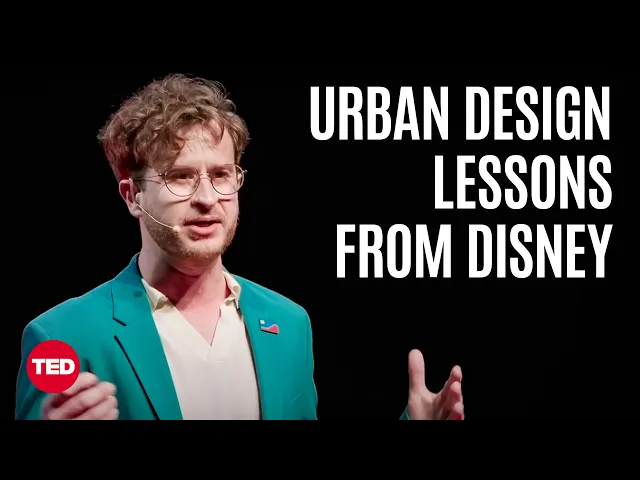
Why We Should Design Cities Like Disney | Zach DeBoer | TED: transcript
- TED
- Published
- Added
- 16:27
- English
AI summary
AI-generated from the transcript below. Check anything that matters against the video.
In this TEDxSioux Falls talk, community designer Zach DeBoer argues that where we live shapes our relationships, emotions, habits and even lifespan, and that most American places are built for cars rather than people. He traces the shift from walkable early-20th-century downtowns to post-war suburban sprawl, restrictive zoning and highway expansion, then turns to Disney theme parks as studies in design where art and human experience come first. He organizes lessons into five categories: density, variety, walkability, theming and magic. He cites a value-per-acre comparison showing a local business outperforming a Walmart, recommends filling vacant lots and parking lots, narrower traffic lanes, four-to-three lane conversions, parking lane lines, crosswalks and street trees, and discusses preserving historic buildings, creating "weenies" and murals, using color to hide utilities, and adding public art, street performers and seasonal celebrations. He closes by urging communities to dream bigger than Walt Disney and design places with care and purpose for people.
Key points
- DeBoer says place shapes relationships, emotions, habits and even how long we live, so design should prioritize human experience.
- He traces the decline of walkable US downtowns to cars, post-war suburbanization, restrictive zoning and highway expansion.
- Density matters economically: he says a local business parcel was five times more valuable per acre than a Walmart.
- He recommends filling vacant lots and parking lots, starting with mixed-use buildings or lower-cost options like parklets and food trucks.
- Narrower lanes (10 feet or less), four-to-three lane conversions and parking lane lines can reduce speeds and crashes.
- Theming includes preserving historic buildings, creating iconic "weenies," murals, flags and using color to hide ugly infrastructure.
- Magic comes from unexpected art, street performers, mascots and holiday celebrations that make a town feel alive and loved.
Chat with AI
Ask about this video. Answers come from its transcript, with links to the moments they use.
Free with a Google, Telegram or email account.
Sign in to chatTranscript
- 0:00
During the pandemic, I got really into watching videos about Disney theme parks. How they're built, their history, upcoming developments, stuff like that. As I worked from home, I would even put on these long, 4K video walkthroughs of the parks up on a second monitor and just let them play in the background like a window into another world. But it wasn't just the escapism that drew me to these places. As an artist, I saw the parks as unique studies of what happens when art, human experience and emotion were the highest priority when it came to designing a place.
- 0:31
In the real world, those are usually the first things cut from any budget. But at Disney theme parks, they were essential. And because of this, guests are able to immerse themselves in fantastical worlds and transcend their daily routines. They can embrace feelings of wonder and joy while creating lifelong memories with their family and friends. And to many, Disney theme parks truly are the happiest place on Earth. See, nothing influences our lives more than place. Our surroundings affect our relationships, emotions, habits, even how long we'll live.
- 1:04
So if we design places with care, purpose [and] the human experience in mind, we can nurture well-being, foster creativity and innovation, [and] build stronger, more resilient communities. And while pockets of great places exist all over this country, most of America looks like this or this, or this. And these places aren't just aesthetically bad. They’re a drain on our physical, mental and economic health. But our places weren't always like this.
- 1:35
American cities at the turn of the 20th century were designed for people to traverse, experience and understand. Work, food, school, whatever you might need was only a short walk or trolley ride away. Developments and streets were smaller and folks weren't as spread out as they are now. And that meant you were more likely to know your neighbors and be more engaged with what was going on in your community. Downtown streets were shared by people, carriages, cyclists and vendors. And as they grew larger, more diverse, cities would develop their own unique identities and cultures that became sources of pride for anyone that called [them] home.
- 2:08
And this wasn't like a new thing. For thousands of years across continents, this is how we built cities. But at the start of the 20th century, the way we built our places and who or what they were built for would change dramatically due to one invention. From 1900 to 1915, the number of automobiles in America went from 8,000 to over two million. And while at first cars shared the road, it wasn't long before their dangerous high speeds and exhaust fumes drove vendors, cyclists and people back onto the sidewalks.
- 2:40
The streets now belonged solely to the car. But this would only be the first change to the American landscape it would be responsible for. And just like Disney's "Cars," the second one was even worse. (Laughter) The economic boom in America after World War II led to a series of disastrous experiments in urban planning that continue to affect us today: the mass exodus of people from city centers to the suburbs on the edge of town, restrictive zoning laws that separated building uses, segregated people based on race or economic level and destructive government-funded projects like highway expansions and urban renewal that demolished historic buildings, erased entire city blocks -- usually just for more places to park their cars.
- 3:30
So instead of designing places for people, we were now designing them for vehicles. And that trend continues to this day, on an even larger scale than before. And while over the past 30 years, we’ve seen the rebirth of many downtowns and historic neighborhoods, we need to do better. Small pockets of great places aren't enough. And I think our communities deserve more. So as I sat in my sweatpants, watching my computer monitor longingly, wanting to be in these places, I started to wonder, why can't our cities be more like this?
- 4:01
Why do these places only exist on vacation? What if we made our main streets more like Main Street, USA? So I want to share with you some ideas, techniques and lessons from Disney theme parks that communities of any size can use to build better places. And so I've broken these ideas up into five different categories: density, variety, walkability, theming and, of course, magic. But let's start with density. Every Disney theme park is jam-packed with things to do and see. Each land you visit is filled with a mix of rides, attractions, food -- all within a few yards of each other.
- 4:35
And this makes it easier to immerse yourself in the land's theming and helps create a more lively, engaging environment. Higher-density places offer greater opportunities for interaction and socialization. But density isn't just about building community or making friends [or] any of that. No, no, no. Denser places also make us more money. Not only do existing businesses benefit from denser development due to higher foot traffic, but because of their more efficient land use, cities see significantly higher return on investment from denser development too.
- 5:10
Take this local example. When we look at Zandbroz and Walmart, at first, Walmart seems like the more valuable development. But just like when we look at a car's miles-per-gallon to determine its value, we need to look at this parcel's value per acre. So when we divide these numbers by the amount of streets and utilities it takes to serve the entire property, we can see that Zandbroz is actually five times more valuable than Walmart. And this is what it looks like if you map the entire value-per-acre for a city.
- 5:41
And everything in green, the city is either making limited money on or even losing money on. And as you can see, downtown and denser developments are actually subsidizing the rest of the city. So now that we know why density matters, where and how do we start applying it in our communities? It's impossible to spread these ideas out evenly across an entire city. So it's important to focus on places where things are already working, where people are already gathering. And usually that place is somewhere downtown. So first we need to start by filling in the gaps.
- 6:12
Vacant lots, empty storefronts, parking lots. They're sprinkled throughout downtowns, and while they may seem innocuous enough, their lack of life can repel people from exploring further on foot. And filling in these gaps with mixed-use buildings is the ideal first choice. But new construction and renovations can be expensive, and I know that's not always an option for some communities. So if money is a concern, there are plenty of other options that require smaller budgets that can make a big impact. Parklets, community gardens, outdoor stages, food trucks, along with regular programming, are great ways to take empty spaces and turn them into ones filled with life.
- 6:48
They say variety is the spice of life, and if that's true, then places like this would be flour. (Laughter) Variety adds beauty, vibrancy and interest to the built environment. Main Street, USA is the perfect example of variety. Dozens of uniquely styled, colorful buildings filled with different kinds of businesses line the busy streets. And when used well, variety builds excitement and makes people want to explore further. And when used really well, variety builds excitement, makes people want to turn that next corner.
- 7:21
So here's how we can add a little bit more variety to our places. First, mixed-use space is one of the best ways to activate your neighborhood 24/7 and keep [it] activated throughout the day. Next, this is what downtown parcels used to look like. And this is what they look like now. Instead of multiple architects designing these places over time, we now have a single developer building entire blocks at a time. Not only does this price out smaller developers, it also tends to make downtown feel more like an office park rather than the charming main streets we all know and love.
- 7:55
Finally, using a variety of colors and styles is essential to creating engaging places. When streets are lined with identical forms like this, people tend to either stay away or stay inside. By differentiating the look of your facades, you can create places that are much more interesting. In fact, Main Street, USA is actually closer to a strip mall than it is to a traditional downtown street, but you'd never know it from the outside. So Disney theme parks are full of some of the most walkable pedestrian places on Earth. You're able to enjoy all these different places and attractions without having to worry about loading up your car, driving through traffic, finding a place to park, and then doing it all over again when you want to go somewhere else.
- 8:36
And beyond looking out for the occasional parade float, children are able to explore the environment freely and safely. Which leads me [to] why it’s so important that we focus on making our streets more walkable. This graph shows the likelihood of survival when a pedestrian is hit by a car. As the vehicle speed increases, the odds of dying grow exponentially. If someone you love is hit by a car going 40 miles an hour, they only have a 15 percent chance of surviving. By changing the geometry of the streets through road diets, we can create places that naturally encourage safer driving.
- 9:12
Here's where we can start. The wider the traffic lane, the faster the car. Traffic lanes inside city limits shouldn’t be wider than 10 feet. They're usually 11 in Sioux Falls. Anything more than that encourages speeding. Converting four-lane roads like this one into three-lane roads like this has been shown to actually improve traffic flow and reduce the potential for accidents. In fact, one study showed that when they did this four-to-three conversion, accidents dropped by 47 percent.
- 9:45
Painting your parking lane lines can visually shrink the streets and help slow speeding traffic. A few years ago, I worked with the city of Sioux Falls to add parking lane lines on 18th Street between Minnesota Avenue and Avera Hospital. And the average speed dropped from 33 miles per hour to 28. And that might not seem like a lot, but when you think about that chart, remember that every little bit could mean the difference between life and death. Adding bump-outs and painting crosswalks at major intersections can shorten crossing distance between corners and give pedestrians greater visibility.
- 10:20
I’d also like to point out, smaller roads mean less snow to plow and fewer potholes to fill each spring. Something to think about. Now that the roads are smaller, we have room to add more useful things like street trees, plants, bike lanes and even angled parking. And now we're getting to the fun stuff. Theming is the art of creating a cohesive and immersive environment that enhances the guest experience. Theming is crucial to telling a land’s story, setting the mood and creating a unique sense of place. But how do we theme a city?
- 10:51
Every land, ride and restaurant in a Disney theme park has a detailed backstory, imagined history, and it's communicated through its layout, its architecture, its food, and a dozen other details you'll probably never even notice. But they all come together to form places with distinct identities. Preserving the history, buildings and culture that made your community the place it is today is an essential part of creating unique spaces. One way we can do that is by preserving our existing places, the houses, buildings, bridges, barns, even the trees around us create the settings for our life stories.
- 11:26
And as the years go on, we form emotional connections with these things. So when they're torn down, we're also severing people's connection to their community and to their own past. So prioritize filling in your existing gaps before you start making new ones. Disney parks are full of iconic buildings [and] structures, and they act as symbols for the parks. Due to their size and eye-catching designs, they act as beacons, urging guests forward. Inspired by the way his dog would follow him from room to room whenever he was snacking on a hot dog, Walt Disney would refer to these buildings as “weenies.”
- 12:00
And Sioux Falls has no shortage of iconic weenies, like the old Courthouse Museum, the Cathedral, The Arc of Dreams. We're also home to an internationally famous weenie, the Statue of David. (Laughter) In rural towns, water towers, churches, silos, they can all act in that same purpose, like in Faulkton, South Dakota, where this amazing mural can be seen from miles away. And it's the envy of any town with a grain elevator. Speaking of murals, they’re a great way to communicate a place’s identity.
- 12:32
I paint a lot of murals in cities across South Dakota, and some of my favorite to do are these postcard ones where I get to work with communities to showcase the history, places and people that make them unique, like the Rodeo in Clear Lake or Centerville’s zebra doughnuts. City flags can represent a place’s history, culture and aspirations, and a well-designed flag can evoke a sense of pride and belonging in the people that live there. And there are few cities that have embraced their flag more than the city of Sioux Falls. Cities are filled with ugly stuff.
- 13:04
When things like lights, speakers, or outside buildings break the reality of [a] land’s theming, Disney uses a color called "Go Away Green" to make that item fade into the background and disappear. And you can use colors to hide things or make them part of the theme. You can also draw more attention to them by making them into artwork. These are some light pole wraps I designed for my neighborhood that are meant to look like Sioux Quartzite stone from afar, but up close are filled with pictures of children's artwork, historic photos of homes, and pictures of the people who live in the neighborhood.
- 13:37
The last category I want to talk about tonight is magic, and this one can be a little harder to define. Disney Magic is created by the combination of unique sights, sounds and smells, by attention to detail, and the energetic atmosphere found in every corner of the parks. Magic is the thing that keeps people coming back for more, and makes them fall in love with a place. And we can make magic happen in our places in big and small ways. Public art is great, but public art isn't just murals and statues. So why have a normal garbage can on the beach when you could feed it to a fish named Goby?
- 14:11
Or if you’re pouring a new sidewalk, why not add some local poetry? Integrating art in a unique or unexpected way can turn ordinary cities into extraordinary ones. "Streetmosphere" is the term Disney uses for the various performers and sights you might see at the parks. And great places have energetic streets. And you can make your streets more active by adding outdoor seating or patios, hiring street musicians, or you can close down streets for special events like block parties or parades or farmers markets. Disney is not the only home -- the only place that's home to iconic costumed characters that generations of people know and love.
- 14:51
Mascots from your city sports teams, and high schools, as well as beloved TV personalities, can all play a part in developing a city's identity. And just like flags, they can become symbols of pride for communities too. Disney goes all out during holidays and celebrations with decorations, seasonal characters, limited-time-only food. In your community, little efforts like hanging some lights or tailgating before the big homecoming game are ways to communicate to visitors and to the people that live there that their town is alive and loved.
- 15:23
And this is another place where I get to say Sioux Falls gets it right. When it comes to the holidays, we don't mess around. (Laughter) Years before Disneyland opened, every Saturday, Walt would take his daughters around town for some quality time together. They’d visit amusement parks, playgrounds, carousels, which the girls loved. But Walt would inevitably find himself alone on a park bench with all the other adults watching their kids play. And he thought to himself, there should be something built where parents and children could have fun together.
- 15:55
And eventually, that idea evolved into Disneyland, a place where people of all ages could come together, create lasting memories, where imagination could become reality, where dreams could come true. But I want to challenge you to dream bigger than Walt Disney. These ideas don't have to stay on vacation. If we design places with care, purpose and for people, any community can become the happiest place on Earth. Thank you, Sioux Falls. (Applause)
Questions
AI-generated, and answered only from the transcript.
What five categories does DeBoer use to organize his Disney-inspired ideas?
He lists density, variety, walkability, theming and magic. Each category draws lessons from how Disney theme parks are designed.
What does DeBoer say about the value of denser development?
He says denser places generate more foot traffic for businesses and higher return on investment for cities. He cites a comparison where a local business parcel was five times more valuable per acre than a Walmart.
What street changes does he recommend to improve walkability and safety?
He suggests traffic lanes no wider than 10 feet, converting four-lane roads to three lanes, painting parking lane lines, and adding bump-outs and painted crosswalks. He says a four-to-three conversion study showed accidents dropped 47 percent.
What is a "weenie" in Disney design terms?
It is an iconic building or structure that acts as a beacon urging guests forward. DeBoer says Walt Disney used the term, inspired by how his dog followed him around when he was eating a hot dog.
How can communities add variety to their downtowns?
He recommends mixed-use spaces that keep neighborhoods active throughout the day, avoiding single developers building entire blocks, and using varied colors and styles on facades. He says identical forms make people stay away or stay inside.
What does DeBoer mean by magic?
He describes magic as the combination of unique sights, sounds and smells, attention to detail and an energetic atmosphere that keeps people coming back. Communities can create it through unexpected public art, street performers, mascots and holiday celebrations.
Related transcripts
The Missing Voice in the Diversity Conversation | Sierra Grandy | TEDxWatkins Glen
In this TEDx talk, Sierra Grandy, a neurodiversity educator, disability rights advocate, attorney, and suicide survivor, argues that…
How to Make Parenting Less Lonely | Stacey McLachlan | TED
In this TEDxVancouver talk, writer Stacey McLachlan addresses the social isolation many parents experience after having children. She cites…
छठ पर्व पर सास ने बहू को घर से निकाला 😭 फिर छठी मैया ने दिखाया अपना चमत्कार! 🙏 | छठ पूजा की कहानी
यह वीडियो छठ पर्व की पृष्ठभूमि पर बनी एक काल्पनिक नैतिक कहानी है। गंगापुर में रहने वाली कमला देवी के पास धन-दौलत की कमी नहीं थी, लेकिन वे…
Why It’s So Hard to Listen When You Disagree | Emily Kasriel | TED
In this TED talk, author and mediator Emily Kasriel argues that most people believe they should be better listeners but find it especially…
3 Great Smoky Mountains Hikers Who Realized Their Partner Wasn't Human
This Mr. Midnight video presents three first-person horror stories set in the Great Smoky Mountains, each about a hiker whose companion…
Discriminación de género
El video, narrado por Ángela, una joven de 16 años de la comuna 3 de Medellín, cuenta su experiencia de discriminación de género en el…



Latest transcripts
The Work of the Co Creator: Visualization II - Hugh McCague
In this RosicrucianTV presentation, Hugh McCague continues a series on mental creation or visualization as a central Rosicrucian exercise…
The Work of the Co-Creator - Visualization - Hugh McCague
This RosicrucianTV presentation by Hugh McCague explores visualization, or mental creation, as one of the central Rosicrucian exercises for…
Rosicrucian Exercises: A Foundation for Daily Living VI - Hugh McCague
In this sixth installment of the Rosicrucian Exercises series, Hugh McCague of the Rosicrucian Order, AMORC, guides viewers through an…
Rosicrucian Exercises: A Foundation for Daily Living V - Hugh McCague
This video is the fifth installment in a Rosicrucian Order AMORC series on Rosicrucian exercises as a foundation for daily living, presented…
Rosicrucian Exercises: A Foundation for Daily Living IV - Hugh McCague
In this RosicrucianTV session, Hugh McCague guides viewers through a series of Rosicrucian exercises as a foundation for daily living. He…
Rosicrucian Exercises: A Foundation for Daily Living III - Hugh McCague
This RosicrucianTV video, presented by Hugh McCague, is the third installment in a series on Rosicrucian exercises as a foundation for daily…


