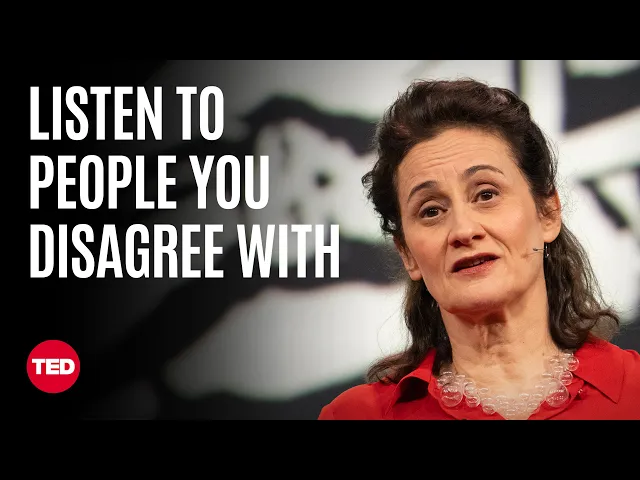
Why It’s So Hard to Listen When You Disagree | Emily Kasriel | TED: transcript
- TED
- Published
- Added
- 10:51
- English
AI summary
AI-generated from the transcript below. Check anything that matters against the video.
In this TED talk, author and mediator Emily Kasriel argues that most people believe they should be better listeners but find it especially hard when they disagree, because of a psychological bug: the fear that listening to unpalatable ideas will contaminate us. She traces this to a dangerous myth that listening means agreeing, a confusion reinforced since childhood when "listen to me" meant "obey me." Kasriel recounts her early BBC career mistake in Ethiopia, where her confrontational questioning of Meles Zenawi caused him to end the interview, costing her a chance to understand him. She presents her Deep Listening framework, illustrated through Ilona, a Russian-speaking Latvian, and Hawraa, a Lebanese Muslim who once shunned Syrian refugees but now volunteers at a school for them. Kasriel cites a global research project with the BBC and the British Council training over 1,000 people across 100 countries, where participants felt safer expressing themselves, more connected, and began questioning their own attitudes. She closes by inviting listeners to try deeply listening to someone they disagree with.
Key points
- Kasriel says a psychological bug makes us fear that listening to unpalatable ideas will contaminate us.
- She argues we have bought into a dangerous myth: that listening means agreeing.
- As a young BBC reporter in Ethiopia, she refused to listen to Meles Zenawi and he cut the interview short.
- Her Deep Listening approach includes taking time out to listen to yourself first and noticing your judgments.
- Ilona, a Russian-speaking Latvian, used the steps and a warm silence to help her neighbor feel safe.
- Hawraa, a Lebanese Muslim, came to see listening as neither surrender nor betrayal of her values.
- A BBC and British Council project trained over 1,000 people across 100 countries in Deep Listening.
- Kasriel invites the audience to deeply listen to someone whose disagreement really stings.
Chat with AI
Ask about this video. Answers come from its transcript, with links to the moments they use.
Free with a Google, Telegram or email account.
Sign in to chatTranscript
- 0:04
You know, there's something quite strange going on, because most of us believe we should be better listeners, but, as I found in my research, we find it so hard, especially when we disagree. There's a kind of psychological bug that gets in the way. We fear that if we listen to people whose ideas we find unpalatable, we'll be contaminated without realizing it. We've bought into a dangerous myth -- listening means agreeing.
- 0:37
Listening means agreeing. So we avoid it, and instead, we fixate on trying to explain ourselves more loudly, more fiercely, more insistently. "If only they'd understand." You know, I should know, because I threw away a once-in-a-lifetime opportunity to understand one of Africa's most intriguing and powerful leaders, because I wasn't ready to listen. So let me tell you about a time when I was in Ethiopia, reporting for the BBC at the start of my career.
- 1:10
I landed an interview with its president and later prime minister, Meles Zenawi. I was so proud. This was my big scoop. But it was also a time when his opponents were tortured or disappeared. So the president, he was keen to talk about his record crop production of maize, of sorghum and barley, critical in a country with a history of famine. But I refused to listen, incessantly circling back to human rights. To be honest, my questions, they were masks for my desire to confront the president.
- 1:46
And what did he do? He edged further and further away from me, behind his vast wooden desk, and then cut the interview early. You know, it wasn't so much that I was wrong to hold the president to account. That was essential, but my lack of curiosity and my inability to listen caused him to put up his defenses, and so I walked away empty-handed. And over the years, I've learned from my mistakes as a journalist and my work as an executive coach, and I've drawn on scholars and psychologists and peacebuilders, and I've woven these ideas together into a book and an approach I call Deep Listening.
- 2:30
Because the standard way we so often perform listening, it starves us of real connections. We struggle to engage with our coworkers, with our family -- just ask my own -- [with] anyone from a different background or generation, anyone whose ideas conflict with our own. Now you see, I think I’m rational, and my sense is that you think you're rational, but we're all driven by our judgments, by our emotions and our past, clinging onto the moral high ground.
- 3:07
The problem is that, from an early age, we've been brought up to believe that listening means agreement, that listening signals obedience. You know, I remember my first teacher yelling at me, "Listen to me." What she meant [was], “Obey me. Keep quiet. Put those crayons away." [It] wasn’t really an invitation to listen -- it was a command to comply. And this muddling up of listening and agreement means that now, as adults, we fear listening to people whose ideas might disturb us.
- 3:39
"Will I lose myself?" "Will I be forced to change my mind?" "Will I be changed?" At a primal level, it can feel scary to open ourselves up to ideas which clash with our values. And the result? A world in which we think it's better, even more moral, to sidestep any encounters across divides. But in avoiding these exchanges, we only help deepen the fault lines of polarization that are tearing our families, our communities and, of course, our nations apart.
- 4:15
So let me give you an example. Take the Baltic state of Latvia, which has a traumatic history of decades under Soviet rule. And not long after the Russian full-scale invasion of Ukraine, feelings there were running deep and high, threats of reinvasion were real, and suspicion was falling on the one in three Latvians who spoke Russian at home. So I was invited to train people from both communities together -- that's the Latvians and the Russian speakers -- so they could practice Deep Listening to someone from the other side.
- 4:49
But how can you listen when your feelings are so strong, and when there's so much at stake? So can I tell you about Ilona? She's a Russian-speaking Latvian. And to be honest, at the start, when she started using the Deep Listening steps, it felt pretty unnatural. It was hard for her to stay curious and accept she didn't yet know what her neighbor might be thinking. But cautiously, she began putting the eight steps to work -- taking time out, for example, to listen to herself first, and notice what her neighbor might provoke in her.
- 5:25
Maybe they reminded her of a bullying older sister, so she felt eight again, powerless and trapped. Or she might notice how judgmental she was feeling. "That neighbor. She's selfish, for sure." Or she might realize that she'd projected, like most of us, the parts of herself she found hardest to accept onto her neighbor. Because after all, we see the world not as it is, but as we are.
- 5:58
Slowly, Ilona learns to put her own stuff aside so she could be more present with whatever unfolded, whatever her neighbor wanted to share. She didn't manage it every time, mind -- some conversationsstill left her tight-jawed and defensive, but she began to notice that in the moment. And then, she experimented with something simple. (Silence) I meant to do that. Silence. The warm, empathetic kind, to allow her neighbor to reflect more, and give Ilona a chance to make more sense of their perspective.
- 6:36
Ilona found out that she could tap into something called your “Third Ear,” which is about tuning into what's important but unspoken. And I like to think the Third Ear is located just next to our heart, and our Third Ear can be more insightful than our conscious intelligence, which relies on the two ears [on] either side of our brain. Afterwards, Ilona reflected that maybe she could enable her neighbor to feel safe so they started to trust her and shared more of their deeper story. What Ilona discovered isn't unique to her.
- 7:11
We ran a big global research project with the BBC and the British Council, recruiting over 1,000 people across 100 countries to train in Deep Listening. Something remarkable happened. People didn’t just feel safer to expressing themselves and more connected -- they also started to question their own attitudes. And I've seen other research that shows that when people feel truly heard, they actually soften their beliefs.
- 7:43
Now that’s a powerful incentive for all of us to deeply listen to others. So there's this woman, Hawraa. She's a Lebanese Muslim, and she wanted to learn how to listen more deeply. Now her father was determined that she restrict her friendships to those with a similar upbringing, and she carried those judgments into adulthood, telling me that she used to be against Syrian refugees in Lebanon, staying clear of them because some allowed their girls to get married at 11 or 13, "not living a proper Lebanese life," she said.
- 8:18
I got to know her while training communities from Lebanon, and her breakthrough moment came when she understood, not just intellectually but emotionally, that listening to someone with different perspectives is not a surrender or a betrayal of your values. Today, Hawraa has become something of a poster child for Deep Listening. Every Tuesday, she now works with teenagers at a school for Syrian refugees. And by listening in this new way to her students, she’s come to understand [that] more than one perspective is possible.
- 8:54
"It felt like a glimpse of light," she told me, though it still takes strength, patience and an open heart. Hawraa is aware of the tensions which still exist between her ideas and those of others, she's still passionately against child marriages, but she's finding ways to try harder to open and deepen her understanding, while keeping true to her values. Now I have a piece of good news for you. You don't need to live in a conflict zone to practice Deep Listening while disagreeing.
- 9:29
So I'd like to offer you a small, slightly risky experiment. I'd like you to think of someone you know who sees the world differently. Not the most extreme case, but someone [with whom] the disagreement really stings, and then take time out to deeply listen to them with as much curiosity and openness as you can manage. Notice your discomfort. Notice your resistance. And notice, too, if you have the courage to move past both, even if it feels a little awkward.
- 10:04
I’ve found that, over time, these experiences make me feel more alive as I open myself up to profoundly connecting with another person, whatever their beliefs, and giving them the gift of feeling truly heard. So Deep Listening, it's about respect for the other person's dignity and the fullness of their humanity, whatever they stand for. And now, with the stakes quite so high in our polarized times, just think what might be possible if we firmly and permanently separated listening from agreement.
- 10:43
Thank you. (Cheers and applause) Thank you. (Cheers and applause)
Questions
AI-generated, and answered only from the transcript.
What myth about listening does Emily Kasriel identify?
She says we have bought into a dangerous myth that listening means agreeing. This confusion, reinforced since childhood, makes us avoid listening to people whose ideas disturb us.
What happened when Kasriel interviewed Meles Zenawi in Ethiopia?
She kept circling back to human rights, using her questions as masks for a desire to confront him. He edged away behind his desk and cut the interview early, leaving her empty-handed.
What is the Third Ear in Deep Listening?
Kasriel describes it as tuning into what is important but unspoken. She likes to think it sits next to our heart and can be more insightful than our conscious intelligence.
What did the global Deep Listening research project find?
Run with the BBC and the British Council, it trained over 1,000 people across 100 countries. Participants felt safer expressing themselves and more connected, and they started to question their own attitudes.
How did Hawraa's views change after learning Deep Listening?
She came to understand emotionally that listening to different perspectives is not surrender or betrayal of her values. She now works every Tuesday with teenagers at a school for Syrian refugees while remaining against child marriage.
What experiment does Kasriel ask the audience to try?
She asks them to think of someone whose disagreement really stings, though not the most extreme case, and to listen deeply with curiosity and openness. She advises noticing discomfort and resistance and moving past both.
Related transcripts
The Missing Voice in the Diversity Conversation | Sierra Grandy | TEDxWatkins Glen
In this TEDx talk, Sierra Grandy, a neurodiversity educator, disability rights advocate, attorney, and suicide survivor, argues that…
How to Make Parenting Less Lonely | Stacey McLachlan | TED
In this TEDxVancouver talk, writer Stacey McLachlan addresses the social isolation many parents experience after having children. She cites…
छठ पर्व पर सास ने बहू को घर से निकाला 😭 फिर छठी मैया ने दिखाया अपना चमत्कार! 🙏 | छठ पूजा की कहानी
यह वीडियो छठ पर्व की पृष्ठभूमि पर बनी एक काल्पनिक नैतिक कहानी है। गंगापुर में रहने वाली कमला देवी के पास धन-दौलत की कमी नहीं थी, लेकिन वे…
Why We Should Design Cities Like Disney | Zach DeBoer | TED
In this TEDxSioux Falls talk, community designer Zach DeBoer argues that where we live shapes our relationships, emotions, habits and even…
3 Great Smoky Mountains Hikers Who Realized Their Partner Wasn't Human
This Mr. Midnight video presents three first-person horror stories set in the Great Smoky Mountains, each about a hiker whose companion…
Discriminación de género
El video, narrado por Ángela, una joven de 16 años de la comuna 3 de Medellín, cuenta su experiencia de discriminación de género en el…




Latest transcripts
The Work of the Co Creator: Visualization II - Hugh McCague
In this RosicrucianTV presentation, Hugh McCague continues a series on mental creation or visualization as a central Rosicrucian exercise…
The Work of the Co-Creator - Visualization - Hugh McCague
This RosicrucianTV presentation by Hugh McCague explores visualization, or mental creation, as one of the central Rosicrucian exercises for…
Rosicrucian Exercises: A Foundation for Daily Living VI - Hugh McCague
In this sixth installment of the Rosicrucian Exercises series, Hugh McCague of the Rosicrucian Order, AMORC, guides viewers through an…
Rosicrucian Exercises: A Foundation for Daily Living V - Hugh McCague
This video is the fifth installment in a Rosicrucian Order AMORC series on Rosicrucian exercises as a foundation for daily living, presented…
Rosicrucian Exercises: A Foundation for Daily Living IV - Hugh McCague
In this RosicrucianTV session, Hugh McCague guides viewers through a series of Rosicrucian exercises as a foundation for daily living. He…
Rosicrucian Exercises: A Foundation for Daily Living III - Hugh McCague
This RosicrucianTV video, presented by Hugh McCague, is the third installment in a series on Rosicrucian exercises as a foundation for daily…


