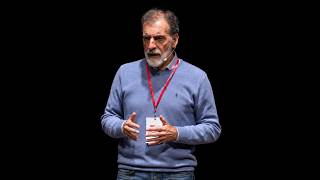
I worked for big tech—now I’m worried about AI | Dex Hunter-Torricke | TEDxBerlin: transcript
- TEDx Talks
- Published
- Added
- 12:17
- English
- auto-generated captions
AI summary
AI-generated from the transcript below. Check anything that matters against the video.
In this TEDxBerlin talk, Dex Hunter-Torricke describes spending nearly two decades advising powerful tech leaders and most recently leading communications for Google DeepMind before leaving Big Tech in October 2025. The son of a refugee from Burma and an immigrant from Malaysia, and the first in his family to earn a degree, he says his outsider perspective on power shaped his concern about how institutions are handling AI. He outlines the hopeful promises made about AI, including curing disease, removing drudgery and helping crack nuclear fusion, but argues these gains will not be shared on the current path. He points to dark factories, extreme wealth concentration, job losses, geopolitical instability with more than 60 wars underway, and climate change as problems AI could turbocharge. Rejecting the tidal-wave analogy, he insists the future is a choice and calls for a radically broader public conversation about who benefits from AI, arguing none of us win unless all of us win the future together.
Key points
- Hunter-Torricke left Big Tech in October 2025 after leading communications for Google DeepMind.
- He says frontier AI labs believe human-level machine intelligence could arrive within a decade, perhaps five years.
- He warns AI gains may concentrate among a few companies, people and countries, widening the digital divide into an abyss.
- He cites 12 US billionaires holding as much wealth as half the world, and only 8% of Germans expecting their children to be better off.
- He notes more than 60 wars are underway and over 500 million children live in war zones, with AI speeding up military action.
- He rejects the tidal-wave analogy for the future, arguing societies have choices about how AI develops.
- He calls for a radically expanded public conversation, saying the greatest challenges are not mostly technical.
Chat with AI
Ask about this video. Answers come from its transcript, with links to the moments they use.
Free with a Google, Telegram or email account.
Sign in to chatTranscript
- 0:00
[music] [music] >> I worked for this guy. I worked for this guy. And I spent the last few years telling the story of AI for one of the world's most powerful AI labs. At this point you're thinking, why the heck do we invite this guy to come here? Usually when people introduce me now and they say he used to work for Elon and Zuckerberg and a bunch of those big tech leaders, there are some big question marks in the minds of the audience before I start talking.
- 0:41
Well, let me explain myself. These folks are much more in part of my story than anyone I ever worked for. These are my parents. I am the chubby little kid down there in the corner. Uh my dad was a refugee from Burma during the Second World War. He grew up in a refugee camp in India. My mother was an immigrant from Malaysia. She came to the UK in the 1970s to be a nurse in Britain's National Health Service. And growing up life was really, really tough.
- 1:10
And I was the first person in my family to earn a degree. Uh I got to go and have extraordinary opportunities in my life. But I was struck all the way throughout my life just how precarious the path to a good future for myself and for my family was going to be. And because of that, and because I was a bit of a strange kid, I was obsessed from a very early age with systems. Why is it that some kids are born into lives where the path is smooth for them from before they're even born? Why is it that for others, including most people in the world, life is one giant constant uphill struggle?
- 1:50
I wanted to go and work on that, and that's what actually led me to go and work in the tech industry because technology should be something deeply hopeful. And it seems extraordinary now to think about it, but a few years ago, of course, uh the tech industry and the things that were being developed in Silicon Valley were deeply hopeful. It was a completely different moment in the world. Well, I'm here to tell you now we're probably not going to be arriving in a deeply hopeful future if we continue on the path that big tech has laid out for us.
- 2:23
And because of my obsession with systems, that's actually why I left big tech a few months ago and I'm talking about all the things I'm going to talk about here today with you. We are in a moment now where the systems that are transforming the world are advancing very, very rapidly. Every single one of the dots that appears on screen here, these are things that used to take years. Now they are unfolding in months. New systems with more and more powerful capabilities arriving all the time. On the path towards perhaps the most advanced AI of all, artificial general intelligence, human-level intelligence in machines, which many of the leaders of the big AI labs, the so-called frontier AI labs, believe we will emphatically arrive at within the next decade, perhaps closer to 5 years.
- 3:13
And a whole bunch of promises have been made to us based on the advancement of those technologies. We've been told that as AI gets more and more sophisticated, it's going to take away all the boring parts of our jobs. It's going to get rid of all the drudgery and you're going to enjoy doing much more meaningful work. We've been told that AI is going to cure diseases. It's going to have an extraordinary effect on improving all of our lives and making us into healthier people. And it might well do. It is something that truly is hopeful at a time when we are living through a golden age of discovery. A hundred years ago, life expectancy in the world was 32 years on average. Imagine if we got even a tiny fraction of extra life. Imagine if our children got slightly extra life.
- 4:02
How would that change the choices we make going to the future? And we've been told that as those choices become more and more extraordinary, we might just end up solving problems that are so massive, we end up in a true science fiction utopia of sorts. Um one of the great advancements that was being worked on at Google in the time I was there was using AI to try and crack nuclear fusion technology. A dream of the energy industry for more than 70 years. Can you build essentially small artificial star on Earth? Can you create clean unlimited energy by replicating the way energy is created in the core of Earth's sun? It is the hardest engineering challenge of our time. And there are teams at Google and many other companies around the world who are using AI now to crack the remaining technical obstacles in the way of fusion. And some of the scenarios that have been mapped out in a world where we might go and solve our energy crisis definitively using that
- 4:59
technology are extraordinary. One of the thought experiments that was very popular in the industry for the last few years and it got me really, really excited. You may have heard this one. Is if we crack fusion, what would our grandchildren be doing in their lives one day? They might go to the stars. That was the vision conjured up by this extraordinary chain of events. If you could create clean unlimited energy for the world, you might transform the entire global economy. You might wipe out a whole bunch of social challenges standing in the way of kids like me when I was growing up. You might be able to go and do the most expensive thing in human history and send millions of people to live amongst the solar system.
- 5:37
That is literally the sort of conversation that animates leaders at the top of those big AI labs and I know that cuz I've been in the room with them for a long time. Well, I've got some very bad news. Our grandchildren are not going to go to the stars. Not on the path we're on. We are living in the most disruptive moment in history. In the tech industry, there's a story people love to tell. Technology changes the world. And it does. But we always leave out the other half that story. The world changes technology. It doesn't just show up in some immaculate world.
- 6:14
Hands up. How many people here things are generally going well in the world right now? Absolutely nobody. And so there's some true nihilists out there applauding for the bad future. Well, guess what happens if AI rolls out on the path they're on? There might be a lot of things that happen, but I've got a pretty good guess of some of the things that might happen. This is a picture taken inside a so-called dark factory in China. We call them that because they don't need to have the lights on them because there's no human workers. It's the peak of automation technology. For me, it is a glimpse of a future where a small number of companies, a small number of people, a small number of countries might just get runaway advantages because they were able to jump into the AI future first.
- 7:02
We have a so-called digital divide. Well, in this century that divide is about to become an abyss. AI might transform all of our economies. It might make us grow. It might make us more productive. But who says those gains have to belong to everyone? Well, I'll tell you what. Right now, 12 billionaires in the United States have as much wealth as half the world. 50% of the German population have just 4% of this country's wealth. And this is a much more egalitarian society than many others around the world. What do we think will actually happen as the most powerful technology in history turbocharges the ability of a very small number of people to do more with less.
- 7:41
Literally the promise of building more advanced AI. Well, you might see a scenario where many people lose their jobs. Many people are stuck in dead-end jobs. Where our societies no longer have a model to lift up people's lives. Uh here in Germany, actually, just 8% of people polled believe their children will have better lives than they did. Historically, not a strong measure of a stable future society. You might end up in a model where things like what happened in Nepal in September last year, where a whole generation uh decided to rise up and take down their government because of the staggering inequality and the lack of economic growth finally destabilized the entire system. In a global century, everything domestic ends up flowing internationally. We, of course, have seen just in the last few days ballistic missiles raining down across cities across the Middle East. Anti-aircraft guns raking the sky in Kyiv. We are all preparing, of course, for extraordinary geopolitical events that might come
- 8:39
closer and closer to our borders every year in just the next few years. And we're now living at the most unstable time in history since the 1940s. There are more than 60 wars underway in the world. More than 500 million children living in war zones right now. And AI is turbocharging the ability of militaries and irresponsible decision-makers to speed up the scale of these destabilizing actions. That is exactly why we are in a state of crisis geopolitically. In many cases, people are launching attacks and carrying out operations now which they never would have felt emboldened to do previously.
- 9:14
AI might transform your office job, but it also transforms the entire industry of destruction. And you get through that and you still end up with the final boss of the 21st century, climate change. We can try to not just talk about it and hope it goes away. Some people have tried to uh do that. Historically, not a good way to solve your problems. We're in a moment now where we are on a path to some of the worst-case climate change scenarios. And AI will turbocharge the ability of our economies to consume resources. Between 2018 and 2023, the world consumed almost as many resources as 1/3 of the 20th century. Uh we've got 150 species going extinct every day. If you think this is going to get better without dramatically transforming our economies and our societies to be more sustainable, I've got a bridge to the future to sell you. And usually when you capture all of these devastating problems, which are here right now before we arrive in the age of advanced AI, it spoils the vibes thoroughly. Some people think, "Ah, the future's like a
- 10:12
tidal wave." We get that analogy all the time, and I hate it. I used to be a speech writer, so I hate all analogies. They're all broken. They distort our thinking. The future is not a tidal wave. We have choices. That is one possible future, but there's another one where we can choose a deeply empowering, hopeful one where technology serves us and not the other way around. How do we get there? We're going to need a different agenda entirely. And so my message to you is this, when you think about the future of AI, do not think of it in the terms that have been written for you by Big Tech.
- 10:45
The greatest challenges we face are not mostly technical. You will not find them in simply trying to tweak a few algorithms. It is all about fundamentally who we become as people. What kind of lives and societies do we want to live in? It is fundamentally a future that must belong to all of us. I don't believe that those folks who I spent a lot of my career in rooms with should control the future of the world. I do not believe that 12 billionaires in the United States have the best interests of the world at heart. And that means we need to radically expand the conversation in our societies about who do we want to be.
- 11:22
And it's very inconvenient to be a leader in the 21st century. You don't have to take anything I told you seriously. You don't have to take the future seriously. But you've got to have your own version of the future that you believe is coming. And you must stand up for what you believe in at this pivotal moment in history. The stakes are too extraordinary not to do that. And we'll close here by saying this is truly what we're fighting for now, a different vision of the entire world. You might try to win as an individual, as a company, as a country, but I've got news for you. None of us are going to win unless all of us win the future together. That is the choice before us right now in this extraordinary moment in history. Thank you very much.
- 12:03
>> [applause] [music] [music]
Questions
AI-generated, and answered only from the transcript.
Why did Dex Hunter-Torricke leave Big Tech?
He says he left a few months before the talk, in October 2025, not because he lost faith in technology but because he saw powerful institutions sleepwalking into AI's transformation of society. His long obsession with systems led him to speak out.
When do frontier AI labs expect human-level machine intelligence?
He says many leaders of the frontier AI labs believe artificial general intelligence will arrive within the next decade, perhaps closer to five years.
What is a dark factory?
He describes a dark factory in China as peak automation technology where the lights can stay off because there are no human workers. He sees it as a glimpse of runaway advantages for a few companies, people and countries.
What does he say about the tidal-wave analogy for the future?
He dislikes the analogy, saying it distorts thinking. The future is not a tidal wave; we have choices, and one possible future is empowering and hopeful, with technology serving us.
What does he say about wealth inequality?
He says 12 billionaires in the United States have as much wealth as half the world, and 50% of the German population hold just 4% of the country's wealth. He warns AI could turbocharge these gaps.
What is his closing message?
He urges people to have their own vision of the future and stand up for it at this pivotal moment. He argues none of us will win unless all of us win the future together.
Related transcripts
Una specie di Coraggio | Valter Fraccaro | TEDxSiena
Nel suo intervento a TEDxSiena, Valter Fraccaro ripercorre la storia della conoscenza umana come espressione di coraggio. Parte da…
What Happens When Everyone Can Build Software
This Lightcone episode features Paul Copplestone, co-founder and CEO of Supabase, discussing how the company has grown to 13 million…
Build Flutter Ecommerce App with Admin Panel Using AI (No Coding)
This tutorial from N-Educate shows how to build a Flutter ecommerce app with an admin panel using AI and no manual coding. The presenter…
Marc Andreessen: The Biggest Gap I’ve Seen in My Career
In this a16z podcast, Chris Dixon joins Marc Andreessen, Ben Horowitz and Erik Torenberg to announce that a16z crypto is being expanded into…
Amazon CEO Andy Jassy on Reinventing Amazon for the AI Era
In this a16z podcast, Amazon CEO Andy Jassy joins Ben Horowitz and Erik Torenberg to discuss Amazon's AI-era strategy five years into his…
Why OpenAI Is Racing to Make Computer Use Superhuman
This a16z podcast episode features hosts Seema Amble and Fabrizio Serafini speaking with OpenAI's Ari Weinstein and James Sun about…



Latest transcripts
Rosicrucian Principles for Dealing with Challenging Situations - Nana Ama Korankye
In this RosicrucianTV teleconference, Nana Ama Korankye presents Rosicrucian principles for dealing with difficult and challenging…
Transforming our Autonomic Responses -- Grand Master Julie Scott
Grand Master Julie Scott of the Rosicrucian Order explains the autonomic nervous system (ANS) and how to transform its habitual responses.…
Initiation in Ancient Egypt - Grand Master Julie Scott
This video explores initiation in ancient Egypt, acknowledging that exact rituals remain unknown due to oaths of secrecy. Grand Master Julie…
In this video, I share 5 signs that pride is showing up in the way you communicate.
In this short video, Orator Walubengo lists five communication habits that he says reveal pride. First, picking up your phone while someone…
Your Money Habits Reflect Your Mindset!
In this short video, Orator Walubengo argues that small money habits reveal a person's mindset, claiming that folding or grabbing money…
The Art Beneath the Weapon | Nithin K & Shradha Rajeevan | TEDxMVJCE
This TEDxMVJCE 2026 talk and demonstration by Kalaripayattu artist and instructor Nithin K., with Shradha Rajeevan, presents the Kerala…