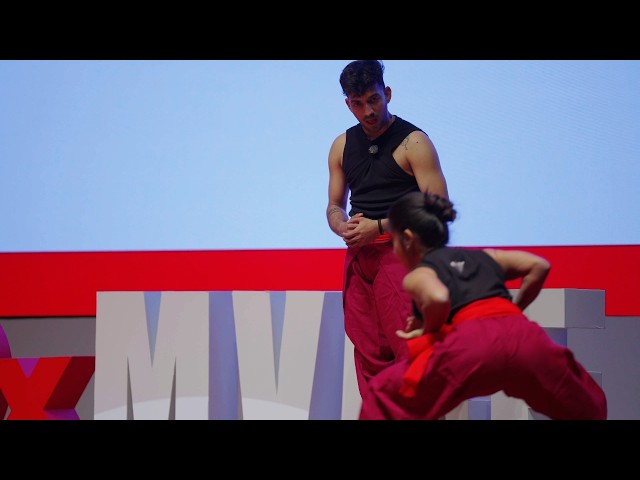
The Art Beneath the Weapon | Nithin K & Shradha Rajeevan | TEDxMVJCE: transcript
- TEDx Talks
- Published
- Added
- 18:14
- English
- auto-generated captions
AI summary
AI-generated from the transcript below. Check anything that matters against the video.
This TEDxMVJCE 2026 talk and demonstration by Kalaripayattu artist and instructor Nithin K., with Shradha Rajeevan, presents the Kerala martial art as something that begins not with fighting but with movement and observation. The speakers explain that masters observed animals such as the elephant, snake, and horse, and developed the ashtavadivu, eight animal-inspired postures (gaja, kukuda, simha, ashwa, varaha, matsya, marjara, and sarpavadivu) that form a foundation of the practice. The session shows these postures individually and as a continuous sequence, then demonstrates part of the meypayattu body-conditioning stage, performed to traditional oral commands, noting that animal forms remain present. The presenters then explore how the body changes when an external element is added, showing sword and shield movements from the ankathari stage, and explain the progression from meythari to kolthari (wooden weapons, beginning with the long stick) and then ankathari. A basic long-stick demonstration follows. The talk closes by arguing that the basics are not left behind but carried forward with deeper understanding, a lesson for any art form.
Key points
- Kalaripayattu is one of the oldest traditional martial arts of Kerala, with northern and southern styles; the speakers practice the northern style.
- The demonstration opens with a salutation, not a fight: the body first acknowledges the earth, tradition, and teachers.
- The ashtavadivu are eight animal-inspired postures, including gaja (elephant), simha (lion), ashwa (horse), and sarpavadivu (snake).
- Meythari is the first training stage in the northern tradition, centered on meypayattu body conditioning for flexibility, strength, awareness, and control.
- The sword and shield belong to the ankathari stage, shown here only to explore what happens when an external element is present.
- Kolthari is the wooden-weapon stage, beginning with the long stick, which prepares body and mind for sharper weapons.
- The talk concludes that progress means carrying the basics forward with deeper understanding, not leaving them behind.
Chat with AI
Ask about this video. Answers come from its transcript, with links to the moments they use.
Free with a Google, Telegram or email account.
Sign in to chatTranscript
- 0:00
Heat. [music] Heat. [music] [music] Heat. [music] [music] [music] Heat.
- 0:45
[music] Heat. [music] Heat. [music] [music] Heat. [music] [bell] Heat.
- 1:23
[music] >> [music] >> Hey, [music] [music] [music] [music] [music] heat. Hey. Heat.
- 2:02
[music] [music] Heat. [music] [music] >> [music] [applause] >> What you just witnessed was not a fight.
- 2:37
It was a salutation. Before we learn to attack, we learn to go. In calary pride, the body first acknowledges the earth beneath us. The tradition that came before us and the teachers who pass it on. Kalipite is one of the oldest tradition martial art of Kerala. It has a different styles and traditions that developed over generations.
- 3:07
Two broad styles are there uh commonly known what color the northern style taken calorie the southern style. We practice the northern style. >> When you hear the word kaler pa, you would probably imagine a warrior, a fight, a swad, or perhaps somebody performing a spectacular jump or a kick. But what if we told you that kalori pita does not begin with fighting. It begins with learning how to move. And even before that, it begins by observing.
- 3:46
Observing nature and observing how living beings move. Think of an elephant. Its power comes from being deeply grounded. A snake can change its directions without changing its speed. And a horse carries tremendous energy in every step that it takes. Each animal has its own way of standing, balancing and even responding to danger.
- 4:17
And somewhere along the way, the masters of kalaripa observed this and asked a fascinating question. What if the human body could learn from them? This idea seen in a part of kalipite called ashtaval. Ashta means eight. Viva means a posture or a stance. These eight animal inspired postures are an important foundation of karip.
- 4:48
Now we will show you the eight animal postures. Gajawa the elephant. Naruka the rooster. Simha the lion. Ashawa the horse.
- 5:21
Vahava the wildboard. Malia the fishara the cat and sarpadiva the snake nara.
- 5:48
Now let us observe how these postures comes together as a one continuous sequence. Heat. [music] [music] Heat. [music] [music] Heat.
- 6:17
[music] Heat. [music] >> [music] >> Heat. Heat. [music] Heat. Heat. [music] Heat.
- 6:53
Heat. [music] Heat. Heat. [music] >> [music] [applause] >> As you train in depth in karipa, you begin to notice that these forms slowly begin to connect. The postures become movement and the movement becomes a language.
- 7:46
What you see in kaler pa the jumps the kicks the speed and the combat rests on a body that has spent years learning how to move. The first stage of training in the northern tradition of kaleripa revolves around preparing the body and is called may tar. In this stage, a rigorous body conditioning sequence called mi pa is performed in order to increase flexibility, strength, body awareness and control.
- 8:25
It is often said that before you learn to control something outside the body, you learn to control the body itself. So may pa forms a base for the weapon training that comes in the later stages. Now we will present a small part of the may pater done to traditional oral commands in kaler. foreign kitty.
- 9:34
PDC. Day. for foreign.
- 10:54
for picture. Okay.
- 11:25
>> [applause] >> You may have noticed that even this sequence the animal poses are still present. Now what happens when these movements meets a weapon? The relationship between the body and the surrounding space changes but the foundation still present. Now we will show you these movements through sword and shield.
- 11:52
An important thing to note here is that the sword and the shield belong to the angari stage which is not the immediate stage after may pa or may tar what we have just performed. Instead we are just observing and exploring what happens to the body when an external element is present. In this case the sword and the shield. Heat.
- 12:27
[clears throat] Heat. [music] Heat. Heat. Oh, [music] heat, heat.
- 13:38
After the mari comes the colari or the stage of wooden weapon training. The first weapons to be introduced in this stage is the long stick. Colari prepares the body and the mind [snorts] for the sharper weapons that come in the next stage which is angatari. Here the weapon becomes an extension of the body demanding precision and control.
- 14:10
Now we will present a basic version of the ketakari piet or the long stick file. But now we want you to observe the body beneath the weapon. You will still notice that the animal forms that we began with are present in some of the movements done. Presenting to you the ketakari fighter. >> [snorts] >> Heat.
- 15:34
[snorts] Heat. Heat. HEAT.
- 16:33
HEAT. HEAT. >> [snorts] [applause] [applause] >> There is still much more to learn as we go deeper into calorie pipite. In many ways, the learning never ends. And this bring us back to where we began. The ashiv the ashto are not simply a beginning of calorie piet. They are the foundation that everything else transform from. And this foundation does not disappear even if the training becomes advanced. It
- 17:29
stays with us. And this is true for any art form that we practice. We learn the basics. We practice them and we return to them each time. Progress does not mean leaving the basics behind. It means carrying them with us with a deeper understanding each time that we go back to them because a strong foundation gives us the power and freedom to go further. Thank you.
- 18:03
[applause]
Questions
AI-generated, and answered only from the transcript.
What is Kalaripayattu described as in the talk?
It is described as one of the oldest traditional martial arts of Kerala, with different styles and traditions developed over generations. The speakers name northern and southern styles and say they practice the northern style.
What are the ashtavadivu?
They are eight animal-inspired postures that form an important foundation of Kalaripayattu. The demonstrated postures include the elephant, rooster, lion, horse, wild boar, fish, cat, and snake.
What is meythari and what is meypayattu?
Meythari is the first stage of training in the northern tradition, focused on preparing the body. Within it, the rigorous meypayattu sequence is performed to increase flexibility, strength, body awareness, and control.
Why do the speakers show sword and shield if it is not the next stage?
They note that sword and shield belong to the ankathari stage, which does not immediately follow meythari. They show it only to observe and explore what happens to the body when an external element is present.
What is kolthari?
Kolthari is the stage of wooden weapon training that comes after meythari. The first weapon introduced is the long stick, and the weapon becomes an extension of the body demanding precision and control.
What is the main lesson the talk ends with?
The speakers say the basics are not simply a beginning but the foundation everything transforms from. Progress means carrying the basics with us with deeper understanding each time we return to them.
Related transcripts
JOGUEI 100 DIAS NO STARDEW VALLEY
No vídeo, o criador do canal Hyak joga 100 dias (um ano do jogo) em Stardew Valley, comemorando os 10.000 inscritos do canal. Ele cria a…
COMO USAR AS FERRAMENTAS MAIS RÁPIDO | Cancelamento de Animação - Stardew Valley
O vídeo ensina a usar o AutoHotkey para realizar o cancelamento de animação no Stardew Valley, técnica usada por speedruns para quebrar…
O guia DEFINITIVO do ANO 1 | Stardew Valley - PARTE 1
Neste vídeo, Dieguinho apresenta a primeira parte de um guia definitivo para o primeiro ano de Stardew Valley, cobrindo a primeira metade da…
ЕСЛИ БЫ РИКА И МОРТИ СОЗДАВАЛИ В РОССИИ | Сыендук
В этом видео Дима Сыендук фантазирует на тему, как выглядел бы мультсериал «Рик и Морти», если бы его создавали в России, опираясь на…
Assistant to the Villain Recap 💜 *spoilers!*
This video is a spoiler-filled recap by Hannah of the cozy fantasy novel Assistant to the Villain by Hannah Nicole Maehrer. It follows Evie…
#07 | WEST WING | When the wicked prince wants to ru!n your life for his twisted revenge
This video is a fan-made story video posted by the channel Jasmine, titled as part seven of a "West Wing" series about a wicked prince…


Latest transcripts
Rosicrucian Principles for Dealing with Challenging Situations - Nana Ama Korankye
In this RosicrucianTV teleconference, Nana Ama Korankye presents Rosicrucian principles for dealing with difficult and challenging…
Transforming our Autonomic Responses -- Grand Master Julie Scott
Grand Master Julie Scott of the Rosicrucian Order explains the autonomic nervous system (ANS) and how to transform its habitual responses.…
Initiation in Ancient Egypt - Grand Master Julie Scott
This video explores initiation in ancient Egypt, acknowledging that exact rituals remain unknown due to oaths of secrecy. Grand Master Julie…
In this video, I share 5 signs that pride is showing up in the way you communicate.
In this short video, Orator Walubengo lists five communication habits that he says reveal pride. First, picking up your phone while someone…
Your Money Habits Reflect Your Mindset!
In this short video, Orator Walubengo argues that small money habits reveal a person's mindset, claiming that folding or grabbing money…
90° Parallelo | Luca Bracali | TEDxSiena
Luca Bracali, fotografo e documentarista con 41 anni di carriera e collaborazioni con la Rai e National Geographic, racconta la spedizione…


